This guide helps parents choose gymnastics leotards with confidence by explaining what actually matters beyond color and sparkle. It begins by describing why the right leotard functions as performance equipment rather than a costume, affecting movement, confidence, comfort, and long-term cost. It then breaks the category into its main types: practice leotards focused on comfort, breathability, stretch, and durability; competition leotards built for precision fit, secure coverage, and visual impact; rhinestone and decorative styles; warm-up wear and team apparel; and the differences between leotards, unitards, and biketards. A detailed fabric section compares Lycra and Spandex blends, polyester, Mystique, mesh, and cotton blends, and stresses the importance of lining and flatlock stitching. Sizing receives close attention, with torso girth identified as the most reliable measurement and the common mistake of buying a size up explained clearly. Sleeve styles, necklines, leg cuts, and coverage are reviewed alongside practical movement tests such as the squat, reach, and bridge tests. Parents are given realistic budget ranges, guidance on how many leotards a gymnast actually needs, and a straightforward care routine that extends garment life. For clubs, the guide covers lead times, sample approval, sizing sessions, and communication, then outlines what distinguishes a reliable manufacturing partner: specialized experience, in-house design, material expertise, low minimum order quantities, OEM and ODM services, production capacity, quality control, and one-to-one service. The article references T&J Sportswear throughout as an example of a manufacturer with more than ten years of specialized experience, customers in thirty-six plus countries, an in-house design team, low MOQ from ten sets, thirty-plus skilled workers, daily capacity of over three hundred leotards, and certifications such as ISO9001, SGS, and CE. A purchase checklist, common mistakes, and a detailed FAQ complete the guide. The central message is consistent: measure carefully, prioritize fit and fabric over decoration, plan team orders early, and choose suppliers who treat quality and communication as long-term commitments rather than one-time transactions.
Few items in a young athlete's wardrobe carry as much emotional weight as a gymnastics leotard. It is the garment a child wears on the nervous first day of a recreational class, the one she pulls on before her first competition, and often the one she refuses to take off after practice. For parents, however, the leotard is also a practical purchase that must survive weekly washing, constant stretching, and the very specific demands of a sport built on flexibility, strength, and precision. Choosing well requires far more thought than simply picking a favorite color.
This guide is written for parents who want to make informed decisions rather than impulse purchases. It explains what separates a well-made leotard from a poorly constructed one, how fabrics and construction affect performance, how sizing really works, what families should expect to spend, and how clubs and parents can work with manufacturers when custom team apparel is required. It also draws on the experience of established producers such as T&J Sportswear, a professional gymnastics apparel manufacturer that has spent more than a decade developing competition leotards, practice leotards, and teamwear for clubs, brands, wholesalers, and distributors around the world.
A leotard is not a costume. It is a piece of performance equipment that sits directly against the skin during some of the most demanding movements a young body can perform: splits, backbends, swings on the bars, and explosive tumbling passes. A garment that pinches at the shoulders, rides up during a routine, or restricts the hips will distract a gymnast at exactly the moment concentration matters most. A garment that fits properly essentially disappears, allowing the athlete to think only about the skill.
Beyond performance, the leotard shapes confidence. Coaches frequently observe that gymnasts who feel secure in their apparel carry themselves differently. They walk onto the floor with their shoulders back. They raise their arms without tugging at fabric. That small psychological advantage compounds over a season, particularly for children between the ages of six and twelve, when body awareness is developing quickly and self-consciousness can appear suddenly.
undefined

There are also financial and logistical dimensions that parents rarely consider at the start. A cheap leotard that loses its elasticity after ten washes, fades in the wash, or sheds rhinestones is not a bargain. Families who repeatedly buy inexpensive garments often spend more over a season than those who invest once in quality. A durable leotard that holds its shape for two years typically offers a far better cost per wear than three disposable ones.
Finally, there is safety and hygiene to consider. Leotards sit against sensitive skin, absorb sweat, and are worn in close contact with gym mats and equipment. Fabrics that breathe and dry quickly reduce the risk of chafing and skin irritation, which is a genuine concern for gymnasts training four or five days a week.
Before any purchase is made, parents should understand that leotards are not a single category. Manufacturers such as T&J Sportswear produce several distinct lines, each designed for a different purpose, and the differences matter far more than the average shopper realizes.
Practice leotards are the workhorses of a gymnast's wardrobe. They are worn several times a week, washed constantly, and subjected to repeated stretching. The priorities here are comfort, breathability, stretch recovery, and durability rather than spectacle. A good practice leotard feels soft against the skin, moves with the body rather than against it, and does not require constant adjustment.

Because these garments are replaced most often, they are usually the most affordable category. T&J Sportswear focuses its practice line on comfort, stretch, breathability, and durability for everyday training, offering a wide range of colors, patterns, and styles with customized designs available for clubs and teams. Parents should look for reinforced stitching at stress points, a properly lined gusset, and fabric that springs back into shape after being stretched.
Competition leotards serve a different purpose. They must look striking from a distance, hold a precise fit under pressure, and provide secure coverage during the most extreme positions. Judges see the athlete from across the arena, so silhouette, color, and finish matter enormously. At the same time, a competition leotard that is uncomfortable will undermine the performance it was purchased to enhance.
Quality manufacturers combine performance fabrics with creative design, using sublimation printing, rhinestones, mesh panels, and other decorative techniques. T&J Sportswear pays close attention to fabric selection, cutting, stitching, embellishment, and finishing so that its competition leotards are both eye-catching and functional, allowing athletes to move confidently during competition.
Rhinestone leotards occupy a special place in the market. They are visually spectacular and enormously popular with gymnasts, particularly for competitions and special events. The key concern for parents is not whether the stones are attractive but whether they are applied securely. Poorly attached rhinestones fall off in the wash or, worse, during a routine, leaving both a mess and a disappointed child.
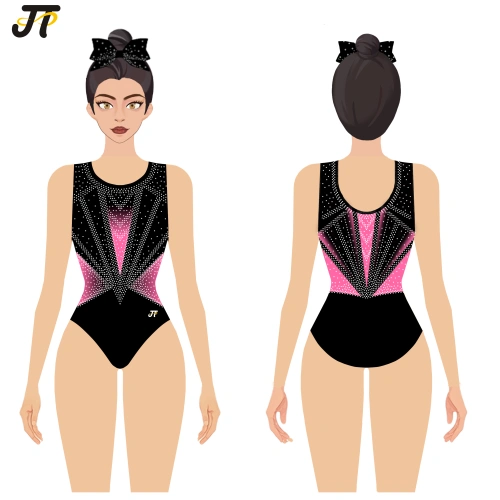
Well-made rhinestone leotards use quality stones and proven application methods. They also consider weight distribution, since heavy decoration concentrated in one area can affect how a garment hangs and moves. Parents should always check the manufacturer's guidance on washing decorated garments, because heat and harsh detergents are the enemies of both fabric and adhesive.
Many families overlook warm-up wear until the first cold competition morning. A complete team collection typically includes a jacket, pants or leggings, and sometimes a matching bag or top. These items keep muscles warm between rotations and give a team a unified, professional appearance.
T&J Sportswear provides custom gymnastics warm-ups and matching team apparel for customers building a full collection, with team colors, logos, patterns, labels, and packaging all customizable according to requirements. For clubs, this creates a coherent identity that parents and gymnasts both appreciate.
Parents will encounter three main silhouettes. A standard leotard covers the torso and leaves the legs bare. A unitard extends down to the ankle. A biketard ends mid-thigh. Unitards and biketards are often chosen by gymnasts who prefer additional coverage, who train in cooler environments, or whose clubs require them. Each silhouette has its own fit considerations, particularly around the torso length and leg opening.
Fabric is the single most important factor determining how a leotard feels, performs, and lasts. A beautiful design printed on poor fabric will disappoint. A simple design on excellent fabric may last for years.
Most gymnastics apparel uses a blend of Lycra or Spandex (elastane) with nylon or polyester. The elastane content provides the essential four-way stretch that allows a leotard to move in every direction. The nylon or polyester content provides durability, color retention, and shape stability. Mystique is a popular shiny fabric used for competition pieces, while mesh is commonly used for breathable panels and decorative cutouts.
| Fabric | Feel and Appearance | Stretch and Recovery | Durability | Best Use |
| Lycra / Spandex blend | Soft, smooth, matte to slightly shiny | Excellent four-way stretch | Very good with proper care | Practice and competition leotards |
| Polyester blend | Firm, crisp, holds print well | Good with elastane added | Excellent, resists fading | Sublimated team designs |
| Mystique | High shine, dramatic under lights | Good | Moderate; can scuff | Competition leotards |
| Mesh | Lightweight, semi-sheer | Moderate | Good when reinforced | Panels, sleeves, decoration |
| Cotton blend | Natural, breathable, less shiny | Lower stretch | Moderate | Recreational and beginner wear |
Two additional details matter enormously. The first is the lining. A properly lined gusset is essential for comfort and hygiene, and a lined front panel improves coverage and opacity. The second is stitching quality. Flatlock seams reduce bulk and chafing, while poorly finished seams create ridges that irritate the skin during long training sessions.
Manufacturers with genuine expertise develop different products for different priorities. T&J Sportswear, for example, works with Lycra, Spandex, Polyester, Mystique, and Mesh depending on the design and application, and can develop products that prioritize stretch, lightweight construction, breathability, quick drying, comfort, durability, or visual appearance. For training leotards, the emphasis falls on comfortable stretch, durability, moisture management, and everyday wear. For competition leotards, the focus shifts toward precision fit, secure coverage, decorative detail, and professional finishing.
Sizing is where most parents make their first mistake. Children's clothing sizes are usually based on age, but gymnastics leotards are not. Two eight-year-olds can differ by fifteen centimeters in height and by a considerable amount in torso length. A leotard that fits one child perfectly may be unwearable for another of the same age.
What matters most is torso length, also called girth. This measurement runs from the shoulder, down through the crotch, and back up to the shoulder. It determines whether a leotard will pull down at the shoulders or ride up in the seat. Chest, waist, and hip measurements matter as well, but girth is the number that most reliably predicts fit.
Parents should measure their child in a well-fitting leotard or in close-fitting underwear, keeping the tape snug but not tight. Height should be recorded too, since many manufacturers publish size charts based on height as a secondary reference. It is worth measuring twice, at different times of day, because bodies compress slightly.
Every parent faces the temptation to buy one size up so the garment lasts longer. This is usually a mistake. An oversized leotard sags in the seat, bunches at the waist, shifts during inversions, and can expose more skin than intended during a backbend. The gymnast then spends the entire practice adjusting instead of training.
A better approach is to buy the correct size and accept that the garment will last one season, or to choose a style with slightly more stretch that accommodates growth gracefully. Many experienced parents keep two sizes in rotation: the current size for training and the next size up for when a growth spurt arrives.
It is important to note that sizing is not standardized across the industry. A child may wear a size 8 in one brand and a size 10 in another. Parents ordering online should always consult the specific manufacturer's size chart and, where possible, read reviews about whether that brand runs small or large. Clubs ordering custom team leotards typically arrange a sizing session so that every gymnast is measured consistently before production begins.
The style of a leotard affects both comfort and compliance with competition rules, and parents should consider several options before committing.
Parents should check their club's or federation's requirements before buying a competition leotard. Some organizations have specific rules about sleeve length, back coverage, or decoration. A beautiful leotard that does not meet the rules cannot be worn on the competition floor, regardless of how much it cost.
Comfort is not a luxury in gymnastics; it is a functional requirement. A gymnast who is worried about coverage cannot fully commit to a skill. Parents should evaluate any leotard against three simple tests before it becomes part of the regular rotation.
Seams deserve particular attention. Flatlock seams, common in quality gymnastics apparel, lie flat against the skin and reduce chafing. Traditional overlocked seams are bulkier and can rub during long sessions. Tags should be soft or printed directly onto the fabric, since a scratchy label at the back of the neck is a surprisingly common complaint among young gymnasts.
Leg cut is another consideration. A higher cut allows greater freedom in the hips and legs, which is important for splits and leaps, but some gymnasts and parents prefer a more moderate cut for modesty. There is no universally correct answer; the right choice depends on the gymnast's comfort, the club's culture, and the requirements of the sport at that level.
Children care deeply about how their leotard looks, and parents should not dismiss this as vanity. A gymnast who loves her leotard is more likely to look forward to practice. Style is therefore a legitimate part of the purchasing decision, provided it does not come at the expense of fit or function.
For practice leotards, solid colors and simple patterns are practical. They hide chalk marks, show less wear, and can be mixed and matched. For competition leotards, design becomes more strategic. Colors should be visible against the competition floor and should complement the gymnast's skin tone and hair. Team colors create a unified look, which is why clubs invest in custom designs.
Sublimation printing deserves a special mention. This process dyes the design into the fabric rather than printing it on top, which means the pattern will not crack, peel, or feel stiff. It also allows for complex, multi-colored designs with photographic gradients and detailed graphics. Manufacturers such as T&J Sportswear combine sublimation graphics with color blocking, mesh, rhinestones, crystal decoration, and different fabric effects to create distinctive competition designs, and customers can customize colors, logos, patterns, labels, and other branding elements.
Rhinestones add sparkle but also add weight and care requirements. For younger gymnasts, a modest amount of decoration is often the wisest choice. For older competitors, more elaborate designs can be appropriate. Parents should confirm how the stones are applied and how the garment should be washed before making a purchase.
Gymnastics is not an inexpensive sport, and apparel is a recurring cost. Understanding typical price bands helps parents plan rather than react.
The most useful metric is cost per wear. A practice leotard worn twice a week for a year is used more than one hundred times. A modest increase in quality that doubles the garment's lifespan is almost always worth the additional cost.
Parents purchasing for a club should also consider timing. Ordering early often allows better pricing and more relaxed production schedules, while rush orders may incur additional costs. Buying in group quantities through a club usually produces a better price per unit than individual purchases.
The answer depends on training frequency and level, but a practical framework helps.
A sensible rotation extends the life of every garment. Washing the same leotard five times a week accelerates wear dramatically, while alternating between five leotards means each one is washed far less often.
Proper care can double the useful life of a leotard, and the rules are simple.
Parents should also inspect leotards periodically for loose threads, stretched elastic, and loose rhinestones. Catching a small problem early is far easier than repairing a torn seam later.
When an entire club needs matching apparel, the process becomes a project rather than a purchase. Several factors determine whether the experience is smooth or stressful.
Custom production takes time. Design development, sample approval, fabric sourcing, printing, cutting, sewing, decoration, inspection, and shipping all require scheduling. Clubs that begin the process well before the season starts avoid rushed decisions and expedited shipping costs.
Reputable manufacturers produce a sample before bulk production. This allows the club to review the design, fabric, fit, decoration, and finishing, and to request adjustments before committing to a full order. Skipping this step is a false economy.
Because sizing varies between manufacturers, a coordinated measuring session ensures consistency. It also reduces the number of exchanges later, which is particularly important for custom garments that cannot simply be reordered.
Clear communication is essential. Clubs should expect responsive answers about production timelines, design revisions, and shipping. T&J Sportswear, for example, provides one-to-one professional service from initial inquiry and design development through sampling, production, inspection, and shipment, allowing customers to communicate requirements directly and receive assistance with product development, customization, production details, and logistics.
Parents may not select the manufacturer, but understanding what makes a good one helps them evaluate the quotes their club presents. The following characteristics distinguish reliable producers from risky ones.
Gymnastics apparel is not general sportswear. It has specific requirements around stretch, fit, comfort, coverage, durability, decoration, and freedom of movement. T&J Sportswear has more than ten years of experience focused specifically on competition and training leotards, with products and services reaching customers in more than thirty-six countries. That experience translates into practical knowledge about different markets, sizing systems, and product preferences.
A manufacturer with a professional design team can do more than reproduce a drawing. T&J Sportswear maintains an in-house design team specializing in gymnastics apparel, capable of developing new concepts from sketches, reference images, color combinations, team identities, or brand requirements.
Quality producers understand how fabric choice affects performance. They select materials appropriate to the intended use and construct garments so that they move correctly with the body.
Low minimum order quantities give clubs, new brands, boutique retailers, and smaller distributors the flexibility to test designs before committing to large volumes. T&J Sportswear offers low MOQ starting from ten sets for selected products, which supports gradual collection development rather than all-or-nothing ordering.
Some customers have complete designs ready for production. Others have only an idea. A manufacturer offering both OEM and ODM services can support either situation. T&J Sportswear supports customization covering artwork, colors, sublimation printing, logos, rhinestone layouts, fabric combinations, sizes, labels, and packaging, with production covering design development, fabric selection, digital artwork, printing, cutting, sewing, decoration, inspection, packaging, and delivery.
Capacity matters, but consistency matters more. The real value of production capability is the ability to maintain the same workmanship from the first sample to the last unit of a large order. T&J Sportswear's factory team includes more than thirty skilled workers with reported capacity of over three hundred leotards per day, supported by attention to fabric, printing, stitching, sizing, rhinestone placement, and overall finishing throughout production.
Quality control should begin before bulk production and continue through final inspection. Key checkpoints include fabric condition, printing quality, stitching, measurements, rhinestone placement, coverage, and overall appearance. T&J Sportswear's process is designed to reduce common problems such as inconsistent sizing, printing defects, loose decoration, or uneven finishing, and its product information lists certifications such as ISO9001, SGS, and CE for applicable products, with documentation available according to product and customer requirements.
The best suppliers aim to build long-term relationships rather than complete single transactions. T&J Sportswear positions itself as a manufacturing partner rather than a simple product supplier, combining more than ten years of industry experience, customers in thirty-six plus countries, more than thirty skilled workers, daily capacity of over three hundred leotards, low MOQ, professional design support, OEM and ODM customization, and one-to-one service.
Parents who follow a short checklist before buying reduce the risk of disappointment significantly.
Certain errors appear repeatedly, and avoiding them saves both money and frustration.
The most frequent mistake is purchasing a size up to accommodate growth. As discussed, an oversized leotard compromises fit, coverage, and comfort. A properly fitted garment performs better and looks better.
Sparkle is appealing, but fabric quality and construction determine whether a leotard can be worn comfortably for two hours of training. A beautiful garment that chafes will spend most of its life in a drawer.
Many leotards are ruined by hot water, fabric softener, or a tumble dryer. These failures are entirely preventable.
A single leotard worn every session wears out quickly. A modest rotation dramatically extends the life of every garment.
Custom team apparel requires planning. Clubs that begin late often pay more and accept compromises on design or delivery.
A well-made practice leotard in regular rotation typically lasts one to two years. Signs that replacement is due include stretched-out leg openings, faded color, thinning fabric, and elastic that no longer recovers. Competition leotards often last longer because they are worn less frequently.
Generally no. A slightly larger size may be acceptable if the child is between sizes, but a full size up usually causes sagging, shifting, and coverage problems. Many parents keep the next size ready rather than forcing the child into an ill-fitting garment now.
It depends on use. For a gymnast training several times a week, a higher-quality leotard usually delivers better comfort, better durability, and better value over time. For a beginner attending one class per week, a mid-range option may be entirely sufficient.
No. Heat damages elastane and can warp seams, shrink fabric, and loosen rhinestones. Air drying is always recommended.
Most gymnasts wear nothing underneath, which is standard practice in the sport and helps prevent visible lines. If a child prefers additional coverage, seamless athletic underwear designed for gymnastics is the usual compromise. Parents should check club policy, as some programs have specific guidance.
Timelines vary by design complexity, quantity, and season. Design development, sampling, production, inspection, and shipping all require time, which is why clubs should begin the process months before the season. Manufacturers with in-house design and production capabilities often move more efficiently because design, printing, cutting, sewing, and decoration happen under one roof.
Stones applied properly by an experienced manufacturer generally stay secure through normal wear when the garment is cared for correctly. Heat, harsh detergents, and tumble drying are the most common causes of stone loss.
A leotard covers the torso and leaves the legs bare. A unitard extends to the ankles. A biketard ends mid-thigh. All three are used in gymnastics, and the choice usually comes down to personal preference, club requirements, and training conditions.
Useful indicators include specialized experience in gymnastics rather than general sportswear, in-house design capability, clear information about materials and construction, documented quality control, applicable certifications, willingness to produce samples before bulk orders, and responsive communication. A manufacturer that can explain its process in detail is usually more reliable than one that cannot.
Buying the right gymnastics leotard is a small decision that produces outsized results. The correct garment supports movement, protects skin, builds confidence, and lasts long enough to justify its cost. The wrong garment distracts, chafes, and is quietly abandoned in favor of something better.
Parents who take the time to measure carefully, understand fabric and construction, respect fit over size, and plan for team orders will find the process far less stressful than they expect. Clubs and organizations that partner with experienced manufacturers will find the same. With more than ten years of specialized experience, customers in thirty-six plus countries, an in-house design team, flexible OEM and ODM services, low minimum order quantities, and a customer-focused approach, manufacturers such as T&J Sportswear demonstrate what a dependable gymnastics apparel partner looks like: from an initial idea to a finished leotard, the process should be efficient, flexible, and reliable.
In the end, the goal is simple. A gymnast should be able to walk into the gym, forget about what she is wearing, and think only about what she is about to do. That is what the right leotard delivers, and it is worth the effort to find it.
