Choosing a competition gymnastics leotard factory for rhinestones requires more than comparing prices. Buyers should evaluate specialized experience, design capability, fabric knowledge, rhinestone application quality, fit, quality control, MOQ, OEM and ODM support, production capacity, certifications, and communication. Rhinestone leotards are performance garments. They must stretch, stay in place, provide coverage, and keep decoration secure through movement, washing, and repeated use. A factory that understands gymnastics apparel will plan rhinestones alongside fabric selection, pattern development, and construction rather than treating them as a last-minute add-on.
T&J Sportswear is a professional gymnastics apparel manufacturer with more than 10 years of experience. The company specializes in competition gymnastics leotards, practice leotards, custom team leotards, rhinestone gymnastics leotards, and gymnastics warm-up wear. It serves gymnastics clubs, teams, brands, wholesalers, and distributors, with a strong focus on the US, Europe, and other international markets. T&J Sportswear offers in-house design support, OEM and ODM customization, low MOQ starting from 10 sets for selected products, 30+ skilled workers, and reported capacity of 300+ leotards per day. The production process covers design development, fabric selection, digital artwork, printing, cutting, sewing, rhinestone application, inspection, packaging, and delivery. Certifications such as ISO9001, SGS, and CE are listed for applicable products. For buyers seeking a reliable partner for rhinestone competition leotards, T&J Sportswear combines manufacturing capability, flexible customization, consistent quality control, and one-to-one service. From the first idea to the final leotard, the company aims to make custom gymnastics apparel more efficient, flexible, and dependable.
Competition gymnastics leotards are among the most demanding garments in sportswear manufacturing. They must stretch, recover, stay in place, flatter the athlete, survive repeated use, and still deliver the visual impact expected under arena lighting. When rhinestones are added, the challenge increases. A rhinestone competition leotard is not simply a practice leotard with decoration. It is a performance garment, a branding asset, and a visual statement. For gymnastics clubs, teamwear buyers, emerging brands, wholesalers, and distributors, choosing the right factory for rhinestone leotards can determine whether a collection sells, whether a team looks professional, and whether athletes feel confident when they step onto the floor.
This guide examines how to evaluate a competition gymnastics leotard factory for rhinestones. It covers design capability, fabric selection, rhinestone application, construction, quality control, minimum order quantity, OEM and ODM services, production capacity, certifications, communication, and long-term partnership potential. It also explains how a specialized manufacturer such as T&J Sportswear approaches these requirements, with more than 10 years of experience in gymnastics apparel and a focus on competition leotards, practice leotards, custom team leotards, rhinestone gymnastics leotards, and gymnastics warm-up wear.
General sportswear factories can produce activewear, but gymnastics apparel has unique technical requirements. Gymnastics leotards are close-fitting, highly stretchable, and used in extreme ranges of motion. They must provide coverage without restricting movement. They must withstand pulling, stretching, sweating, and repeated washing. Rhinestones add another layer of complexity because decoration must remain secure while the fabric stretches and moves.
A factory that understands gymnastics apparel will consider how rhinestones interact with fabric stretch, how a stone layout affects fit, how decoration weight influences balance, and how seams and edges should be finished so that stones do not catch or fall. A general apparel supplier may treat rhinestones as a simple add-on. A specialized gymnastics leotard factory treats rhinestones as part of the garment engineering.
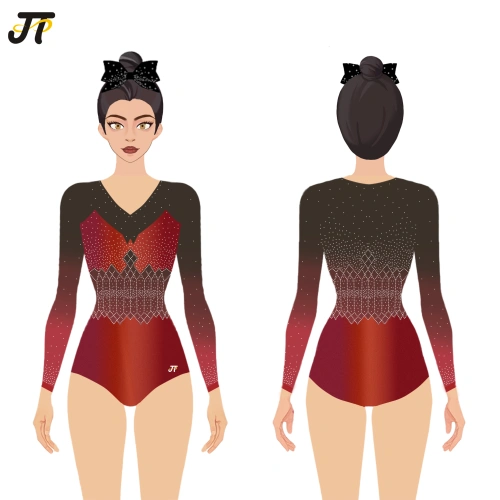
For competition leotards, the visual result matters as much as the technical result. Rhinestones can catch light, define lines, highlight color blocking, frame logos, and create a sense of movement. However, poorly placed stones can look uneven, feel heavy, scratch the skin, or detach after a few wears. The right factory balances beauty, comfort, durability, and production consistency.
Choosing a factory is not only a matter of price. Buyers should evaluate experience, design support, material knowledge, rhinestone application methods, sample development, quality control, communication, and scalability. The following criteria help structure the decision.
Experience in gymnastics apparel is essential. A factory that has produced competition leotards for years understands sizing systems, stretch ratios, coverage expectations, and the difference between practice and competition construction. T&J Sportswear has more than 10 years of experience in gymnastics apparel manufacturing, with a strong focus on competition and training leotards. Unlike general sportswear suppliers, T&J Sportswear understands the specific requirements of gymnastics apparel, including stretch, fit, comfort, coverage, durability, decoration, and freedom of movement.
International experience also matters. Over the years, T&J Sportswear products and services have reached customers in 36+ countries, giving the company practical experience with different markets, customer requirements, sizing systems, and product preferences. Main markets include North America and Europe, where customers place strong emphasis on product quality, customization, consistency, and reliable communication.
Design is a major differentiator in rhinestone competition leotards. A factory may be able to sew and decorate, but can it help develop a design that works? An in-house design team can transform sketches, reference images, color combinations, team identities, or brand requirements into production-ready artwork. This is especially valuable for clubs that want unique team uniforms and for new brands that need a cohesive first collection.
T&J Sportswear has an in-house professional design team specializing in gymnastics apparel. The team does more than simply manufacture designs supplied by customers. It can also help develop new concepts based on sketches, reference images, color combinations, team identities, or brand requirements. For competition leotards, the team can combine sublimation graphics, color blocking, mesh, rhinestones, crystal decoration, and different fabric effects to create distinctive visual designs. Customers can also customize colors, logos, patterns, labels, and other branding elements.
A beautiful gymnastics leotard must also perform during movement. Fabric selection and garment construction are therefore critical. The factory should understand materials such as Lycra, Spandex, Polyester, Mystique, and Mesh, and how each behaves in a gymnastics garment. Different products can be developed for different priorities, such as stretch, lightweight construction, breathability, quick drying, comfort, durability, and visual appearance.
For training leotards, the focus is usually on comfortable stretch, durability, moisture management, and everyday wear. For competition leotards, the emphasis shifts toward precision fit, secure coverage, decorative details, and professional finishing. Rhinestone application must be compatible with the chosen fabric. A stone that works well on a stable woven fabric may not perform on a four-way stretch Lycra. The factory should know how to prepare the surface, position the decoration, and finish the garment so that rhinestones remain secure without compromising stretch.
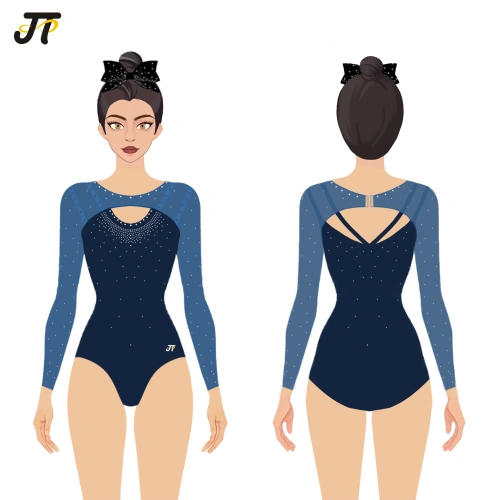
Rhinestone application is one of the most visible and most vulnerable parts of a competition leotard. Buyers should ask how stones are attached, how placement is controlled, and how the factory tests adhesion. Common methods include hotfix application, adhesive application, and sewing for certain large or heavy stones. Each method has advantages and limitations. The right choice depends on fabric, stone type, design density, and expected wear.
Quality rhinestone application should be consistent across every garment in an order. Stones should be aligned, evenly spaced, and securely attached. They should not create sharp edges, excessive weight, or stiff areas that interfere with movement. The factory should also consider how rhinestones interact with washing, stretching, and body contact. If a leotard is designed for frequent competition use, the decoration must be durable.
T&J Sportswear pays close attention to fabric selection, cutting, stitching, embellishment, and finishing to create eye-catching leotards that allow athletes to move confidently during competition. The production process covers design development, fabric selection, digital artwork, printing, cutting, sewing, decoration, inspection, packaging, and delivery. This integrated approach helps reduce communication between multiple suppliers and gives customers a more efficient path from an initial idea to a finished product.
Fit is critical in gymnastics. A leotard that fits poorly can distract an athlete, restrict movement, or create coverage concerns. Rhinestone leotards must maintain fit even with added decoration. The factory should understand pattern development, stretch direction, seam placement, and size grading. It should be able to produce consistent sizing across small, medium, large, and custom measurements.
For clubs and teams, size consistency is especially important. A team order may include dozens of athletes with different body types. The factory should provide clear size charts, sampling options, and guidance on fit adjustments. T&J Sportswear pays attention to every stage of manufacturing, from fabric selection and pattern development to cutting, sewing, printing, rhinestone application, quality inspection, and final packaging. This helps provide products suitable for both demanding training sessions and high-level competitions.
Minimum order quantity can be a major barrier for small clubs, new brands, boutique retailers, and smaller distributors. A factory that requires large volumes may prevent buyers from testing new designs or launching a collection gradually. A low MOQ policy gives customers flexibility to start small, validate the market, and scale up later.
One major advantage for small and growing customers is T&J Sportswear low MOQ starting from 10 sets for selected products. This gives gymnastics clubs, new brands, boutique retailers, and smaller distributors greater flexibility when testing new designs or launching new collections. Instead of requiring customers to commit to large quantities before they know how a design will perform in their market, T&J Sportswear can support smaller initial orders and help customers gradually develop their collections.
Customization is at the center of a successful rhinestone leotard program. Some customers have complete designs and need a factory to produce them. Others have only an idea, a sketch, or a reference image and need design support. A factory that offers both OEM and ODM services can accommodate different levels of readiness.
T&J Sportswear supports OEM and ODM services, from design development and sample making to bulk production. The professional design team can help transform ideas, sketches, or reference images into finished gymnastics apparel. Customization can cover artwork, colors, sublimation printing, logos, rhinestone layouts, fabric combinations, sizes, labels, packaging, and other details. With low MOQ, flexible customization, competitive pricing, and one-to-one service, T&J Sportswear makes it easier for new brands, gymnastics clubs, and established distributors to develop their own collections.
Production capacity matters for lead times and scalability. A factory with skilled workers and reliable daily output can support both small custom orders and larger wholesale projects. T&J Sportswear factory team includes 30+ skilled workers, with reported production capacity of 300+ leotards per day. This provides a balance between flexible customization and the ability to support larger wholesale and team orders.
For customers, production capacity is not simply about quantity. The real value is the ability to maintain consistent workmanship when moving from samples to bulk production. T&J Sportswear pays attention to fabric, printing, stitching, sizing, rhinestone placement, and overall finishing throughout production. Consistent workmanship is especially important for rhinestone leotards because decoration errors are highly visible and difficult to correct after production.
Quality control should start before bulk production. During sample development, customers can review the design, fabric, fit, decoration, and finishing before confirming mass production. This reduces the risk of costly errors. For finished garments, key inspection points can include fabric condition, printing quality, stitching, measurements, rhinestone placement, coverage, and overall appearance.
A reliable factory designs its production process to reduce common problems such as inconsistent sizing, printing defects, loose decoration, or uneven finishing. T&J Sportswear product information also lists certifications such as ISO9001, SGS, and CE for applicable products. Specific certification and testing documentation can be provided according to the product and customer requirements.
Manufacturing quality is only one part of a successful supplier relationship. Clear communication and responsive service are equally important, especially for customized gymnastics apparel. Buyers need to discuss design changes, sampling feedback, production schedules, inspection results, and shipping details. A factory that provides one-to-one support can make the process smoother and more predictable.
From initial inquiry and design development to sampling, production, inspection, and shipment, the T&J Sportswear team provides professional support throughout the process. Customers can communicate their requirements directly and receive assistance with product development, customization, production details, and logistics.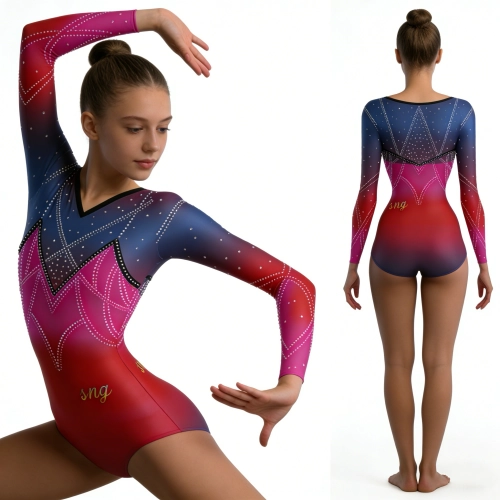
Rhinestones are not only decorative. They influence the visual balance, perceived quality, and performance of a leotard. Designers use rhinestones to create focal points, outline patterns, add sparkle, and differentiate a team or brand. However, the design must be practical. Too many stones can add weight and reduce stretch. Poorly placed stones can irritate the skin or interfere with movement. The best rhinestone layouts are planned alongside the garment pattern, not added as an afterthought.
When evaluating a factory, buyers should ask how the design team plans rhinestone placement. Do they consider body mapping? Do they account for stretch direction? Do they test samples for adhesion and comfort? A factory with gymnastics expertise will understand that rhinestones must move with the athlete. The decoration should enhance the performance, not limit it.
Hotfix rhinestones are common in competition leotards because they can be applied quickly and consistently. The process uses heat-activated adhesive. The factory must control temperature, pressure, and timing to ensure proper adhesion without damaging the fabric. Different fabrics respond differently to heat, so the factory must test each combination. Hotfix stones can be very durable when applied correctly, but poor application can lead to stones falling off after stretching or washing.
Adhesive rhinestones may be used for delicate fabrics or specific design effects. The adhesive must be strong enough to hold the stone but flexible enough to move with the garment. The factory should consider skin contact, washing, and storage. Adhesive application can be less durable than hotfix or sewing, so it is often used for lighter decoration or areas with less stress.
Sew-on rhinestones are typically used for larger, heavier stones or where maximum security is required. They are more labor-intensive and can add weight, but they offer strong attachment. In competition leotards, sew-on stones may be used sparingly for focal points. The factory must ensure that the sewing does not pucker the fabric or create uncomfortable knots on the inside.
Many high-end competition leotards combine rhinestones with sublimation printing, mesh, foil, or crystal decoration. The factory must manage these techniques together. For example, sublimation printing may be applied before rhinestones. The design team must ensure that the printed pattern and the stone layout align. Mesh panels may require different stone application methods. The final garment should look cohesive and perform reliably.
Fabric is the foundation of a competition leotard. It determines stretch, recovery, comfort, opacity, and how rhinestones adhere. Buyers should understand the main options and how they affect the final product.
Lycra and Spandex are common in gymnastics leotards because they offer excellent stretch and recovery. They allow freedom of movement and a close fit. For rhinestone application, these fabrics require careful heat control because excessive heat can damage the fibers. The factory should use appropriate stabilizers or application methods to protect the fabric.
Polyester is durable, colorfast, and often used in sublimation printing. It can be blended with Spandex for stretch. Polyester leotards may feel slightly different from Lycra, but they can be very practical for training and teamwear. Rhinestones can be applied to polyester, but the factory must test adhesion and heat resistance.
Mystique fabric has a shiny, metallic appearance that is popular in competition leotards. It can create a dramatic look, especially when combined with rhinestones. However, Mystique can be sensitive to heat and may show marks if rhinestone application is not precise. The factory should have experience with this material.
Mesh is often used for sleeves, side panels, and illusion cutouts. It adds breathability and visual interest. Rhinestones on mesh require special handling because the fabric is open and delicate. The factory may need to use a backing or specific application method to secure the stones without tearing the mesh.
Many competition leotards combine multiple fabrics. For example, a solid Lycra body with mesh sleeves and Mystique accents. The factory must manage different stretch rates and decoration requirements. Rhinestones may be placed only on certain panels. The design and production teams must coordinate to ensure that the garment fits and moves correctly.
Sampling is where a design becomes real. For rhinestone competition leotards, sampling is especially important because it allows the buyer to see the actual sparkle, placement, and fit. A sample also reveals how the fabric and stones behave together. Buyers should never approve a rhinestone leotard design based only on a digital mockup. The physical sample is essential.
During sampling, buyers should check the following:
A good factory will provide clear photos, measurements, and feedback during sampling. T&J Sportswear supports sample development and can assist with artwork development and product optimization, helping customers turn concepts into finished gymnastics apparel. The company understands that different customers have different order requirements. Whether a customer is a growing gymnastics club looking for customized team uniforms, a new brand developing its first collection, or an established distributor requiring regular production, T&J Sportswear provides flexible solutions with low MOQ, competitive pricing, professional communication, and one-to-one service.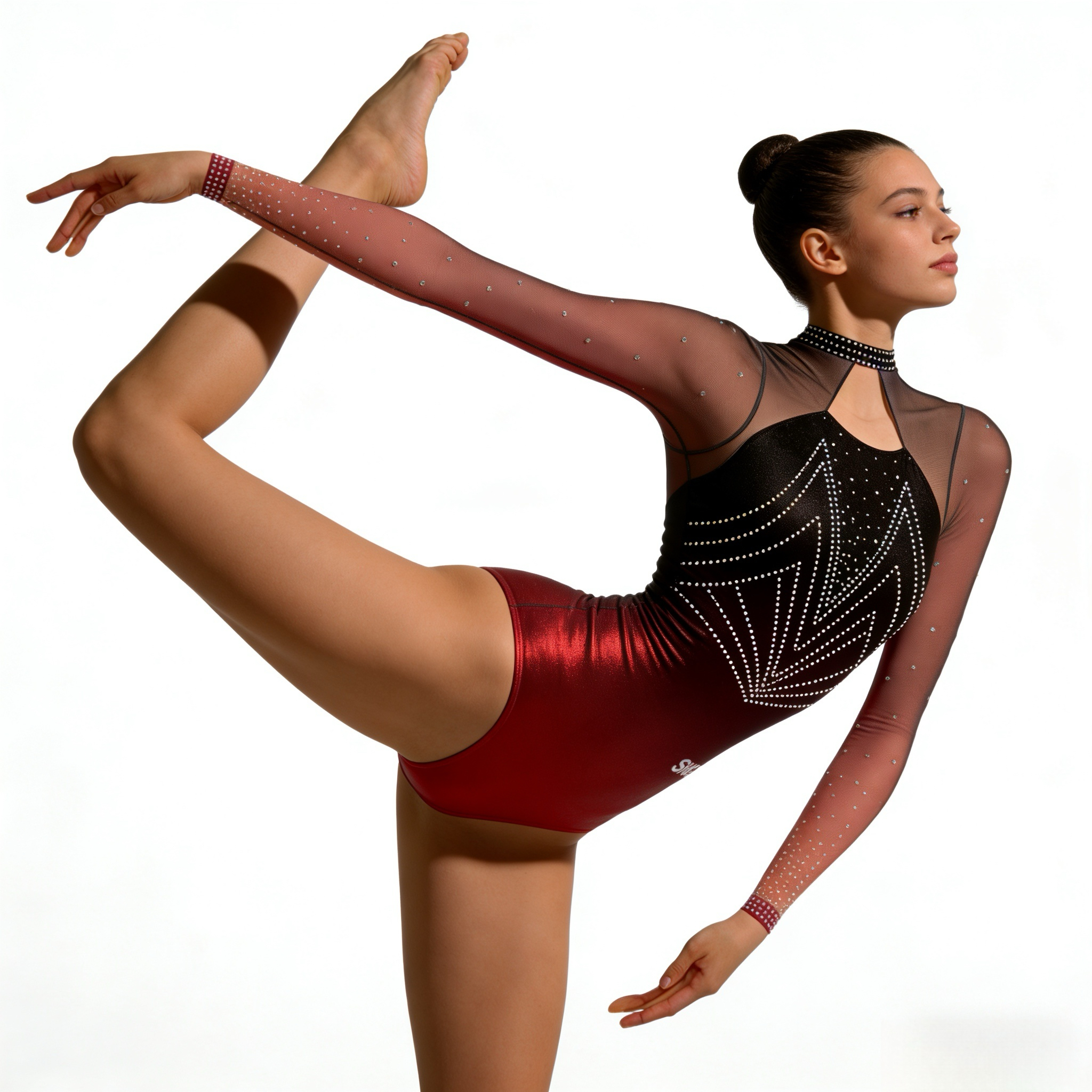
Quality control should be systematic. A factory that inspects rhinestone leotards thoroughly will reduce returns, complaints, and brand damage. The following table outlines key inspection points.
| Inspection Area | What to Check | Why It Matters |
|---|---|---|
| Fabric | No holes, pulls, shading, or defects | Affects appearance and durability |
| Printing | Sharp graphics, correct colors, no smudging | Brand and design accuracy |
| Stitching | Even seams, no loose threads, secure edges | Comfort and longevity |
| Measurements | Consistent with size chart and sample | Fit and team uniformity |
| Rhinestone Placement | Correct layout, spacing, and alignment | Visual impact and premium quality |
| Rhinestone Adhesion | Stones securely attached, no loose edges | Prevents loss during use |
| Comfort | No sharp stones or rough backing inside | Athlete comfort and focus |
| Coverage | Opacity and fit in motion | Confidence and performance |
| Labels and Packaging | Correct labels, tags, and polybags | Branding and retail readiness |
Buyers should ask for inspection reports and, when possible, third-party testing for applicable products. T&J Sportswear lists certifications such as ISO9001, SGS, and CE for applicable products. Specific certification and testing documentation can be provided according to the product and customer requirements.
Rhinestone leotards often involve more labor and materials than plain leotards. Pricing depends on fabric, design complexity, rhinestone quantity and quality, printing, labor, packaging, and order volume. Buyers should request a detailed quotation that explains what is included. A low unit price may hide costs such as sampling, artwork, or special packaging.
MOQ is another important factor. Low MOQ allows clubs and new brands to test designs without excessive inventory risk. T&J Sportswear offers low MOQ starting from 10 sets for selected products. This is particularly useful for gymnastics clubs that need small team orders, new brands launching a first collection, and distributors testing new designs. As demand grows, the factory can scale production with its 30+ skilled workers and 300+ leotards per day capacity.
Buyers should also consider total cost of ownership. A cheaper leotard with falling rhinestones, poor fit, or inconsistent sizing can cost more in replacements, returns, and reputation. Investing in a reliable factory with consistent quality is usually more economical in the long run.
Clear communication is essential for custom rhinestone leotards. The buyer and factory must align on design, materials, sizes, quantities, deadlines, and shipping terms. Misunderstandings can lead to production errors, delays, and financial loss. A factory with one-to-one service can provide a dedicated contact who understands the project.
T&J Sportswear emphasizes professional communication and one-to-one service. From initial inquiry and design development to sampling, production, inspection, and shipment, the team provides support throughout the process. Customers can communicate their requirements directly and receive assistance with product development, customization, production details, and logistics. This is especially valuable for international buyers who may be working across time zones and different business cultures.
Answers to these questions reveal whether a factory is truly capable of producing competition-grade rhinestone leotards. Buyers should look for specific, practical responses rather than general claims.
Many buyers make avoidable mistakes when sourcing rhinestone gymnastics leotards. One common mistake is choosing a factory based only on price. Low prices may come with poor rhinestone adhesion, inconsistent sizing, or delayed production. Another mistake is failing to request a physical sample. Digital mockups cannot show how rhinestones reflect light, how the fabric stretches, or how the garment fits.
Some buyers also overlook communication. A factory that responds slowly or provides unclear answers may cause problems during production. Others ignore MOQ and order too much inventory before testing the market. This is especially risky for new brands and small clubs. A better approach is to start with a small order, evaluate quality, and then scale up with a reliable partner.
Finally, buyers should not treat rhinestones as a last-minute addition. The design, fabric, and decoration should be planned together. A factory that collaborates on design from the beginning can prevent technical problems and produce a better final product.
T&J Sportswear is a professional gymnastics apparel manufacturer specializing in the development and production of high-quality gymnastics leotards and teamwear. With more than 10 years of experience in the sportswear industry, the company has built strong expertise in product development, custom design, manufacturing, and international business. Main products include competition gymnastics leotards, practice gymnastics leotards, custom team leotards, rhinestone gymnastics leotards, and gymnastics warm-up wear.
The company works with gymnastics clubs, teams, brands, wholesalers, distributors, and other sportswear businesses, with a strong focus on customers in the US, Europe, and other international markets. T&J Sportswear understands that gymnastics apparel needs to combine comfort, flexibility, durability, fit, and visual appeal. The production team pays attention to every stage of manufacturing, from fabric selection and pattern development to cutting, sewing, printing, rhinestone application, quality inspection, and final packaging. This helps provide products that are suitable for both demanding training sessions and high-level competitions.
Customization is one of T&J Sportswear key strengths. The company offers OEM and ODM services and can develop products based on customer designs, sketches, reference images, color requirements, or original ideas. The professional design team can assist with artwork development and product optimization, helping customers turn concepts into finished gymnastics apparel.
T&J Sportswear also understands that different customers have different order requirements. Whether a customer is a growing gymnastics club looking for customized team uniforms, a new brand developing its first collection, or an established distributor requiring regular production, the company provides flexible solutions with low MOQ, competitive pricing, professional communication, and one-to-one service.
Quality and consistency are important throughout the production process. T&J Sportswear works to maintain stable workmanship and carefully inspects finished products before shipment. The goal is not only to manufacture gymnastics apparel but also to build long-term partnerships with customers through reliable products and responsive service. With experienced production capabilities, professional design support, flexible customization, and a customer-focused approach, T&J Sportswear is committed to being a dependable gymnastics apparel manufacturing partner for customers around the world.
T&J Sportswear competition leotards combine performance fabrics with creative designs, sublimation printing, rhinestones, and other decorative techniques. The company pays close attention to fabric selection, cutting, stitching, embellishment, and finishing to create eye-catching leotards that allow athletes to move confidently during competition.
T&J Sportswear practice gymnastics leotards focus on comfort, stretch, breathability, and durability for everyday training. A wide range of colors, patterns, and styles is available, with customized designs for gymnastics clubs and teams.
For customers looking to build a complete team collection, T&J Sportswear also provides custom gymnastics warm-ups and matching team apparel. Team colors, logos, patterns, labels, packaging, and other details can be customized according to requirements. This allows clubs and brands to create a unified look across competition and training.
Not all rhinestones are equal. Buyers should ask about stone type, cut, color, and manufacturer. Cheaper stones may lose shine, have inconsistent sizes, or fall off more easily. Higher-quality stones may cost more but deliver better sparkle and durability. The factory should be able to recommend the right stones for the design and budget.
Durability testing is important. The factory can perform stretch tests, adhesion tests, and wash tests on samples. These tests help predict how the leotard will perform in real use. For competition leotards, even a few missing stones can affect the overall look. Therefore, the factory should have strict standards for rhinestone application and inspection.
Buyers should also consider the inside of the garment. Stones should not scratch the athlete. Backing materials, adhesives, and sewing knots should be smooth or covered. Comfort is essential because gymnasts wear leotards for long training sessions and competitions.
For brands and distributors, packaging and labeling are part of the product experience. A rhinestone leotard should arrive in packaging that protects the decoration and presents the brand professionally. Custom labels, hang tags, size tags, and polybags can be produced according to requirements. The factory should understand retail packaging standards for different markets.
T&J Sportswear provides customization for labels, packaging, and other details. This helps brands create a cohesive product line and meet retailer requirements. For clubs, packaging may be simpler, but size labeling and team identification are still important. Clear labeling reduces confusion and improves the customer experience.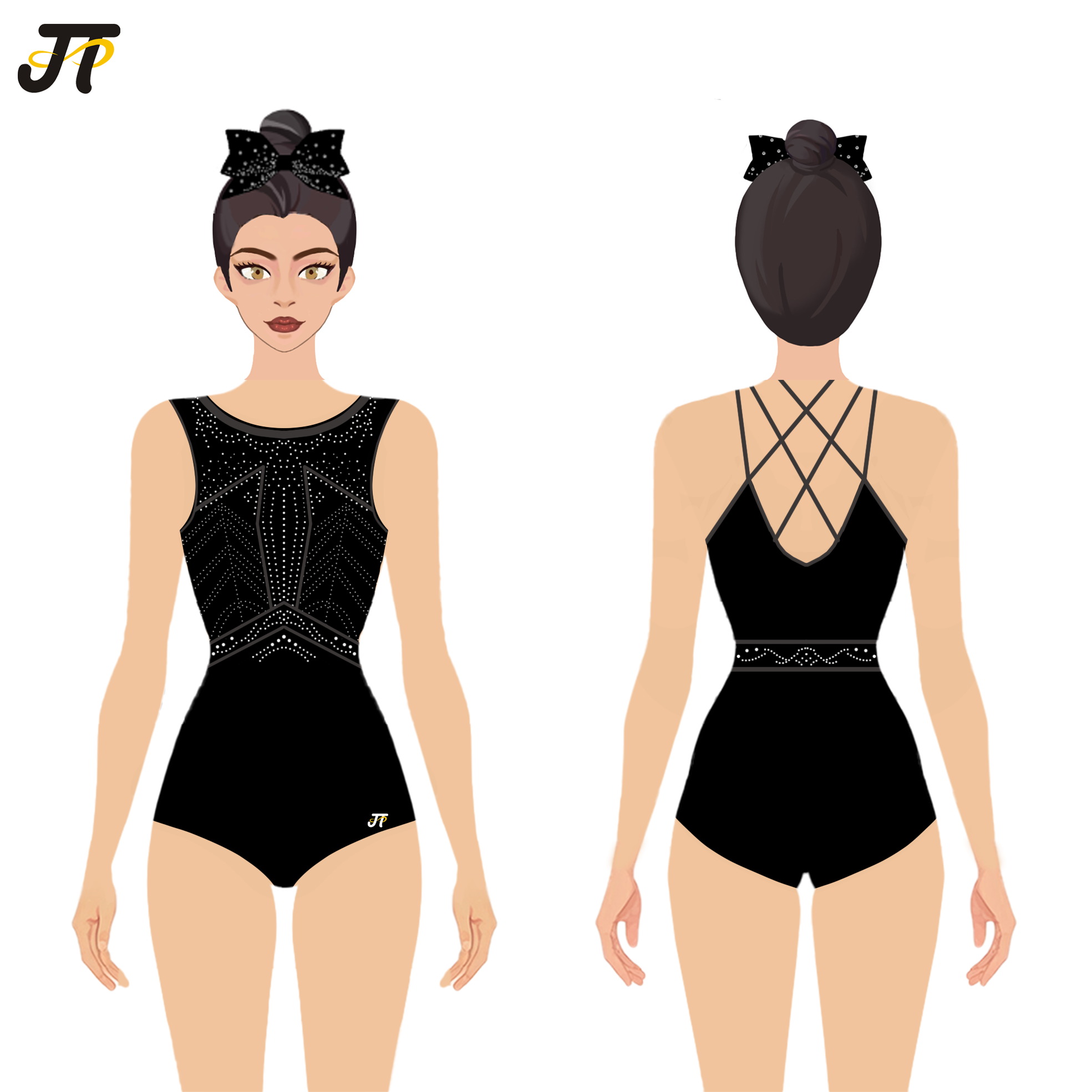
International buyers should discuss lead times early. Rhinestone leotards may require additional production time for decoration, inspection, and packaging. The factory should provide a realistic schedule based on design complexity, order quantity, and material availability. Buyers should also clarify shipping terms, customs documentation, and delivery responsibilities.
T&J Sportswear works with international customers and understands the importance of reliable communication and logistics. From production to shipment, the team can assist with details to help ensure a smooth delivery process. For customers in the US, Europe, and other markets, this support is valuable for planning launches, team seasons, and wholesale deliveries.
The best factory relationships are long-term partnerships. A reliable manufacturer learns the buyer brand, understands sizing preferences, and maintains consistent quality over repeated orders. This reduces the need to explain requirements again and again. It also allows for faster development of new designs and more efficient production.
T&J Sportswear aims to build long-term partnerships rather than simply complete individual orders. Whether a customer is a gymnastics club developing team uniforms, a new brand launching a collection, a distributor expanding a product range, or an established buyer looking for a reliable manufacturing partner, T&J Sportswear provides flexible solutions based on requirements.
With 10+ years of industry experience, 36+ countries served, 30+ skilled workers, 300+ daily leotard capacity, low MOQ, professional design support, OEM and ODM customization, and one-to-one service, T&J Sportswear combines manufacturing capability with the flexibility required by today international gymnastics apparel market. From the first idea to the final leotard, T&J Sportswear is committed to making custom gymnastics apparel more efficient, flexible, and reliable.
Choosing the right factory for rhinestone competition leotards is a strategic decision. The factory affects product quality, brand reputation, athlete comfort, and business growth. By evaluating experience, design, materials, rhinestone application, quality control, MOQ, capacity, and service, buyers can make a more informed choice. For gymnastics clubs, brands, wholesalers, and distributors, a specialized partner such as T&J Sportswear can provide the expertise and flexibility needed to create beautiful, durable, and performance-ready rhinestone leotards.
