This article explores the internal workings of a modern gymnastics leotard factory and the quality processes that turn technical fabric into competition-ready apparel. It begins by explaining why a leotard is a technical garment rather than a simple costume, since it must simultaneously deliver comfort, flexibility, durability, fit, and visual appeal. The article then follows the production journey stage by stage: design and development, fabric selection and incoming material inspection, pattern development and grading, cutting with attention to grain and graphic alignment, sublimation printing and colour management, sewing and assembly of stretch fabrics, and rhinestone and crystal application. It examines the quality control system in detail, including key inspection points, measurement verification, coverage and stretch testing, and certification documentation. A comparison table maps inspection stages to their purpose, and a second table links common industry defects to their root causes and preventive measures. The article also covers consistency between sample and bulk production, the role of skilled workers, OEM and ODM customisation, low MOQ flexibility, packaging and delivery checks, and the importance of clear communication and one-to-one service. It concludes by discussing future trends in gymnastics apparel manufacturing and reaffirming that quality is a continuous process rather than a final promise, using T&J Sportswear as a practical example of a manufacturer combining experience, capacity, design support, and flexible customisation for customers worldwide.
Gymnastics is a sport measured in millimetres and milliseconds. A handstand on the beam, a release move on the uneven bars, a twisting double back on the floor — every one of those moments depends on the athlete's strength, training, and confidence. Yet there is another factor that rarely receives attention from spectators: the garment resting against the athlete's skin. A gymnastics leotard must stretch in four directions, hold its shape through hundreds of wash cycles, stay securely in place during inverted skills, and still look striking under competition lighting. Producing such a garment is far more complex than most people imagine. This article takes a detailed look inside a modern gymnastics leotard factory — the people, the machines, the workflow, and above all the quality systems that turn a roll of technical fabric into a finished competition garment. Throughout, the practices of T&J Sportswear, a professional gymnastics apparel manufacturer with more than ten years of experience in the sportswear industry, serve as a practical example of how a modern leotard factory actually operates.
To understand why a leotard factory needs a rigorous quality process, it helps to first understand what the product has to do. A leotard is worn during some of the most demanding physical movements in any sport. Gymnasts rotate, swing, land, and stretch in ways that place enormous stress on fabric and seams. A garment that restricts movement can affect performance. A garment that shifts, rides up, or becomes transparent during a skill can affect confidence. A garment that loses its elasticity after a few washes becomes a cost problem for clubs and families.
Because of this, gymnastics apparel has to combine comfort, flexibility, durability, fit, and visual appeal in a single piece of clothing. Those five requirements often pull in different directions. Greater stretch can reduce shape retention. Heavier decoration can reduce flexibility. Tighter fit can reduce comfort. A good manufacturer does not simply choose one priority and ignore the rest; it engineers a balance.
At T&J Sportswear, this balance is treated as a manufacturing discipline rather than a marketing phrase. The production team pays attention to every stage of manufacturing, from fabric selection and pattern development to cutting, sewing, printing, rhinestone application, quality inspection, and final packaging. The goal is a product that performs during demanding training sessions and holds up during high-level competition.
undefined
What follows is a walk through the factory floor, department by department, and an explanation of the quality checkpoints embedded in each one.
The first stage of production does not happen at a sewing machine. It happens at a desk, a drawing tablet, and a colour chart. Long before fabric is cut, a design must be created, refined, and translated into something a production line can actually build.
Design is one of the defining strengths of a modern gymnastics apparel manufacturer. T&J Sportswear maintains an in-house professional design team specialising in gymnastics apparel. Importantly, this team does more than simply manufacture designs supplied by customers. It can also help develop new concepts based on sketches, reference images, colour combinations, team identities, or brand requirements. This distinction matters greatly to gymnastics clubs that have a strong visual identity but limited design resources, and to new brands that are building their first collection.
In practice, the design process in a leotard factory involves several overlapping tasks:
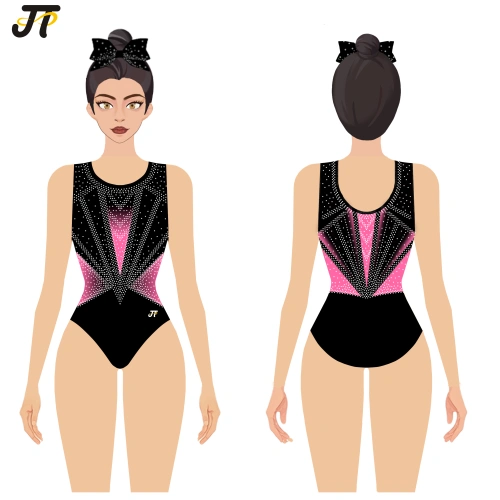
For competition leotards, designers can combine sublimation graphics, colour blocking, mesh, rhinestones, crystal decoration, and different fabric effects to create distinctive visual designs. Customers can also customise colours, logos, patterns, labels, and other branding elements. For practice leotards, the design conversation shifts toward comfort, breathability, and durability, with a wide range of colours, patterns, and styles available.
It is worth noting that design errors become quality defects later. A graphic that is too detailed may not reproduce cleanly in sublimation. A rhinestone cluster placed over a high-stretch zone may crack or detach. A panel seam placed across the hip may create an uncomfortable ridge during a split. Good factories therefore treat design review as the first quality gate, not as a purely creative exercise.
A beautiful gymnastics leotard must also perform during movement. That is why fabric selection and garment construction receive close attention. The material choice determines stretch recovery, opacity, breathability, weight, hand feel, and printability — and it determines how the finished garment will behave after fifty washes.
The product range in a modern gymnastics leotard factory can include Lycra, Spandex, Polyester, Mystique, and Mesh, depending on the design and application. Different products are developed for different priorities, such as stretch, lightweight construction, breathability, quick drying, comfort, durability, and visual appearance.
For training leotards, the emphasis falls on comfortable stretch, durability, moisture management, and everyday wear. Practice garments are washed frequently and worn for hours at a time, so the fabric must tolerate repeated laundering without pilling, fading, or losing elasticity.
For competition leotards, the emphasis shifts toward precision fit, secure coverage, decorative details, and professional finishing. Competition garments are often worn for only a few minutes at a time but are photographed, televised, and scrutinised. Mystique and similar metallic-effect fabrics can deliver dramatic visual impact, while mesh inserts add ventilation and design contrast. Sublimation-friendly polyester blends allow full-colour graphics to be printed directly into the fabric rather than layered on top of it.
Quality control in a well-run factory begins before a single garment is made. Incoming fabric rolls are checked for:
If a fabric roll fails these checks, it never reaches the cutting table. This single discipline prevents a large proportion of the defects that plague lower-quality suppliers — inconsistent sizing, colour mismatch between pieces of the same order, and premature loss of stretch.
Fit is one of the hardest qualities to get right in gymnastics apparel, because a leotard is a close-fitting, high-stretch garment worn by athletes in extreme positions. Pattern development is therefore one of the most technically demanding parts of the factory.
Pattern makers work from body measurements and from the requirements of the specific design. They determine how much negative ease a garment should have, where stretch should be concentrated, how high a leg line should sit, how a neckline should behave during a backbend, and how a sleeve should move through a giant swing on the bars.
Grading is the process of scaling a base pattern across a size range. In gymnastics, this is not a simple mathematical exercise. Children's body proportions differ significantly from adults', and different markets use different sizing systems. A manufacturer serving more than thirty-six countries must understand these variations.
Over the years, T&J Sportswear has reached customers in 36+ countries, which has given the team practical experience working with different markets, customer requirements, sizing systems, and product preferences. Main markets include North America and Europe, where customers place strong emphasis on product quality, customisation, consistency, and reliable communication.
Before bulk production, a sample is made and evaluated. During sample development, customers can review the design, fabric, fit, decoration, and finishing before confirming mass production. This is a critical checkpoint for two reasons. First, it allows the customer to confirm that the product matches their vision. Second, it allows the factory to identify construction problems while changes are still cheap and fast to make.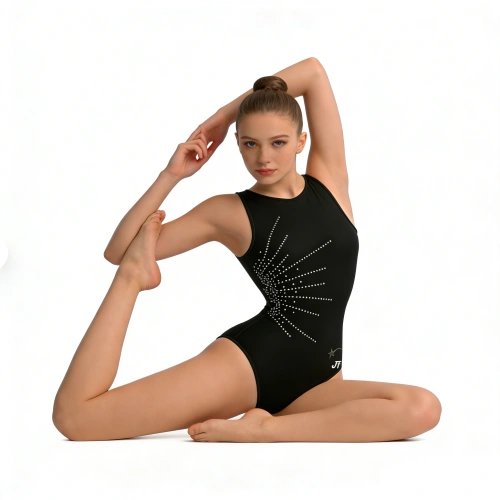
Typical sample review criteria include:
Cutting is where a design becomes physical. In a modern leotard factory, fabric is spread in multiple layers, aligned to the grain, and cut according to the approved pattern. Accuracy here determines whether the finished garment will fit properly and whether panels will match at the seams.
Two details are especially important in gymnastics apparel cutting:
Direction of stretch. Stretch fabrics behave differently along the length and width of the roll. If panels are cut in the wrong direction, a leotard may stretch vertically instead of horizontally, causing it to sag or ride up during movement. Cutters therefore follow a strict grain and stretch-direction plan for every style.
Print and graphic alignment. For sublimated designs, artwork is printed onto fabric before cutting. The cutting plan must therefore account for graphic placement so that the pattern flows continuously across seam lines. Misalignment of even a few millimetres can make an otherwise excellent garment look amateurish.
After cutting, panels are bundled and labelled by size, colour, and style. This tracking system prevents mixing between sizes — one of the most common causes of incorrect measurements in finished garments. When a factory cuts hundreds of leotards per day, discipline in bundling is not administrative detail; it is a core quality control.
Sublimation printing is one of the most important decoration technologies in modern gymnastics apparel. Unlike screen printing, which adds a layer of ink on top of the fabric, sublimation uses heat and pressure to convert solid dye into gas, which then bonds with the polyester fibres. The result is a graphic that does not sit on the surface, does not crack, does not peel, and does not add weight or stiffness.
For gymnastics, this is a major advantage. A printed graphic that sits on the surface of a high-stretch garment will eventually crack along the stretch lines. Sublimated graphics move with the fabric.
Colour accuracy is one of the most persistent challenges in apparel manufacturing. The same digital file can look different depending on the printer, the paper, the transfer temperature, the pressure, and the fabric base. Professional factories manage this through:
Because gymnastics teams often order garments in several sizes and sometimes in multiple batches across a season, colour consistency between orders is particularly important. A club that reorders a leotard two years later should receive a garment that matches the original.
Sewing is the department most people picture when they imagine a garment factory, and in a gymnastics leotard factory it is where the greatest concentration of skill resides. Stretch fabrics are far less forgiving than woven materials. A seam that is too tight will pucker and restrict stretch. A seam that is too loose will gap during movement. The wrong stitch type will snap when the garment is pulled on.
Skilled operators therefore use specific stitch constructions for specific areas. Overlock and flatlock seams are common for their ability to stretch with the fabric while enclosing raw edges. Coverstitch finishes are used where a clean, flat hem is required. Elasticised edges around leg openings and necklines must be applied with controlled tension so that the opening stays in place without digging into the skin.
Experienced sewers in a leotard factory monitor a set of recurring risks:
In a factory with 30+ skilled workers and reported production capacity of 300+ leotards per day, consistency depends on standardised methods. Each style has a defined sewing sequence, defined seam types, and defined tension settings. Samples act as the physical reference standard, and operators compare their output against that standard throughout the run.
Rather than waiting until garments are finished, effective factories inspect at intermediate stages. In-line inspection catches problems early, when correction is cheap. If a batch of panels has been sewn with the wrong tension, it is far better to discover this after ten pieces than after three hundred.
Rhinestone gymnastics leotards are among the most visually striking products in the sport, and they are also among the most difficult to manufacture reliably. A rhinestone is a small, hard object attached to a soft, highly elastic surface. Every time the garment stretches, the fabric moves but the stone does not. If the attachment method is wrong, the stone will eventually detach or the fabric around it will tear.
Professional factories manage this through several practices:
Beyond durability, rhinestone application is a visual quality issue. Symmetry is critical. If one shoulder has twelve stones and the other has eleven, or if a swirl pattern is offset by half a centimetre, the defect is immediately visible on stage. Quality inspectors therefore check stone count, spacing, alignment, and overall balance against the approved artwork.
Quality control does not begin at the end of the line. It begins with the sample. During sample development, customers review the design, fabric, fit, decoration, and finishing before confirming mass production. Once approved, that sample becomes the reference standard for the entire order.
For finished garments, key inspection points include fabric condition, printing quality, stitching, measurements, rhinestone placement, coverage, and overall appearance. The production process is designed to reduce common problems such as inconsistent sizing, printing defects, loose decoration, or uneven finishing.
| Inspection Stage | What Is Checked | Why It Matters |
|---|---|---|
| Incoming fabric | Colour, weight, stretch, opacity, defects | Prevents systemic defects across the entire order |
| Pre-production sample | Fit, construction, decoration, finish | Confirms the reference standard before bulk begins |
| Cutting | Grain direction, panel count, size bundling | Protects fit and prevents size mixing |
| Printing | Colour accuracy, alignment, transfer quality | Ensures visual consistency between sizes and batches |
| In-line sewing | Tension, stitch integrity, seam alignment | Catches defects while correction is still inexpensive |
| Rhinestone application | Placement, symmetry, adhesion | Prevents detachment and visual imbalance |
| Final inspection | Measurements, coverage, stitching, appearance | Confirms the finished garment meets the standard |
| Packing | Size labels, quantity, polybagging, carton marks | Ensures the right product reaches the right customer |
Measurement checking is one of the most objective parts of quality control. A defined set of measurements is taken from each inspected garment and compared against the approved specification with an allowable tolerance. Typical measurement points include chest width, waist width, torso length, leg opening, neckline width, and sleeve length where applicable.
This process is what prevents the most common complaint in the gymnastics apparel market: a leotard labelled as one size that fits like another. Consistent sizing depends on consistent patterns, consistent cutting, and consistent sewing — and on measuring finished garments rather than assuming they are correct.
Coverage is a specific quality concern in gymnastics. A garment may look acceptable on a hanger and still become transparent when stretched during a skill. Inspectors therefore stretch key areas — the seat, the bust area, the leg openings — and check opacity and recovery. A leotard that does not return to shape after stretching fails the standard.
Product information for established manufacturers often lists certifications such as ISO9001, SGS, and CE for applicable products. Specific certification and testing documentation can be provided according to the product and customer requirements. For buyers in North America and Europe, this documentation is frequently essential for retail compliance, insurance, and internal quality policies.
Anyone can make one beautiful leotard. The real test of a manufacturer is whether the three-hundredth leotard matches the first. This is the challenge of scale, and it is where many suppliers fail.
Maintaining consistency requires several systems working together:
For customers, production capacity is not simply about quantity. The real value is the ability to maintain consistent workmanship when moving from samples to bulk production. A factory may report 300+ leotards per day, but the meaningful question is whether the last leotard of the day matches the approved sample as closely as the first.
Modern factories use technology — digital printing, computerised cutting, automated rhinestone placement — but gymnastics apparel remains a skill-intensive industry. The reason is simple: stretch fabric is unpredictable. It moves, it curls, it behaves differently depending on humidity, tension, and handling. Machines execute; people judge.
A factory team of 30+ skilled workers represents a significant concentration of specialised knowledge. Pattern makers who understand how a leotard behaves during a back handspring. Sewers who can feel when tension is slightly wrong. Rhinestone technicians who can place a hundred stones in a symmetrical pattern by eye and hand. Quality inspectors who can spot a two-millimetre measurement deviation across a stack of garments.
This expertise is also why long-term relationships matter. When a customer works with the same manufacturing partner over multiple seasons, the team learns their preferences, their sizing tendencies, their design language, and their market. The result is fewer revisions, faster approvals, and more reliable output.
Customisation sits at the centre of the gymnastics apparel manufacturing service. Manufacturers typically support both OEM and ODM, allowing customers to choose between producing their own designs and developing new products together with the factory team.
OEM — original equipment manufacturing — suits customers who already have a complete design, technical specification, and brand identity. They need a reliable production partner to execute their vision at scale.
ODM — original design manufacturing — suits customers who have a concept, a market opportunity, or a brand direction but need design and development support. The factory helps turn an idea into a finished product.
Customisation can cover artwork, colours, sublimation printing, logos, rhinestone layouts, fabric combinations, sizes, labels, packaging, and other details. The production process covers design development, fabric selection, digital artwork, printing, cutting, sewing, decoration, inspection, packaging, and delivery.
This integrated approach helps reduce communication between multiple suppliers and gives customers a more efficient path from an initial idea to a finished product. For a gymnastics club developing team uniforms, this might mean matching team colours, adding a club logo, and producing a coordinated set of competition leotards, practice leotards, and warm-ups. For a new brand launching a collection, it might mean developing a full range with consistent branding, labels, and packaging.
One major advantage for small and growing customers is a low MOQ, starting from 10 sets for selected products. This gives gymnastics clubs, new brands, boutique retailers, and smaller distributors greater flexibility when testing new designs or launching new collections.
Instead of requiring customers to commit to large quantities before they know how a design will perform in their market, a flexible manufacturer can support smaller initial orders and help customers gradually develop their collections. This approach reflects a realistic understanding of how the gymnastics market works. Clubs grow season by season. New brands test designs before scaling. Distributors add categories incrementally.
A common misconception is that small orders receive less attention than large ones. In a well-managed factory, the opposite is true: small orders are often the testing ground for future large orders, and quality standards apply regardless of quantity. The same inspection protocols, the same measurement checks, and the same finishing requirements apply to a ten-piece club order as to a thousand-piece wholesale production run.
Packaging may seem like a minor detail, but for gymnastics clubs and brands it is part of the customer experience. A leotard that arrives with the wrong size label, an incorrect logo tag, or a damaged polybag creates a poor impression regardless of how well the garment was made.
Final packaging checks typically cover:
For customers in the United States and Europe, these details affect warehouse efficiency, retail presentation, and customer satisfaction. A manufacturer that treats packing as part of quality control, rather than as an afterthought, saves its customers considerable administrative effort.
Manufacturing quality is only one part of a successful supplier relationship. Clear communication and responsive service are equally important, especially for customised gymnastics apparel, where small misunderstandings can lead to significant delays.
From initial inquiry and design development to sampling, production, inspection, and shipment, a professional team provides support throughout the process. Customers can communicate their requirements directly and receive assistance with product development, customisation, production details, and logistics.
One-to-one service means that a customer works with a consistent point of contact who understands their order, their history, and their preferences. In practice, this reduces the risk of information being lost between departments and makes problem-solving faster when questions arise during production.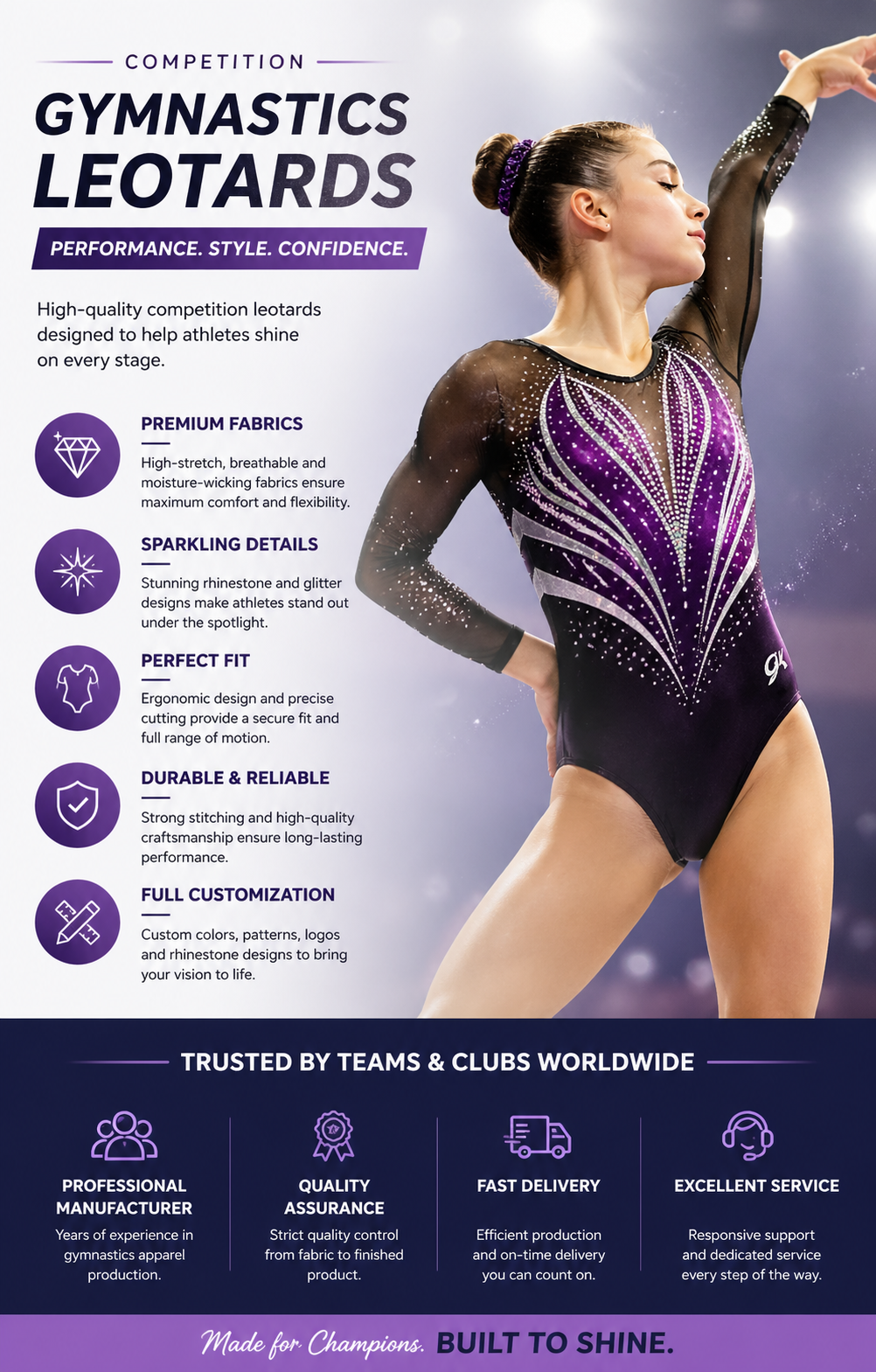
The most effective manufacturer-customer relationships function as partnerships rather than transactions. A gymnastics club developing team uniforms, a new brand launching a collection, a distributor expanding a product range, and an established buyer seeking a reliable manufacturing partner all have different needs — but all benefit from a supplier that provides flexible solutions based on their specific requirements.
With 10+ years of industry experience, 36+ countries served, 30+ skilled workers, 300+ daily leotard capacity, low MOQ, professional design support, OEM and ODM customisation, and one-to-one service, a manufacturer can combine production capability with the flexibility that today's international gymnastics apparel market requires.
It is easy to view quality control as an internal business concern — a matter of defect rates and inspection reports. But in gymnastics, quality has a direct human dimension.
A well-fitted leotard allows an athlete to focus entirely on the routine. A poorly fitted one creates distraction: a strap that slips, a leg line that rides up, a seam that digs in during a pirouette. At the highest levels of the sport, where routines are decided by tenths, distraction is a genuine competitive disadvantage.
There is also the question of durability and cost. Gymnastics families and clubs invest significant sums in apparel over a season. A leotard that keeps its shape, colour, and decoration after repeated wear and washing represents real value. A leotard that fades, stretches out, or loses its rhinestones after a few uses represents waste.
And there is the emotional dimension. A competition leotard is often one of the most memorable garments an athlete will ever wear. It appears in photographs, in medals ceremonies, and in family albums. Producing it well is not merely a technical exercise; it is a contribution to an important moment in a young athlete's life.
One of the clearest ways to understand a quality system is to look at the defects it is designed to prevent. In gymnastics apparel manufacturing, the most common issues are well documented across the industry.
| Defect | Likely Root Cause | Preventive Measure |
|---|---|---|
| Inconsistent sizing | Grading errors, cutting inaccuracy, bundling mistakes | Approved patterns, grain control, size bundling, measurement checks |
| Printing defects | Colour profile drift, incorrect transfer settings | Calibrated printers, test prints, controlled parameters |
| Loose decoration | Poor adhesive settings, stones placed on high-stretch zones | Placement charts, controlled heat application, tug testing |
| Uneven finishing | Inconsistent seam tension, missing inspection stages | Standardised sewing methods, in-line inspection |
| Colour mismatch between batches | Fabric sourcing changes, unrecorded adjustments | Physical colour standards, batch traceability |
| Loss of stretch recovery | Low-quality elastane, excessive heat exposure | Incoming fabric testing, controlled processing |
| Transparency when stretched | Insufficient fabric weight or lining | Opacity testing, coverage inspection, lining selection |
Each of these defects is preventable — but only if the factory has a system that catches the underlying cause rather than simply repairing the symptom. This is the essential difference between a manufacturing operation and a true quality process.
Several trends are shaping the next decade of gymnastics apparel production.
Greater design expectation. Social media has raised the visual bar. Athletes and clubs now expect competition leotards with distinctive graphics, sophisticated colour palettes, and elaborate crystal work. Manufacturers must be able to execute complex designs without sacrificing performance.
Smaller, more frequent orders. Clubs and brands increasingly prefer to test designs in small batches and reorder what works. Low MOQ capability has moved from a niche advantage to a mainstream requirement.
Stronger documentation expectations. Buyers in regulated markets increasingly request certification, testing documentation, and traceability. Manufacturers with organised quality systems are better positioned to meet these expectations.
Continued emphasis on fabric performance. As athletes push technical boundaries, apparel must keep pace. Comfort, stretch recovery, breathability, and moisture management will remain central design priorities.
Despite these shifts, the fundamentals remain constant. Attention to detail at every stage. Consistency between sample and bulk. Honest communication when problems arise. And a genuine commitment to building long-term relationships rather than completing one-off transactions.
Inside a modern gymnastics leotard factory, quality is not a single inspection at the end of a production line. It is a sequence of decisions and checks that begins with fabric selection and continues through pattern development, cutting, printing, sewing, rhinestone application, final inspection, and packaging. Each stage protects the next. Each stage depends on the skill of the people performing it.
The result is a garment that must satisfy five demanding requirements at once: comfort, flexibility, durability, fit, and visual appeal. Achieving that balance at scale — producing the three-hundredth leotard as carefully as the first — is what separates a genuine manufacturing partner from an ordinary supplier.
T&J Sportswear represents this approach in practice. With more than ten years of specialised gymnastics apparel experience, an in-house design team, a production team of 30+ skilled workers, reported capacity of 300+ leotards per day, service to customers in 36+ countries, low MOQ starting from 10 sets for selected products, and full OEM and ODM customisation support, the company focuses on reliable quality, flexible customisation, and professional one-to-one service for clubs, teams, brands, wholesalers, and distributors around the world.
From the first sketch to the final leotard, the objective is straightforward: to manufacture gymnastics apparel that athletes can trust, and to build partnerships that customers can rely on season after season.
