This guide explains how smart buyers can choose a gymnastics leotard supplier with confidence. It emphasizes that leotards are specialized performance garments requiring stretch, fit, coverage, durability, and visual appeal. Buyers should look beyond price and evaluate a supplier's experience, design support, fabric knowledge, customization options, MOQ flexibility, production capacity, quality control, communication, and compliance documentation. The guide covers key product categories such as competition leotards, practice leotards, custom team leotards, rhinestone leotards, and warm-up wear. It also explains how materials like Lycra, Spandex, Polyester, Mystique, and Mesh affect performance and appearance. Customization through OEM and ODM services, including artwork, colors, logos, labels, packaging, and rhinestone layouts, is presented as a major value driver. The article highlights practical checks such as sampling, in-process inspection, final inspection, and written confirmation of specifications. It also discusses common buyer mistakes, shipping and packaging considerations, certifications like ISO9001, SGS, and CE, and the importance of one-to-one service. T&J Sportswear is used as a practical example of a specialized manufacturer with more than ten years of experience, customers in more than thirty-six countries, more than thirty skilled workers, daily capacity of more than three hundred leotards, low MOQ starting from ten sets, and flexible OEM and ODM support. The summary concludes that the best supplier relationship is a long-term partnership built on reliable products, consistent workmanship, responsive communication, and a clear understanding of gymnastics-specific needs.
Selecting the right gymnastics leotard supplier is one of the most important decisions for gymnastics clubs, team directors, boutique brands, wholesalers, distributors, and sportswear businesses. A leotard is not a simple piece of clothing. It must support powerful movement, maintain coverage, resist stretching and wear, look polished under competition lights, and fit athletes of different body types. For buyers, the supplier behind the garment matters just as much as the garment itself. A smart buyer looks beyond a low price and evaluates design capability, fabric knowledge, manufacturing consistency, customization options, communication, quality control, and long-term reliability.
This guide is written for buyers who want to source gymnastics leotards with confidence. It explains what to look for in a supplier, how to compare manufacturers, which product categories matter, how customization works, and why experience in gymnastics apparel is different from general sportswear production. It also uses T&J Sportswear as a practical example of a specialized gymnastics apparel manufacturer that serves clubs, teams, brands, wholesalers, and distributors in the US, Europe, and other international markets.
undefined
Gymnastics places unique demands on apparel. Athletes train for long hours, perform splits, jumps, turns, tumbling passes, and held positions that require extreme range of motion. A leotard must stretch in multiple directions, return to shape, stay in place, and avoid distracting adjustments. It must also provide appropriate coverage and support while remaining light enough for intense movement. In competition, the garment must look clean, symmetrical, and professional from every angle, including under bright arena lighting and on camera.
General sportswear suppliers may understand activewear, but they often lack specific knowledge about gymnastics fit, pattern engineering, rhinestone application, sublimation alignment, and the balance between compression and comfort. A specialized gymnastics leotard supplier understands that a few millimeters of difference in a shoulder seam, leg opening, or crotch depth can affect performance and comfort. That is why smart buyers prioritize suppliers with direct experience in gymnastics apparel rather than treating leotards as a generic category.
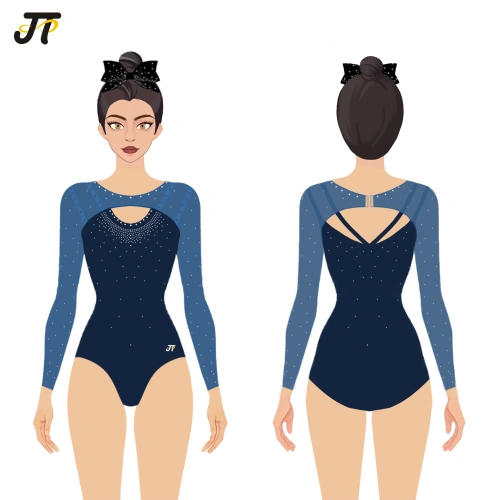
T&J Sportswear is an example of a manufacturer with more than ten years of experience in the sportswear industry and a strong focus on gymnastics leotards and teamwear. The company develops and produces competition leotards, practice leotards, custom team leotards, rhinestone leotards, and gymnastics warm-up wear. Its experience includes product development, custom design, manufacturing, and international business, which helps it understand the practical needs of gymnastics customers in different markets.
Before comparing suppliers, a buyer should define the product categories needed. Gymnastics apparel is not a single product. Different categories require different fabrics, construction methods, decoration techniques, and quality standards. A supplier that performs well in practice leotards may not be equally strong in competition leotards with complex rhinestone layouts. A smart buyer matches the supplier's strengths to the intended product range.
Competition leotards are designed for performance, presentation, and durability under pressure. They often use performance fabrics, sublimation printing, color blocking, mesh panels, rhinestones, crystals, and other decorative techniques. The goal is to create an eye-catching garment that allows athletes to move confidently. Fit precision, secure coverage, and decorative durability are especially important. A competition leotard may be worn for a single season or multiple competitions, so washing, stretching, and handling must not cause premature damage to printing or embellishments.
T&J Sportswear combines performance fabrics with creative designs, sublimation printing, rhinestones, and other decorative techniques for competition leotards. The company pays close attention to fabric selection, cutting, stitching, embellishment, and finishing. This focus helps create leotards that are visually striking and suitable for high-level competition.

Practice leotards are the workhorses of a gymnastics wardrobe. They must be comfortable, stretchy, breathable, and durable for everyday training. While they may be simpler than competition leotards, they still require good pattern design and reliable construction. A practice leotard that rides up, restricts movement, or loses shape quickly will frustrate athletes and coaches. Buyers often order practice leotards in larger quantities and in a range of colors, patterns, and styles.
T&J Sportswear offers practice gymnastics leotards with a focus on comfort, stretch, breathability, and durability. The company provides a wide range of colors, patterns, and styles, and it supports customized designs for gymnastics clubs and teams. This makes it possible for clubs to create a consistent training look while keeping comfort and practicality at the center.
Custom team leotards are developed for clubs, schools, teams, and organizations that want a unified identity. Team colors, logos, patterns, names, numbers, labels, and packaging can be customized. The challenge is to create a design that looks cohesive across different sizes and body types while maintaining comfort and performance. Team orders often require careful size collection, sample approval, and production planning.
T&J Sportswear supports custom team leotards and matching team apparel. The company can customize team colors, logos, patterns, labels, packaging, and other details according to customer requirements. This helps clubs and teams build a complete collection rather than ordering mismatched items from multiple suppliers.
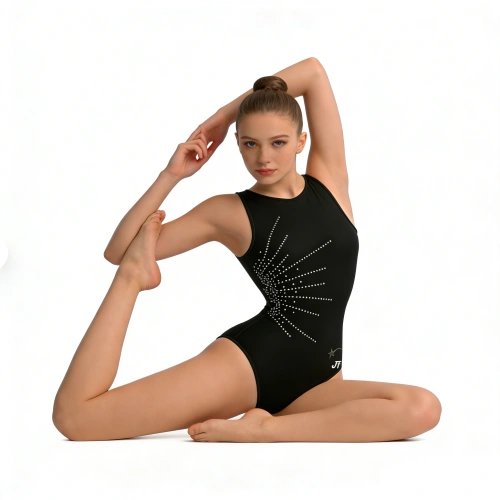
Rhinestone leotards add sparkle and stage presence. However, rhinestone application is a specialized process. Stones must be placed accurately, adhered securely, and arranged to complement the design without adding excessive weight or stiffness. Poor rhinestone work can result in stones falling off, scratching, or creating an uneven appearance. Buyers should ask suppliers about stone quality, application methods, placement accuracy, and inspection procedures.
T&J Sportswear includes rhinestone gymnastics leotards in its main product range. The company can combine sublimation graphics, color blocking, mesh, rhinestones, crystal decoration, and different fabric effects to create distinctive visual designs. Its production process includes rhinestone application and quality inspection, which helps maintain a professional finish.
Warm-up wear is important for athletes who need to stay warm before competition, during breaks, or while traveling. Warm-ups should match team colors and branding while providing comfort, coverage, and ease of movement. A complete team collection may include leotards, warm-up jackets, pants, tops, bags, or other accessories. Suppliers that can produce coordinated teamwear simplify the buying process and help ensure color consistency.
T&J Sportswear provides gymnastics warm-up wear and matching team apparel. Team colors, logos, patterns, labels, packaging, and other details can be customized. This allows clubs, brands, and distributors to develop a cohesive collection that meets both performance and presentation needs.
Not every manufacturer is suited to gymnastics apparel. A reliable supplier should demonstrate specialized knowledge, stable production, flexible customization, and responsive communication. The following qualities are essential for smart buyers to evaluate.
Experience matters because gymnastics apparel has specific requirements. These include stretch, fit, comfort, coverage, durability, decoration, and freedom of movement. A supplier that has produced many leotards understands how different fabrics behave, how patterns should be adjusted for different sizes, and how to prevent common problems such as riding up, gaping, or restricted movement.
T&J Sportswear has more than ten years of experience in gymnastics apparel manufacturing, with a strong focus on competition and training leotards. Over the years, its products and services have reached customers in more than thirty-six countries. This gives the company practical experience with different markets, customer requirements, sizing systems, and product preferences. Its main markets include North America and Europe, where customers place strong emphasis on product quality, customization, consistency, and reliable communication.
Design capability is a major differentiator. Some suppliers only manufacture designs supplied by customers. Others can actively help develop new concepts based on sketches, reference images, color combinations, team identities, or brand requirements. In-house design support is valuable for clubs that need help refining a team look, new brands that are developing their first collection, and distributors that want to offer unique products.
T&J Sportswear has an in-house professional design team specializing in gymnastics apparel. The company does more than simply manufacture customer-supplied designs. It can help develop new concepts and optimize products. For competition leotards, the team can combine sublimation graphics, color blocking, mesh, rhinestones, crystal decoration, and different fabric effects. Customers can also customize colors, logos, patterns, labels, and other branding elements. This design support helps turn ideas into finished gymnastics apparel.
A beautiful leotard must also perform during movement. Fabric selection and garment construction are therefore critical. Suppliers should understand materials such as Lycra, Spandex, Polyester, Mystique, and Mesh. Each material offers different levels of stretch, recovery, breathability, opacity, shine, and durability. The right combination depends on the product category and the athlete's needs.
T&J Sportswear uses materials including Lycra, Spandex, Polyester, Mystique, and Mesh, depending on the design and application. Different products can be developed for different priorities, such as stretch, lightweight construction, breathability, quick drying, comfort, durability, and visual appearance. For training leotards, the company focuses on comfortable stretch, durability, moisture management, and everyday wear. For competition leotards, it places greater emphasis on precision fit, secure coverage, decorative details, and professional finishing.
Minimum order quantity is a common barrier for gymnastics clubs, new brands, boutique retailers, and smaller distributors. Large MOQs force buyers to commit to significant inventory before testing a design in the market. A supplier with low MOQ options allows customers to start small, validate demand, and grow gradually. This flexibility is especially important in the gymnastics market, where club colors, team sizes, and seasonal needs can vary widely.
T&J Sportswear offers low MOQ starting from ten sets for selected products. This gives gymnastics clubs, new brands, boutique retailers, and smaller distributors greater flexibility when testing new designs or launching new collections. Instead of requiring customers to commit to large quantities before knowing how a design will perform, the company can support smaller initial orders and help customers develop their collections step by step.
Customization is at the center of gymnastics leotard sourcing. Buyers may need OEM production, where they provide the design and the supplier manufactures it. They may also need ODM support, where the supplier helps develop a new product based on an idea, sketch, or reference. The best suppliers offer both and can guide customers through artwork development, fabric selection, sampling, and bulk production.
T&J Sportswear supports both OEM and ODM services. Customization can cover artwork, colors, sublimation printing, logos, rhinestone layouts, fabric combinations, sizes, labels, packaging, and other details. The company's production process covers design development, fabric selection, digital artwork, printing, cutting, sewing, decoration, inspection, packaging, and delivery. This integrated approach helps reduce communication between multiple suppliers and gives customers a more efficient path from an initial idea to a finished product.
Production capacity is not only about quantity. The real value is the ability to maintain consistent workmanship when moving from samples to bulk production. A supplier may be able to produce a perfect sample, but bulk orders require repeatable processes, trained workers, and reliable quality checks. Buyers should ask about factory size, daily output, worker skill, and quality control systems.
T&J Sportswear has a factory team that includes more than thirty skilled workers, with reported production capacity of more than three hundred leotards per day. This provides a balance between flexible customization and the ability to support larger wholesale and team orders. The company pays attention to fabric, printing, stitching, sizing, rhinestone placement, and overall finishing throughout production. This helps maintain consistency from sample to bulk order.
Quality control should begin before bulk production. During sample development, customers should be able to review the design, fabric, fit, decoration, and finishing before confirming mass production. Once production begins, inspections should cover fabric condition, printing quality, stitching, measurements, rhinestone placement, coverage, and overall appearance. A good supplier aims to reduce common problems such as inconsistent sizing, printing defects, loose decoration, or uneven finishing.
T&J Sportswear works to maintain stable workmanship and carefully inspects finished products before shipment. Its product information also lists certifications such as ISO9001, SGS, and CE for applicable products. Specific certification and testing documentation can be provided according to the product and customer requirements. For buyers, these certifications can be useful when selling in markets that require compliance documentation.
Manufacturing quality is only one part of a successful supplier relationship. Clear communication and responsive service are equally important, especially for customized gymnastics apparel. Buyers need updates on sampling, production timelines, quality issues, and shipping. Delays or misunderstandings can affect competition schedules, team deliveries, and retail launches. A supplier that provides direct, one-to-one communication helps reduce risk.
T&J Sportswear provides professional support from initial inquiry and design development to sampling, production, inspection, and shipment. Customers can communicate their requirements directly and receive assistance with product development, customization, production details, and logistics. This one-to-one service approach is designed to make the sourcing process smoother and more predictable.
The best supplier relationships are long-term partnerships. A manufacturer that understands a customer's market, brand, and growth plans can provide more value than a transactional supplier. Whether a customer is a gymnastics club developing team uniforms, a new brand launching a collection, a distributor expanding a product range, or an established buyer looking for a reliable manufacturing partner, the supplier should offer flexible solutions based on specific requirements.
T&J Sportswear aims to build long-term partnerships rather than simply complete individual orders. With more than ten years of industry experience, customers in more than thirty-six countries, more than thirty skilled workers, daily capacity of more than three hundred leotards, low MOQ, professional design support, OEM and ODM customization, and one-to-one service, the company combines manufacturing capability with the flexibility required by today's international gymnastics apparel market. From the first idea to the final leotard, T&J Sportswear is committed to making custom gymnastics apparel more efficient, flexible, and reliable.
Smart buyers use a structured evaluation process. Price alone is a poor indicator of value because cheap leotards can lead to unhappy athletes, returns, and damaged brand reputation. The following checklist helps buyers compare suppliers objectively.
Using a checklist helps buyers avoid emotional decisions and focus on the factors that affect product quality, delivery, and long-term satisfaction. It also makes supplier conversations more productive because both sides can discuss specific capabilities and expectations.
Fabric selection is one of the most important technical decisions in leotard production. The wrong fabric can cause discomfort, poor coverage, fading, excessive stretch, or premature wear. The right fabric supports movement, maintains shape, and enhances the design. Buyers do not need to become fabric experts, but they should understand the basic trade-offs.
Lycra and Spandex are common choices for gymnastics leotards because they offer excellent stretch and recovery. They allow athletes to move freely while helping the garment return to its original shape. The quality and percentage of elastane affect fit, compression, and durability. A supplier should be able to explain the fabric composition and how it suits different product types.
Polyester is often used for sublimation printing because it accepts dye well and produces vivid, permanent graphics. It is durable, resistant to shrinking, and can be blended with Spandex for stretch. Polyester is common in competition leotards where complex prints and color blocking are required.
Mystique fabric offers a shiny, metallic appearance that is popular in competition leotards. It can create a dramatic visual effect under stage lights. However, Mystique must be handled carefully during cutting and sewing to avoid marks or damage. A supplier with experience in gymnastics apparel will know how to work with Mystique and combine it with other fabrics.
Mesh is used for breathability, visual texture, and design accents. It can add a modern look and improve ventilation. However, mesh must be selected carefully to ensure appropriate coverage and durability. The placement of mesh panels should be tested during sampling to confirm comfort and appearance.
T&J Sportswear uses materials including Lycra, Spandex, Polyester, Mystique, and Mesh, depending on the design and application. Different products can be developed for different priorities, such as stretch, lightweight construction, breathability, quick drying, comfort, durability, and visual appearance. This flexibility allows buyers to choose fabrics that match their performance goals and price points.
Fabric is only one part of the equation. Construction determines how the leotard fits, feels, and lasts. Buyers should ask about pattern development, seam types, stitching, elastic placement, leg openings, and finishing. Small construction details can make a large difference in athlete comfort.
Patterns must be developed for gymnastics-specific movement. A pattern that works for dancewear or swimwear may not provide the right coverage or range of motion for gymnastics. Pattern makers need to consider shoulder movement, torso length, hip shape, leg openings, and chest coverage. They also need to grade patterns accurately across sizes.
Stitching should be strong, flexible, and smooth against the skin. Flatlock seams, coverstitch, and other techniques can reduce bulk and irritation. Poor stitching can cause seams to pop during movement or create uncomfortable ridges. Buyers should inspect sample stitching carefully and ask how the supplier maintains stitch consistency in bulk production.
Elastic and binding affect fit and coverage. They should be soft, durable, and appropriately tensioned. Too much tension can dig into the skin, while too little can cause gaping or riding up. The leg openings and neckline are particularly important because they must stay in place during dynamic movement.
Sublimation printing, rhinestones, crystals, and appliques require precise application. Printing should be aligned with pattern pieces and seams. Rhinestones should be securely attached and evenly spaced. Decoration should not make the garment stiff or uncomfortable. Quality inspection should include checking decoration after production and, where possible, after wash testing.
T&J Sportswear pays attention to every stage of manufacturing, from fabric selection and pattern development to cutting, sewing, printing, rhinestone application, quality inspection, and final packaging. This helps provide products suitable for both demanding training sessions and high-level competitions.
Customization is one of the main reasons buyers choose a specialized manufacturer. Gymnastics clubs want team colors and logos. Brands want unique designs that reflect their identity. Distributors want products that stand out in their market. A supplier that can handle customization efficiently becomes a valuable partner.
The customization process often begins with an idea, sketch, reference image, or color palette. The supplier's design team converts this into digital artwork and a technical specification. For leotards, the artwork must be adapted to the garment pattern so that graphics align correctly across seams and panels. This requires both design skill and production knowledge.
T&J Sportswear can develop products based on customer designs, sketches, reference images, color requirements, or original ideas. Its professional design team can assist with artwork development and product optimization, helping customers turn concepts into finished gymnastics apparel.
Colors should be selected with fabric and printing in mind. The same color can look different on Lycra, Polyester, Mystique, or Mesh. Logos can be printed, sublimated, embroidered, or applied as labels. Labels, hangtags, and packaging can also be customized to support a brand's presentation. For clubs, names and numbers may be added to teamwear.
Rhinestone layouts can range from subtle accents to full coverage. The design should consider stone size, color, placement, weight, and adhesion. A supplier should be able to recommend layouts that enhance the design without compromising comfort or durability. Sampling is especially important for rhinestone leotards because it allows the buyer to see the sparkle, density, and placement before bulk production.
Customization also includes sizing. Clubs and teams often need a range of sizes, sometimes including child and adult sizes. Suppliers should provide size charts and guidance on measuring athletes. For brands, consistent sizing across a collection is essential. Buyers should discuss size grading, tolerance, and fit expectations before production.
Labels and packaging may seem minor, but they affect brand perception and retail readiness. Custom care labels, size labels, hangtags, poly bags, and carton markings can be coordinated. For distributors, packaging that protects the garment during shipping and presents well to retailers is important.
T&J Sportswear supports OEM and ODM services and can customize artwork, colors, sublimation printing, logos, rhinestone layouts, fabric combinations, sizes, labels, packaging, and other details. Its integrated production process helps reduce the need to coordinate multiple suppliers, giving customers a more efficient path from concept to finished product.
MOQ and pricing are often the first topics buyers ask about, but they should be considered alongside quality, customization, and total cost. A low price may not be a good value if the product has inconsistent sizing, poor fabric, or unreliable delivery. A slightly higher price may be worthwhile if it reduces returns, protects the brand, and keeps athletes satisfied.
MOQ can vary by product, fabric, design complexity, and customization requirements. Simple practice leotards may have lower MOQs than complex competition leotards with rhinestones and custom sublimation. Buyers should ask whether MOQ can be mixed across sizes or colors, and whether sample orders are available.
T&J Sportswear offers low MOQ starting from ten sets for selected products. This is especially helpful for gymnastics clubs, new brands, boutique retailers, and smaller distributors that want to test designs before committing to larger production. Smaller initial orders allow buyers to validate fit, colors, and market response, then scale up as demand grows.
Leotard pricing is influenced by fabric type, fabric weight, design complexity, printing coverage, rhinestone quantity and quality, labor, order quantity, packaging, and shipping. A design with full sublimation and heavy rhinestone coverage will cost more than a simple solid-color practice leotard. Buyers should request a detailed quotation that explains what is included, such as sample fees, printing, decoration, labels, and packaging.
Payment terms, deposit percentages, production timelines, and shipping terms should be agreed in writing. Buyers should understand Incoterms, lead times, and responsibilities for customs clearance and duties. For international orders, clear documentation and communication are essential. A supplier with experience in the US, Europe, and other international markets will be familiar with common shipping and documentation requirements.
Gymnastics has seasonal peaks related to competition seasons, back-to-school periods, and club registration. Buyers should plan orders in advance to allow time for sampling, production, quality inspection, and shipping. Last-minute orders can lead to rushed production and higher shipping costs. A reliable supplier will provide realistic lead times and keep customers informed about progress.
Quality control is not a single step at the end of production. It is a process that begins with design and continues through fabric inspection, cutting, sewing, decoration, finishing, and packing. A strong quality control system reduces the risk of defective products reaching athletes and customers.
Samples allow buyers to evaluate design, fabric, fit, decoration, and finishing before bulk production. The sample stage is the best time to request changes. Buyers should check measurements, stretch, coverage, seam comfort, print alignment, and rhinestone placement. They should also wash or stretch a sample if possible to assess durability.
In-process inspection catches issues early, when they are easier and cheaper to correct. This may include checking cut pieces, print quality, sewing alignment, and decoration application. A supplier with trained workers and clear procedures can maintain consistency across a production run.
Final inspection should cover fabric condition, printing quality, stitching, measurements, rhinestone placement, coverage, and overall appearance. The goal is to identify problems such as inconsistent sizing, printing defects, loose decoration, or uneven finishing before shipment. For customized orders, final inspection should also confirm that logos, labels, and packaging match the approved specifications.
T&J Sportswear works to maintain stable workmanship and carefully inspects finished products before shipment. Its product information lists certifications such as ISO9001, SGS, and CE for applicable products. Specific certification and testing documentation can be provided according to the product and customer requirements. These certifications can support buyers who need compliance documentation for their markets.
Even the best factory can create problems if communication is poor. Custom gymnastics apparel involves many details: colors, sizes, artwork, fabrics, rhinestones, labels, packaging, and deadlines. Misunderstandings can lead to expensive mistakes. A supplier that responds quickly, asks clarifying questions, and provides regular updates reduces risk and builds trust.
One-to-one service is particularly valuable. When a buyer has a dedicated contact, it is easier to track samples, approvals, production, inspection, and shipping. The buyer does not need to repeat information or chase multiple departments. This saves time and helps ensure that the final product matches the original vision.
T&J Sportswear provides one-to-one professional service from initial inquiry and design development to sampling, production, inspection, and shipment. Customers can communicate their requirements directly and receive assistance with product development, customization, production details, and logistics. This customer-focused approach is designed to make international sourcing more manageable.
Production capacity matters for both small and large buyers. Small buyers need a supplier that can handle low MOQs without deprioritizing their orders. Large buyers need a supplier that can scale up while maintaining quality. The ideal supplier balances flexibility with capacity.
T&J Sportswear has a factory team of more than thirty skilled workers and reported production capacity of more than three hundred leotards per day. This allows the company to support both customized team orders and larger wholesale production projects. More importantly, the company focuses on consistency when moving from samples to bulk production. Fabric, printing, stitching, sizing, rhinestone placement, and finishing are monitored throughout the process.
For buyers, consistency means fewer surprises. A club can order the same team leotard next season and expect the same fit and colors. A brand can reorder a popular style without worrying about changes in quality. A distributor can fulfill retail orders with confidence. Consistency is a key part of supplier reliability.
Gymnastics leotard suppliers serve a range of customers. Each type has different needs, order sizes, and expectations. A smart buyer understands their own category and chooses a supplier that matches it.
Clubs and teams need custom team leotards, practice leotards, and warm-ups. They often require size sets, team colors, logos, and delivery by a specific date. They may also need help with design and sizing. Low MOQ and sample support are valuable because clubs may order in smaller quantities than retailers.
New brands need design support, low MOQ, consistent quality, and packaging that supports their brand image. They may start with a small collection and expand as they gain customers. A supplier that offers OEM and ODM services can help a new brand move from concept to market more efficiently.
Wholesalers and distributors need reliable production, competitive pricing, consistent sizing, and the ability to reorder. They may carry multiple styles and sizes. A supplier with production capacity, quality control, and international shipping experience can support their business.
Established businesses may need a manufacturing partner for specific product lines. They value communication, compliance, quality, and the ability to scale. They may also require custom labels, packaging, and documentation. A specialized gymnastics manufacturer can complement their existing supply chain.
T&J Sportswear works with gymnastics clubs, teams, brands, wholesalers, distributors, and other sportswear businesses. Its focus on customers in the US, Europe, and other international markets means it understands the expectations of different buyer types and can provide flexible solutions.
Smart buyers learn from common mistakes. Avoiding these pitfalls can save time, money, and reputation.
By avoiding these mistakes, buyers can improve their chances of receiving leotards that meet expectations and support their athletes or customers.
International sourcing requires attention to shipping and packaging. Leotards are relatively light, but they must be protected from moisture, dirt, and crushing. Custom labels and packaging should be checked before shipment. Carton markings should match the buyer's requirements.
Buyers should discuss shipping methods, lead times, and Incoterms with the supplier. Air freight is faster but more expensive. Sea freight is slower but more economical for large orders. Express couriers are useful for samples and small urgent orders. The supplier should provide tracking information and documents such as commercial invoices, packing lists, and certificates when required.
T&J Sportswear has experience in international business and serves customers in the US, Europe, and other markets. This experience helps the company support buyers with production details and logistics. Clear communication about shipping expectations helps avoid delays and misunderstandings.
Certifications can be important for buyers selling in regulated markets or to certain customers. ISO9001 indicates a quality management system. SGS and CE may be relevant depending on the product and market. Buyers should ask which certifications apply to their specific products and request documentation as needed.
T&J Sportswear lists certifications such as ISO9001, SGS, and CE for applicable products. Specific certification and testing documentation can be provided according to the product and customer requirements. Buyers should confirm the exact documentation needed for their market and ensure it is included in the supplier agreement.
Gymnastics fashion continues to evolve. Buyers who understand trends can create products that appeal to athletes, clubs, and retailers. Current trends include bold sublimation graphics, color blocking, mesh panels, gradient effects, rhinestone accents, and personalized team branding. Sustainable fabrics and recycled materials are also gaining interest in some markets. Comfort and fit remain the most important factors, because athletes will not wear a leotard that restricts movement or causes discomfort.
Suppliers with in-house design teams can help buyers interpret trends and adapt them to their brand or team identity. They can also advise on production feasibility, cost, and durability. This is where a specialized gymnastics manufacturer adds value beyond basic production.
T&J Sportswear is a professional gymnastics apparel manufacturer specializing in the development and production of high-quality gymnastics leotards and teamwear. With more than ten years of experience in the sportswear industry, the company has built expertise in product development, custom design, manufacturing, and international business. Its main products include competition gymnastics leotards, practice gymnastics leotards, custom team leotards, rhinestone gymnastics leotards, and gymnastics warm-up wear.
The company works with gymnastics clubs, teams, brands, wholesalers, distributors, and other sportswear businesses, with a strong focus on customers in the US, Europe, and other international markets. It understands that gymnastics apparel needs to combine comfort, flexibility, durability, fit, and visual appeal. Its production team pays attention to every stage of manufacturing, from fabric selection and pattern development to cutting, sewing, printing, rhinestone application, quality inspection, and final packaging.
Customization is one of the company's key strengths. T&J Sportswear offers OEM and ODM services and can develop products based on customer designs, sketches, reference images, color requirements, or original ideas. Its professional design team can assist with artwork development and product optimization, helping customers turn concepts into finished gymnastics apparel.
The company also understands that different customers have different order requirements. Whether a customer is a growing gymnastics club looking for customized team uniforms, a new brand developing its first collection, or an established distributor requiring regular production, T&J Sportswear provides flexible solutions with low MOQ, competitive pricing, professional communication, and one-to-one service.
Quality and consistency are important throughout the production process. The company works to maintain stable workmanship and carefully inspects finished products before shipment. Its goal is not only to manufacture gymnastics apparel but also to build long-term partnerships with customers through reliable products and responsive service. With experienced production capabilities, professional design support, flexible customization, and a customer-focused approach, T&J Sportswear is committed to being a dependable gymnastics apparel manufacturing partner for customers around the world.
Sourcing gymnastics leotards is a strategic decision. The right supplier helps clubs look professional, keeps athletes comfortable, supports brands in building a loyal following, and gives distributors products they can sell with confidence. The wrong supplier can cause delays, quality problems, and reputational damage. Smart buyers therefore evaluate suppliers on specialization, design capability, fabric knowledge, customization, MOQ flexibility, production capacity, quality control, communication, and long-term partnership potential.
Buyers should start with clear product requirements, request samples, confirm details in writing, and plan for realistic lead times. They should look for a manufacturer that understands gymnastics-specific fit, movement, coverage, and decoration. They should also consider the total cost of ownership, not just the unit price. A reliable leotard supplier is not an expense. It is an investment in athlete performance, brand quality, and business growth.
Whether the goal is a small custom team order, a new brand launch, or a large wholesale production project, the smart buyer chooses a supplier that combines manufacturing capability with flexibility, consistency, and service. From the first idea to the final leotard, a dependable partner makes the entire process more efficient and reliable.
