This article explores what a specialized gymnastics leotard factory can offer custom teams, using T&J Sportswear as a practical example. It begins by distinguishing a true manufacturer from a reseller, explaining how vertical integration — from fabric selection and pattern development to cutting, sewing, printing, rhinestone application, inspection, and packaging — gives clubs and brands far greater control over the final product. The discussion then breaks down what customization actually means for a team, covering colors, color blocking, sublimation printing, rhinestone and crystal decoration, mesh panels, logos, labels, packaging, and sizing. The article follows the design journey from sketch to sample, highlighting the value of an in-house design team that can interpret reference images and develop original concepts. It examines performance-oriented materials such as Lycra, Spandex, Polyester, Mystique, and Mesh, and explains how training leotards and competition leotards prioritize different qualities. Separate sections address practice wear, warm-ups, and complete team collections. Operational topics include low MOQ starting from 10 sets, OEM and ODM services, production capacity supported by 30+ skilled workers and 300+ leotards per day, and quality control from sample to bulk production. Certifications such as ISO9001, SGS, and CE are noted, along with the importance of one-to-one communication and responsive service. The article also covers common ordering mistakes, a practical production timeline, and a checklist for evaluating manufacturing partners. With 10+ years of experience and customers in 36+ countries, T&J Sportswear illustrates how a dedicated factory can function as a long-term partner, helping clubs, brands, and distributors build distinctive, high-performing gymnastics apparel.
A gymnastics club is defined by more than its routines, its coaching philosophy, or the medals hanging in the lobby. It is also defined by what its athletes wear when they walk onto the competition floor. A team leotard signals unity, professionalism, and pride. It tells judges, parents, and rival clubs that the organization takes its craft seriously. For that reason, the question of where custom team leotards come from — and who manufactures them — has become a strategic decision rather than a routine purchasing task.
Many clubs begin by browsing online stores or visiting local retailers. Eventually, they discover that off-the-shelf leotards rarely match a team's colors, logo, size range, or performance requirements. That is when the conversation shifts to a specialized gymnastics leotard factory. A manufacturer that focuses exclusively on gymnastics apparel operates very differently from a general sportswear supplier. It understands stretch ratios, coverage requirements, rhinestone application, sublimation printing, and the particular fit expectations of gymnasts at every level, from the first recreational class to the elite competitive stage.
T&J Sportswear is one such manufacturer. With more than ten years of experience in the sportswear industry, the company specializes in the development and production of high-quality gymnastics leotards and teamwear, working with gymnastics clubs, teams, brands, wholesalers, and distributors across the United States, Europe, and other international markets. This article explores, in practical terms, what a dedicated leotard factory can do for custom teams — from the first sketch to the final shipment.
undefined
On the surface, buying leotards looks simple. A club picks a style, chooses colors, submits a size list, and waits for delivery. In practice, the difference between a reseller and an actual factory becomes obvious the moment something needs to change — a color adjusted, a sleeve lengthened, a logo repositioned, or a rhinestone pattern redesigned.
A reseller typically passes requests along a supply chain and returns with limited answers. A factory, by contrast, owns the production process. T&J Sportswear, for example, manages fabric selection, pattern development, cutting, sewing, printing, rhinestone application, quality inspection, and final packaging under one roof. That vertical integration means a club's request travels from the design table to the sewing floor without being lost between intermediaries.
This matters for custom teams because customization is rarely a single decision. It is a chain of decisions. A club selects a base color, then a secondary color, then an accent. It chooses a neckline, a back design, a sleeve length, a logo placement, and a level of sparkle. Each choice affects the others. A factory that understands the whole chain can guide a team through those choices instead of simply accepting an order.
General sportswear factories produce t-shirts, leggings, tracksuits, and jerseys. Gymnastics leotards demand something different. They must stretch in multiple directions, recover their shape, stay securely in place during tumbling and vaulting, and provide reliable coverage without restricting movement. The fabric behaves differently on a body in motion than it does on a cutting table.
T&J Sportswear has spent more than a decade concentrating on this specific category, with a strong focus on competition and training leotards. That focus shapes everything from the patterns used to the way seams are positioned, and it is the reason the company's products and services have reached customers in more than 36 countries.

Serving 36+ countries is not simply a badge of scale. It reflects practical experience with different sizing systems, cultural preferences, and expectations around quality and communication. North American and European markets, which represent a significant portion of T&J Sportswear's business, tend to place strong emphasis on product quality, customization depth, consistency between sample and bulk order, and reliable communication throughout a project.
A club ordering twelve team leotards and a distributor ordering several hundred units have very different needs, but both benefit from a manufacturer that has seen a wide range of orders and can anticipate problems before they appear.
The word custom is often used loosely. For a gymnastics team, it should mean something concrete. A genuinely custom leotard is built around a specific club's identity and a specific group of athletes, not adapted from a generic template.
T&J Sportswear approaches customization as a set of layers, each of which can be adjusted independently or combined into a complete team collection. Understanding those layers helps clubs plan more effectively and avoid the frustration of discovering, too late, that a detail they cared about was never truly customizable.

Team colors are usually fixed by tradition or branding. A factory can reproduce them accurately across an entire order, which is essential when a club's identity depends on a precise shade of blue, red, black, or gold. Beyond flat color, color blocking allows a design to combine multiple shades in geometric panels, creating visual structure and helping athletes stand out on the floor.
Sublimation printing allows graphics, gradients, patterns, and photographic elements to be integrated into the fabric itself rather than applied on top of it. For competition leotards, this opens the door to intricate designs that would be impossible with plain fabric alone. It also means the design does not crack, peel, or fade in the way surface prints can.
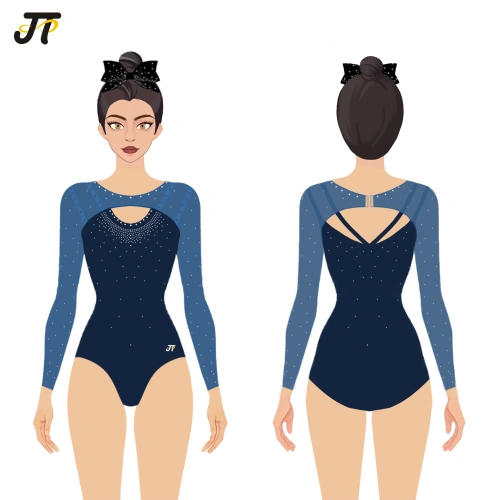
Sparkle is part of the visual language of competitive gymnastics. Rhinestone gymnastics leotards use carefully placed stones to catch arena lighting and emphasize the lines of the body. Placement is a design decision as much as a decorative one — stones can trace a neckline, follow a seam, form a club emblem, or scatter across a panel to create a sense of motion.
Mesh panels add contrast, ventilation, and visual depth. Combined with solid fabric, mesh can create a modern, layered look while keeping the garment breathable. Different fabric effects — matte, glossy, metallic, or textured — can be mixed within a single design to give it dimension.
For clubs and brands alike, branding extends beyond the garment. Custom woven labels, printed neck labels, hang tags, and packaging can all be produced to match a team's or a brand's identity. A club handing out team leotards in branded packaging creates an experience, not just a uniform. A new brand launching its first collection benefits from consistent labeling across every piece.
Perhaps the most underestimated layer of customization is sizing. A team is not a single body. It includes athletes of different heights, torso lengths, and proportions. A factory that develops its own patterns can accommodate size ranges and fit preferences that generic sizing charts cannot.
Design is one of the areas where a dedicated factory adds the most value. T&J Sportswear maintains an in-house professional design team specializing in gymnastics apparel. This means the company does more than manufacture designs supplied by customers — it can also help develop new concepts from sketches, reference images, color combinations, team identities, or brand requirements.
For clubs, this is often the difference between a good idea and a finished product. A coach may have a clear mental image of what the team should look like but no ability to translate it into a technical drawing. A parent volunteer may have collected reference photos from social media but no understanding of how those designs would behave on a moving body. A design team bridges that gap.
Reference images are a common starting point. A club might share photographs of leotards it admires, screenshots of color palettes, or examples of rhinestone layouts. The design team interprets those references, identifies the elements that actually matter, and proposes a version that fits the team's budget, timeline, and performance needs.
This interpretation step is important because a design that looks striking in a photograph may not work in practice. A back cutout that appears elegant on a still image might shift during a back handspring. A heavy rhinestone cluster might add weight where an athlete needs freedom. Experienced designers flag those issues early, before sampling costs are incurred.
Before any fabric is cut, digital artwork allows a club to see the design as a whole. Colors can be adjusted, proportions refined, and logo placements tested. Mockups reduce the risk of surprises and give club representatives something concrete to review with coaches, athletes, and boards.
Sampling is the stage where the design becomes physical. A sample reveals how the fabric drapes, how the colors read in natural light, how the rhinestones catch the eye, and how the garment fits a real athlete. For team orders, sampling is not a formality — it is the checkpoint that protects the club from committing to hundreds of units of a design that does not feel right.
At T&J Sportswear, customers can review the design, fabric, fit, decoration, and finishing during sample development before confirming mass production. That review period is where most refinements happen, and it is far less expensive to adjust a sample than to correct a finished bulk order.
A beautiful gymnastics leotard must also perform during movement. This principle guides material selection at every stage of production. The right fabric makes a leotard comfortable, durable, and visually impressive; the wrong fabric creates problems that no amount of decoration can hide.
T&J Sportswear's product range can use materials including Lycra, Spandex, Polyester, Mystique, and Mesh, depending on the design and application. Each material brings distinct characteristics, and different products can be developed for different priorities such as stretch, lightweight construction, breathability, quick drying, comfort, durability, and visual appearance.
Lycra and Spandex provide the elasticity that gymnastics apparel depends on. They allow a leotard to stretch with the body during splits, leaps, and tumbling passes, then recover its original shape. Recovery is the quality that separates a leotard that lasts a season from one that sags after a few wears.
Polyester contributes durability, color retention, and moisture management. It is frequently used in sublimated designs because it accepts dye in a way that keeps printed graphics sharp and long-lasting, even after repeated washing.
Mystique fabric offers a distinctive shimmer that reads well under competition lighting. It is often chosen for panels that need to catch the eye without the weight of additional decoration, and it pairs effectively with matte fabrics to create contrast.
Mesh adds breathability and visual texture. It is commonly used in sleeves, back panels, and side inserts, where ventilation and design interest are both valuable. Because mesh is more delicate than solid fabric, construction quality matters greatly — poorly finished mesh edges can pucker or fray, while well-executed mesh integrates seamlessly into the garment.
The priorities differ depending on the product. For training leotards, the emphasis falls on comfortable stretch, durability, moisture management, and everyday wear. These garments are worn multiple times a week, washed frequently, and subjected to repeated stress. They must hold up quietly and consistently.
For competition leotards, the emphasis shifts toward precision fit, secure coverage, decorative detail, and professional finishing. A competition leotard may be worn only a handful of times, but each of those times is highly visible. Every seam, every stone, and every edge is part of the presentation.
Competition leotards are the most demanding products in the gymnastics apparel category. They must satisfy technical requirements, withstand the scrutiny of judges and audiences, and give athletes confidence the moment they step onto the floor.
T&J Sportswear's competition leotards combine performance fabrics with creative designs, sublimation printing, rhinestones, and other decorative techniques. The company pays close attention to fabric selection, cutting, stitching, embellishment, and finishing to create eye-catching leotards that allow athletes to move confidently during competition.
A competition leotard is viewed from a distance. Judges and spectators see the overall silhouette, the balance of color, and the way light interacts with the garment. Designers therefore think in terms of bold shapes, clear contrast, and strategically placed sparkle rather than fine detail that disappears across a gymnasium floor.
At the same time, the athlete experiences the leotard from the inside. Straps that dig into the shoulders, a back that feels insecure, or a leg line that rides up can distract an athlete at the worst possible moment. Competition designs must therefore balance visual impact with security and comfort.
This is where pattern development expertise becomes critical. Small adjustments to strap width, back construction, and leg opening geometry can transform how a leotard feels, even when the design appears identical.
Rhinestones and crystal decoration are not merely ornamental. Applied thoughtfully, they emphasize the body's lines and draw attention to movement. Applied carelessly, they add weight, create visual clutter, and risk falling off. The quality of rhinestone application — the adhesive, the placement precision, and the finishing — determines whether a leotard still looks pristine after a full season of competitions.
Competition leotards attract attention, but practice leotards do the real work. A gymnast may wear a practice leotard four or five times a week, through long sessions that include conditioning, drills, and repetitions. Comfort, stretch, breathability, and durability matter more here than spectacle.
T&J Sportswear's practice gymnastics leotards focus on exactly those qualities. The company offers a wide range of colors, patterns, and styles, with customized designs available for gymnastics clubs and teams that want their training apparel to reflect the same identity as their competition wear.
Some clubs treat practice leotards as purely functional. Others recognize that consistent training apparel builds a sense of belonging. When every athlete in a training group wears the same colors and the same club mark, the group feels like a team rather than a collection of individuals.
Custom practice leotards also simplify logistics. Instead of parents hunting for suitable garments in various stores, the club provides a single approved option in the correct sizes.
Practice wear is purchased in larger quantities and replaced more often than competition wear. Clubs therefore tend to be more cost-conscious. A factory can help by proposing fabric and construction choices that keep costs reasonable without sacrificing the stretch and durability that training demands.
A team's appearance does not begin and end with the leotard. Warm-up jackets, pants, and matching apparel frame the team before and after competition. For clubs looking to build a complete team collection, T&J Sportswear also provides custom gymnastics warm-ups and matching team apparel.
Team colors, logos, patterns, labels, packaging, and other details can be customized according to requirements. This allows a club to present a coordinated image from the moment athletes arrive at a venue to the moment they leave.
Complete collections are not only for clubs. Brands and distributors often want a coherent range that includes competition pieces, training pieces, and warm-up wear. A factory that can produce all of these under consistent quality standards gives a brand a stronger foundation for its catalog.
Team orders are complicated by human variety. A single order might include athletes ranging from petite to tall, with different torso lengths and shoulder widths. A manufacturer that treats sizing as an afterthought creates problems that no design can fix.
Fit begins with patterns. Developing a pattern for gymnastics apparel requires understanding how fabric behaves when stretched, how much negative ease is appropriate, and where coverage must be preserved regardless of movement. T&J Sportswear's production team pays attention to every stage of manufacturing, from fabric selection and pattern development through cutting, sewing, printing, rhinestone application, quality inspection, and final packaging.
Many clubs provide measurements rather than relying on standard sizes. A factory that supports this approach helps clubs collect accurate information and maps it to the correct garment dimensions. Clear size sets reduce returns and exchanges, which are costly and disruptive for a team preparing for a season.
Consistency is as important as accuracy. If two leotards labeled the same size fit differently, athletes notice and parents complain. Maintaining stable workmanship across an order is a core manufacturing discipline, and it depends on consistent cutting, sewing standards, and inspection.
One of the most practical advantages a factory can offer small and growing customers is a low minimum order quantity. T&J Sportswear provides low MOQ starting from 10 sets for selected products. This gives gymnastics clubs, new brands, boutique retailers, and smaller distributors greater flexibility when testing new designs or launching new collections.
Low MOQ changes the economics of decision-making. Instead of requiring customers to commit to large quantities before they know how a design will perform in their market, a factory can support smaller initial orders and help customers gradually develop their collections.
A recreational club with forty athletes may only need twelve competition leotards in a given season. A new competitive squad may need six. Under traditional manufacturing minimums, those orders would be impossible or prohibitively expensive. Low MOQ makes custom apparel accessible to organizations that are still growing.
A new brand launching its first collection faces a different challenge: it must test designs in the market without tying up capital in inventory. Low minimums allow a brand to order a small run, evaluate sales, gather feedback, and then scale up the winners. This iterative approach is far safer than committing to a large first production run.
Distributors often want to test new styles alongside established products. Low MOQ lets them introduce variety without overcommitting warehouse space or budget.
Customization sits at the center of a manufacturing service, and it takes two common forms. T&J Sportswear supports both OEM and ODM, allowing customers to choose between producing their own designs and developing new products together with the company's team.
In an OEM arrangement, the customer arrives with a finished design — technical drawings, specifications, colors, and branding. The factory's role is to reproduce that design faithfully and consistently. This path suits established brands and clubs with clear, finalized concepts.
In an ODM arrangement, the customer brings an idea, a mood board, or a general direction, and the factory's design team helps develop it into a finished product. This path suits new brands, clubs without in-house design resources, and customers who want expert input on what will work in production.
Customization can cover artwork, colors, sublimation printing, logos, rhinestone layouts, fabric combinations, sizes, labels, packaging, and other details. The production process spans design development, fabric selection, digital artwork, printing, cutting, sewing, decoration, inspection, packaging, and delivery.
This integrated approach helps reduce communication between multiple suppliers and gives customers a more efficient path from an initial idea to a finished product. Instead of coordinating a designer, a printer, a sewer, and a packager separately, a customer works with one team that manages the entire sequence.
Capacity matters, but not in the way many buyers assume. The value of production capacity is not simply the ability to produce a large quantity. The real value is the ability to maintain consistent workmanship when moving from samples to bulk production.
T&J Sportswear's factory team includes 30+ skilled workers, with reported production capacity of 300+ leotards per day. This provides a balance between flexible customization and the ability to support larger wholesale and team orders.
Gymnastics leotards are not simple garments. They involve stretch fabrics that shift during sewing, curved seams that must lie flat against the body, and decorative elements that require a steady hand. Skilled sewers understand how tension affects fit and how small adjustments influence comfort.
Rhinestone application, in particular, is difficult to automate at high quality. Placement precision and adhesion quality depend on trained hands and careful process control.
A club that approves a sample expects the bulk order to match it. Achieving that requires discipline at every stage: the same fabric lot where possible, the same patterns, the same stitching standards, and the same inspection criteria. Capacity without consistency is of limited value.
Quality control does not begin when the finished garments are boxed. It begins before bulk production, during sample development, and continues through every stage of manufacturing.
At T&J Sportswear, customers can review the design, fabric, fit, decoration, and finishing before confirming mass production. For finished garments, key inspection points can include fabric condition, printing quality, stitching, measurements, rhinestone placement, coverage, and overall appearance.
The production process is designed to reduce these problems before they reach the customer. Inspection checkpoints catch issues while they can still be corrected rather than after shipment.
Product information lists certifications such as ISO9001, SGS, and CE for applicable products. Specific certification and testing documentation can be provided according to the product and customer requirements. For brands selling into regulated markets, this documentation supports compliance and builds buyer confidence.
Manufacturing quality is only one part of a successful supplier relationship. Clear communication and responsive service are equally important, especially for customized gymnastics apparel, where details matter and misunderstandings are costly.
From initial inquiry and design development to sampling, production, inspection, and shipment, T&J Sportswear's team provides professional support throughout the process. Customers can communicate their requirements directly and receive assistance with product development, customization, production details, and logistics.
When a club asks a question about fabric weight or rhinestone color, the answer should come from someone who knows the production floor. One-to-one service means fewer layers between the question and the answer, which shortens decision cycles and reduces the risk of errors.
Gymnastics seasons are predictable. Clubs know when competitions begin and when uniforms must be ready. A responsive manufacturer helps customers work backward from those dates, planning sampling, approval, production, and shipping so that deadlines are met without rushed compromises.
A leotard is worn for a season, but the identity it represents lasts much longer. Clubs that invest in thoughtful design create visual continuity across years. Alumni recognize the colors. New athletes understand they are joining something established.
This is where working with a manufacturing partner rather than a one-time supplier becomes valuable. A partner retains knowledge of a club's preferences, size charts, and design history. When it is time to refresh a design, that institutional memory shortens the process considerably.
Strong team identities are rarely complicated. A distinctive color combination, a consistent logo placement, and a recognizable silhouette do more than a dozen competing elements. Factories experienced in gymnastics apparel can advise on which choices will read clearly in a competition setting.
Teams often want to modernize their look without abandoning their history. A factory can help strike that balance, preserving core colors and emblems while updating cuts, fabrics, and decorative techniques.
Different customers need different things from a leotard factory, and a capable manufacturer adapts accordingly.
Clubs need accurate sizing, dependable delivery, and designs that reflect their identity. They value guidance through the design process and clear communication about timelines and costs. Many clubs also appreciate low minimums, since team sizes vary from year to year.
Brands need consistent quality, reliable production, and support with design and development. They often want OEM or ODM services, custom labeling, and packaging that reflects their market positioning. A factory that can grow with a brand — from a small first collection to regular production — becomes a long-term asset.
Wholesalers and distributors need repeatable quality across larger volumes, competitive pricing, and dependable scheduling. They benefit from a manufacturer with the capacity to handle bulk orders without sacrificing the consistency that their own customers expect.
Buyers with existing supply chains sometimes look for a second source or a more flexible partner. A factory with 10+ years of industry experience, 36+ countries served, 30+ skilled workers, 300+ daily leotard capacity, low MOQ, professional design support, OEM/ODM customization, and one-to-one service offers a combination of capability and flexibility that suits a wide range of situations.
Experience across thousands of orders reveals patterns. Certain mistakes appear repeatedly, and most of them are avoidable with better planning.
Custom production involves design, sampling, approval, and manufacturing. Clubs that begin the process a few weeks before a competition often face compromises. Starting a season ahead allows time for thoughtful design and relaxed review.
Some customers approve samples without careful review, assuming the bulk order will look the same. In reality, the sample is the last opportunity to catch issues before they are multiplied across an entire order. Reviewing fit, color, and decoration at the sample stage protects the club.
A striking design that fits poorly will not perform. Athletes need garments that stay in place, provide coverage, and allow full range of motion. Fit should be evaluated alongside appearance.
Collecting accurate measurements early prevents last-minute scrambles. A team with a wide range of body types benefits from a manufacturer experienced in pattern development and grading.
Price matters, but the lowest quotation is not always the lowest cost. A leotard that fades, loses its shape, or sheds rhinestones creates replacement expenses and disappointed athletes. Evaluating quality, communication, and reliability alongside price produces better long-term value.
Understanding the sequence of a custom order helps clubs plan with confidence. While timelines vary by complexity and quantity, the general flow is consistent.
The club shares its ideas, colors, references, and requirements. The factory's design team reviews the information and proposes directions, asking clarifying questions about fit preferences, performance needs, and budget.
Artwork and mockups are prepared. Colors are refined, logos placed, and design elements balanced. The club reviews and requests adjustments until the concept is approved.
A physical sample is produced. The club examines fabric, fit, decoration, and finishing, and provides feedback. Revisions are made if necessary.
Once the sample is approved, production begins. Fabric is selected and cut, garments are sewn, printing and rhinestone application are completed, and each piece moves through inspection.
Finished garments are checked for measurements, stitching, print quality, decoration security, and overall appearance. They are then labeled, packaged according to the customer's requirements, and prepared for shipment.
The order is shipped to the club, brand, or distributor, with communication maintained throughout the process so customers know what to expect and when.
A supplier completes orders. A partner helps customers succeed. The distinction becomes clear over time, as a relationship develops and both sides learn from each other.
T&J Sportswear's goal is to build long-term partnerships rather than simply complete individual orders. Whether a customer is a gymnastics club developing team uniforms, a new brand launching a collection, a distributor expanding a product range, or an established buyer looking for a reliable manufacturing partner, the company provides flexible solutions based on requirements.
A club that orders twelve leotards this year may order fifty in three years. A brand that launches with one style may develop a full catalog. A distributor that tests a single product line may expand into several. A manufacturing partner that supports those transitions becomes part of the customer's growth story.
Quality and consistency are important throughout the production process. Stable workmanship and careful inspection before shipment are the foundation of reliable supply. The objective is not only to manufacture gymnastics apparel, but also to build long-term partnerships through dependable products and responsive service.
For clubs, reliability means uniforms arrive on time and fit as expected. For brands, it means customers receive products that match the catalog. For distributors, it means repeat orders perform like the first one. In every case, reliability is built through process discipline rather than promises.
From fabric selection and pattern development to cutting, sewing, printing, rhinestone application, quality inspection, and final packaging, every stage contributes to the finished result. A weakness at any point shows up in the garment. That is why a specialized factory treats the entire sequence as one continuous quality system.
The result is a range of products suitable for demanding training sessions and high-level competitions. Practice leotards that withstand daily wear, competition leotards that perform under the spotlight, warm-ups that complete the look, and custom team apparel that brings everything together.
Gymnastics is a demanding sport, and its apparel requirements are correspondingly specific. Factories that specialize in this category develop knowledge that general manufacturers rarely accumulate.
Designers and pattern makers who work with gymnastics apparel understand how a leotard moves during a giant swing on bars, a tumbling pass on floor, or a vault run. They know where fabric tension concentrates, where coverage is vulnerable, and where decoration interferes with performance.
They also understand how garments read from a distance, how lighting affects color and sparkle, and how small design choices influence the overall impression a team makes.
Finally, they understand the business realities their customers face: tight seasonal deadlines, budget constraints, fluctuating team sizes, and the need for dependable communication. A specialized factory operates at the intersection of craft and commerce.
Clubs, brands, and distributors evaluating manufacturers can use a practical checklist to compare options.
A manufacturer that satisfies most of these criteria is well positioned to become a long-term partner rather than a transactional supplier.
The gymnastics apparel market continues to evolve. Clubs are more design-conscious than ever. Brands are launching with smaller, more focused collections. Distributors are looking for flexibility rather than pure volume. Athletes and parents expect garments that perform as well as they look.
These trends favor manufacturers that combine design capability, flexible minimums, consistent quality, and responsive service. A factory that can move from a six-piece order to a several-hundred-piece order without changing its standards is positioned to serve the full spectrum of the market.
Sublimation printing continues to expand what is possible, allowing increasingly intricate graphics. Rhinestone layouts grow more sophisticated, with designers using stones to create gradients, lines, and patterns rather than simple accents. Mesh and mixed-fabric constructions add dimension and breathability.
Customers increasingly value transparency and communication. They want to know where their garments are made, how quality is controlled, and what happens if something goes wrong. Factories that invest in clear processes and documentation stand out.
A gymnastics leotard factory delivers far more than garments. It delivers design capability, technical expertise, production capacity, quality control, and a relationship that helps teams and businesses grow.
T&J Sportswear is a professional gymnastics apparel manufacturer specializing in custom gymnastics leotards and teamwear for clubs, teams, brands, wholesalers, and distributors worldwide. With more than 10 years of manufacturing experience, the company provides reliable quality, flexible customization, and professional service for customers in the US, Europe, and other international markets.
Its main products include competition gymnastics leotards, practice gymnastics leotards, custom team leotards, rhinestone gymnastics leotards, and gymnastics warm-up wear. From everyday training to competition performances, these products are designed to provide a comfortable fit, excellent flexibility, and a professional appearance.
With experienced production capabilities, professional design support, flexible customization, and a customer-focused approach, T&J Sportswear is committed to being a dependable gymnastics apparel manufacturing partner for customers around the world. From a first idea to the final leotard, the company works to make custom gymnastics apparel more efficient, flexible, and reliable.
For clubs, that means uniforms their athletes are proud to wear. For brands, it means a production partner that can grow with them. For distributors, it means dependable supply. For everyone involved, it means the confidence that comes from working with a factory that understands gymnastics — not just apparel.
