A competition gymnastics leotard has to satisfy two demanding sets of requirements at once. It must fit like a second skin, stretching and recovering through extreme ranges of motion without riding up, pinching, or restricting the athlete. It must also deliver visual presence, reading clearly under arena lighting through color, contrast, sublimation graphics, mesh panels, specialty fabrics, and rhinestone decoration. The balance between fit and flash is not a marketing concept but a manufacturing discipline, shaped by pattern development, fabric selection, construction methods, decoration technique, and consistent quality control. Fit is created primarily through pattern development, where panels are mapped to the way fabric stretches across the body during specific skills. Fabric behavior, including stretch percentage and recovery, determines whether a garment holds its shape over time. Sizing systems vary between markets such as North America and Europe, so manufacturers that serve international customers must work comfortably with multiple charts and custom sizing. Flash comes from design language: sublimation printing that moves with the fabric, rhinestone layouts that catch the light, mesh for depth and breathability, and metallic or pearlescent surfaces that shift under different lighting angles. Every decorative choice carries a functional consequence, which is why the best designs treat embellishment as part of the garment architecture rather than an afterthought. Quality control protects both halves of the equation. Inspection of fabric condition, printing quality, stitching, measurements, rhinestone adhesion, coverage, and overall appearance prevents the problems that undermine team orders, such as inconsistent sizing or detached decoration. Specialized experience matters because gymnastics apparel requirements differ from general sportswear, and a manufacturer that has focused on competition and training leotards for more than a decade has learned how designs behave across seasons and markets. For clubs, brands, and distributors, the practical takeaway is that fit and flash should never be treated as competing priorities. They are two halves of the same requirement. Manufacturers that combine design capability, disciplined production, flexible customization, low minimum order quantities, and responsive communication are the ones able to deliver competition leotards that perform in the routine and stand out on the floor.
A competition gymnastics leotard is one of the most demanding garments in all of sportswear. It is asked to stretch in four directions at once, hold its shape through hundreds of hours of wear, remain securely in place during a tumbling pass, survive repeated washing and handling, and still look striking enough to be read clearly from the back row of an arena. Very few pieces of apparel are expected to deliver so much simultaneously, and very few garments fail so visibly when a single element is neglected. When a leotard rides up during a leap, the athlete thinks about the garment instead of the routine. When a leotard looks flat under competition lighting, a team loses a small but real part of its presence. That is why the phrase fit and flash is not a marketing slogan but a genuine engineering problem that every gymnastics apparel manufacturer has to solve, order after order, season after season.
For gymnasts, coaches, clubs, and apparel brands, the competition leotard sits at the intersection of performance equipment and stage costume. It is a piece of sportswear that must behave like a second skin, and a piece of visual design that must communicate identity, discipline, and confidence in the space of a few seconds. Understanding why both halves of that equation matter, and how they interact, helps buyers make better decisions and helps manufacturers build better products.
Every time a gymnast walks onto the competition floor, two judgments happen almost simultaneously. The first is physical and internal. The athlete feels whether the leotard pulls, twists, pinches, or slides. She notices whether the straps stay where they should, whether the leg openings cut in during a split, whether the fabric breathes during a long warm-up. This internal judgment shapes confidence, and confidence shapes performance.
undefined
The second judgment is visual and external. Judges, spectators, coaches, and cameras register color, silhouette, sparkle, and contrast. A well-designed competition leotard helps the athlete stand out in a crowded rotation, supports the lines of the body, and reinforces a team identity that spectators can recognize instantly. That visual judgment does not change a score directly in most codes, but it shapes the perception of the program, the atmosphere of the arena, and the pride of the athlete wearing it.

These two judgments are not independent. A garment that looks spectacular but restricts movement undermines the first judgment. A garment that fits perfectly but reads as plain or dull under competition lighting weakens the second. The best competition leotards are the ones where neither side of the equation is sacrificed for the other, and achieving that balance requires deliberate decisions at every stage of development.
In everyday clothing, fit is often treated as a simple question of small, medium, or large. In gymnastics apparel, fit is a much more complex concept. A competition leotard must maintain contact with the body without restricting it, compress slightly for support without creating pressure points, and return to its original shape after extreme elongation. It must also accommodate the enormous range of motion that defines the sport, from a full split to a deep arch to a tightly tucked salto.
Because of this, fit is really the product of three connected elements: pattern development, fabric behavior, and sizing accuracy. If any one of them is weak, the garment will feel wrong even if the other two are excellent.
Pattern development is where fit is truly created. A competition leotard pattern is not simply a scaled-down version of a training garment. It is a carefully mapped set of panels that accounts for how fabric stretches across the chest, how it compresses around the waist, how it behaves at the hip and leg opening, and how much negative ease is required so that the garment stays in place during dynamic movement.
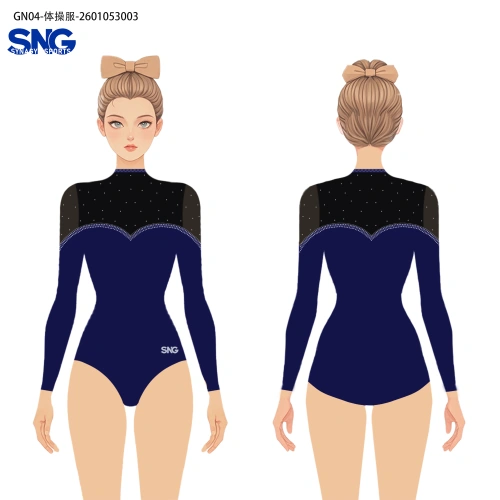
Different events place different demands on the garment. A floor routine involves repeated impacts and wide leg positions. A beam routine demands stability and a snug torso so that nothing shifts during a turn. Bars place enormous stress on the shoulder and upper chest area, where the fabric must stretch without pulling the athlete forward. Vault requires an explosive range of motion in a very short time. A well-developed pattern anticipates all of these and distributes stretch intelligently rather than uniformly.
Manufacturers with long experience in gymnastics apparel typically maintain a library of proven blocks and adjust them for each new design, rather than starting from scratch. This is one reason why specialization matters. A general sportswear supplier may produce technically competent garments, but the specific requirements of gymnastics, including stretch direction, coverage, and freedom of movement, are learned through years of focused production rather than through general capability alone.
Fit becomes even more complicated when a manufacturer serves multiple countries. Sizing expectations differ between North America and Europe, and even between clubs within the same region. Some teams prefer a tighter, more compressive feel, while others prioritize a softer, more relaxed fit. Some organizations use child sizing with specific growth allowances, while others use adult sizing with narrower ranges.
A manufacturer that works across many markets has to be comfortable operating with multiple sizing systems and with custom size charts. This is not a small detail. A competition leotard that fits correctly in one market may be judged as too tight or too loose in another, even though the physical garment is identical. Understanding those differences, and building them into pattern development from the beginning, is part of what separates a reliable supplier from a generic one.

Each of these details is small on its own. Together, they determine whether a gymnast forgets about the leotard entirely, which is exactly what good fit should achieve.
If fit is the technical half of the equation, flash is the emotional half. Competition leotards are worn in large, brightly lit spaces, often in front of cameras, and they need to communicate at a distance. Flash is not simply decoration. It is a design language that includes color, contrast, silhouette, texture, and embellishment, and it serves a practical purpose: helping the athlete and the team be seen and remembered.
Sublimation printing has become one of the most important tools in competition leotard design. Because the dye is transferred into the fabric rather than sitting on top of it, sublimated graphics do not crack, peel, or add weight. This allows designers to create complex gradients, geometric patterns, animal-inspired motifs, and detailed team graphics that move with the fabric and stretch without breaking.
Sublimation also allows for precise color matching across a team order. When a club orders thirty leotards in its official colors, consistency matters. A printed panel that varies slightly from garment to garment is immediately noticeable on the competition floor, especially when the team lines up together.
Rhinestone work is one of the most visible forms of flash in gymnastics apparel. Applied along seams, across the chest, around the neckline, or in scattered patterns that follow the body lines, rhinestones catch arena lighting and create a sense of movement even when the athlete is standing still. For many clubs, a rhinestone layout is part of the team identity, and it is often carried across multiple seasons.
Rhinestone application is also one of the most demanding stages of production. Placement must be consistent, adhesion must be reliable, and the final pattern must be symmetrical. A single misplaced stone can distort a design, and a poorly bonded stone can detach during a routine. Because of this, rhinestone work is a quality control issue as much as a design issue, and it deserves the same attention as stitching or measurement accuracy.
Beyond print and stone, flash also comes from fabric itself. Mesh panels create depth and contrast while adding breathability. Mystique and similar specialty fabrics offer a metallic or pearlescent surface that shifts under different lighting angles, producing a strong visual effect without any added weight. Combining these materials with matte fabrics creates contrast that highlights the body lines and the structure of the design.
The challenge is that every decorative choice has a functional consequence. Mesh must be placed where it does not compromise coverage. Metallic fabrics may have different stretch characteristics than the base fabric, which affects fit if the pattern is not adjusted accordingly. The best designs treat decoration as part of the garment architecture rather than as an addition applied at the end.
The reason the fit and flash balance is genuinely difficult is that the two priorities sometimes pull in opposite directions. Decorative elements add weight and stiffness. Complex paneling creates more seams, and more seams create more opportunities for fit problems. Heavy rhinestone coverage can make a garment less flexible in the areas where flexibility matters most. Tight, compressive fits that stay securely in place during tumbling can feel restrictive if the fabric is not selected properly.
Resolving this tension is a design and manufacturing exercise rather than a purely aesthetic one. It requires asking practical questions early: Where will the athlete stretch the most? Which areas can carry decorative weight without affecting movement? Which fabric combinations stretch at compatible rates? Which rhinestone placements will survive a full season of competition?
Manufacturers that serve both competition and training markets tend to develop strong instincts here, because they see how the same design decisions play out across different levels of the sport. A design that works beautifully for a photographed elite routine may be impractical for a club team competing six weekends in a row, and a design that performs flawlessly in training may need additional visual punch to work on the competition floor.
Fabric is the single biggest lever in the fit and flash balance. Stretch percentage, recovery, weight, opacity, breathability, and surface finish all influence how a leotard performs and how it looks. Common materials in gymnastics apparel include Lycra, Spandex, Polyester, Mystique, and Mesh, and each brings different strengths.
The right choice depends on the priority. For practice leotards, the emphasis usually falls on comfortable stretch, durability, moisture management, and everyday wearability. For competition leotards, the emphasis shifts toward precision fit, secure coverage, decorative detail, and professional finishing. A manufacturer that understands both categories can advise customers on which fabrics support their specific goals rather than simply offering whatever is easiest to produce.
Understanding the production sequence helps explain why the fit and flash balance is not a single decision but a series of them. In a well-organized manufacturing process, each stage influences the next, and problems caught early are far less expensive than problems discovered after bulk production.
When these stages are handled under one roof, the fit and flash balance is easier to protect. When they are split across multiple suppliers, miscommunication becomes more likely, and small inconsistencies accumulate. This is one practical argument in favor of working with a specialized gymnastics apparel manufacturer rather than assembling a supply chain from generalist vendors.
Quality control is where the promise of fit and flash either holds or collapses. A beautiful sample means very little if the bulk order arrives with inconsistent sizing, faded prints, or rhinestones that fall off after two washes. Reliable manufacturers therefore treat quality control as a continuous process rather than a final checkpoint.
During sample development, customers can review design, fabric, fit, decoration, and finishing before confirming mass production. This stage is critical because it is the last point at which changes are inexpensive. Once bulk production begins, adjustments become far more costly and time consuming.
For finished garments, key inspection points typically include fabric condition, printing quality, stitching integrity, measurement accuracy, rhinestone placement and adhesion, coverage, and overall appearance. The purpose is to prevent the most common and most frustrating problems: inconsistent sizing between garments, printing defects, loose decoration, and uneven finishing. In a team order, where dozens of athletes stand side by side, these issues become immediately visible.
Documentation also matters for many buyers. Certifications such as ISO9001, SGS, and CE are often requested for applicable products, and specific testing documentation can be provided according to product and customer requirements. For clubs, brands, and distributors selling into regulated markets, this documentation supports both confidence and compliance.
One of the clearest illustrations of the fit and flash balance is the difference between practice leotards and competition leotards. Both must fit well, but they optimize for different outcomes.
Clubs that build a complete collection, with coordinated competition leotards, practice leotards, and warm-ups, often find that the visual identity becomes stronger and the purchasing process becomes simpler. Colors, logos, patterns, labels, and packaging can be aligned across the entire range.
Competition leotards are rarely purchased as single units. They are purchased as team uniforms, which means consistency becomes a defining requirement. Every athlete in the squad should look like part of the same program, whether the team has eight members or eighty.
Consistency applies at several levels. Color must match across garments. Print placement must align so that the design reads the same way on different body types. Rhinestone layouts must be uniform. Sizing must be predictable so that athletes who wear the same size in training also wear the same size in competition. Logos and branding elements must be positioned and scaled correctly on every piece.
Achieving this level of consistency requires disciplined production rather than artistic improvisation. It also requires clear communication between the customer and the manufacturer, since team identities often involve specific colors, logo files, and design references that must be interpreted accurately.
Increasingly, clubs and brands think beyond the leotard itself. Warm-ups, jackets, pants, and matching team apparel extend the visual identity and give athletes something to wear during the long hours before and after competition. From a design perspective, this creates an opportunity to carry colors, patterns, and branding across an entire collection rather than treating each item separately.
For clubs, a coordinated collection projects professionalism and makes the team instantly recognizable. For brands, it creates a more complete product offering that customers can buy as a set rather than assembling from multiple sources. Team colors, logos, patterns, labels, and packaging can all be customized to reinforce the same identity.
Customization is central to competition leotard development, because very few teams want to wear a stock design. Most customers arrive with a direction, whether that is a sketch, a reference image, a color palette, a team logo, or simply an idea about how they want the team to look.
Manufacturers typically support two models. Under OEM, the customer provides a design and the manufacturer produces it. Under ODM, the manufacturer contributes to the design process, helping develop concepts from initial ideas, sketches, or reference images into finished garments. Many customers use a combination of both, starting with a rough concept and relying on the manufacturer for artwork development and product optimization.
Customization can cover artwork, colors, sublimation printing, logos, rhinestone layouts, fabric combinations, sizing, labels, packaging, and other details. A fully integrated process, from design development and fabric selection through printing, cutting, sewing, decoration, inspection, packaging, and delivery, reduces the coordination burden on the customer and shortens the path from concept to finished product.
Design capability matters here. A manufacturer that only executes instructions can produce a garment, but a manufacturer with an in-house design team can improve a concept, suggest fabric combinations that enhance both fit and appearance, and identify potential problems before they reach production. For new brands launching a first collection, this kind of support can be the difference between a product that sells and one that stalls.
One practical barrier to developing custom competition leotards is order volume. Traditional manufacturing often requires large minimum quantities, which puts new designs out of reach for smaller clubs, boutique retailers, and emerging brands. Low minimum order quantities, sometimes starting from as few as ten sets for selected products, change that calculation entirely.
Low MOQ allows clubs to outfit a single squad without overcommitting. It allows new brands to test a design in the market before placing a large production order. It allows boutique retailers and smaller distributors to build a curated range rather than stocking inventory they cannot sell. In each case, the flexibility reduces financial risk and encourages experimentation.
For the manufacturer, low MOQ requires efficient production planning, which is why experience and capacity matter. A factory with established processes can accommodate small orders without sacrificing quality, while a less organized operation may struggle to maintain consistency when order sizes vary widely.
Capacity is often discussed in terms of daily output, but the more important question is whether consistency survives the transition from sample to bulk. A team of skilled workers and a well-structured production line make it possible to produce hundreds of leotards per day while maintaining stable workmanship across the entire run.
Consistency depends on several factors: standardized patterns, controlled fabric sourcing, calibrated equipment, trained operators, and inspection at multiple points. When these elements are in place, the tenth leotard in an order looks like the first, and the hundredth looks like the tenth. When they are not, customers receive a shipment where every garment is slightly different, and no amount of visual flash can compensate for that.
This is also why experience in a specific category matters. A manufacturer with more than a decade of focused work in gymnastics apparel has seen how designs behave across seasons, how fabrics perform after repeated washing, and how sizing expectations differ between markets. That accumulated knowledge is not easily replicated by a general supplier entering the category for the first time.
When evaluating a gymnastics apparel manufacturing partner, buyers can use a short set of questions to separate capable suppliers from those that simply look capable.
These questions are practical rather than theoretical. They reveal whether a manufacturer understands that a competition leotard is a performance product first and a visual product second, and that the two cannot be separated.
Certain problems appear repeatedly across the industry, and most of them trace back to an imbalance between fit and flash.
Avoiding these mistakes requires a manufacturer willing to ask questions and a customer willing to invest time in the development stage. The payoff is a garment that performs, lasts, and looks the way the team intended.
For clubs, brands, and distributors, the practical question is not whether fit and flash can coexist, but who can reliably deliver both. That requires a partner with specialized experience, in-house design support, disciplined production, and a genuine understanding of how gymnastics apparel is used.
A manufacturer with more than ten years of focused experience in gymnastics apparel, a customer base spanning more than thirty-six countries, an in-house design team, a skilled production workforce, and a daily leotard capacity measured in hundreds is positioned to handle both the technical and the visual sides of development. Add low minimum order quantities, flexible OEM and ODM services, and one-to-one communication, and the model becomes accessible to a wide range of customers, from a growing club ordering custom team uniforms to an established distributor requiring regular production.
That combination is not accidental. It reflects an understanding that gymnastics apparel has to satisfy two very different sets of requirements at the same time, and that the most successful products are the ones where neither requirement is treated as secondary.
The phrase fit and flash sometimes suggests a trade-off, as if a leotard must choose between performing well and looking spectacular. In practice, the strongest competition leotards treat the two as partners. Good fit creates the confidence that allows an athlete to perform freely. Strong visual design creates the presence that makes a performance memorable. Together, they produce a garment that disappears into the routine while making the routine look better.
Achieving that balance is a manufacturing discipline, built on pattern development, fabric selection, precise construction, disciplined decoration, and consistent quality control. It is also a partnership discipline, built on clear communication between the customer and the manufacturer from the first sketch to the final shipment.
For clubs building a team identity, for brands launching a collection, and for distributors expanding a product range, the lesson is straightforward. Fit and flash are not competing priorities to be negotiated. They are the two halves of the same requirement, and the manufacturers who understand that are the ones whose competition leotards look right, feel right, and hold up long after the season ends.
