A rhythmic gymnastics leotard needs more than sparkle because the sport demands extreme movement, fit, coverage, and durability. A beautiful design cannot compensate for poor fabric, weak stitching, or unstable pattern development. Athletes need garments that stretch and recover, breathe, stay in place, and feel comfortable through long training sessions and high-pressure competitions. Key considerations include fabric selection, pattern grading, seam construction, elastic tension, rhinestone application, and quality control. Training leotards prioritize comfort and durability, while competition leotards balance visual impact with precision fit and secure coverage. Custom team leotards also require consistency across sizes, colors, logos, and decoration. Manufacturers such as T&J Sportswear bring more than 10 years of experience, in-house design support, OEM and ODM services, low MOQ from 10 sets, skilled production capacity of more than 300 leotards per day, and a focus on quality inspection. The company serves customers in more than 36 countries, including the US and Europe, and works with clubs, teams, brands, wholesalers, and distributors. The best leotards are built from the inside out. Sparkle is the finish, but performance is the foundation. By evaluating fabric, fit, construction, and decoration together, clubs and brands can choose leotards that help athletes feel confident and perform at their best.
Rhythmic gymnastics is a sport where visual elegance and athletic precision meet. A leotard catches the light, follows the line of the body, and becomes part of the choreography. For many spectators, the first thing they notice is the sparkle. Rhinestones, crystals, foil fabrics, and bright color combinations create a memorable stage presence. However, a rhythmic gymnastics leotard cannot survive on sparkle alone. If the garment pulls, twists, rides up, restricts the shoulders, or loses its shape after one competition, the athlete cannot perform with confidence. The best leotards are built from the inside out. They combine fit, stretch, coverage, durability, breathability, and construction before decoration is added. This article explains why a rhythmic gymnastics leotard needs more than sparkle, and what clubs, coaches, brands, and manufacturers should consider when developing apparel for one of the most demanding aesthetic sports in the world.
Sparkle is easy to sell. A photograph of a rhinestone-covered leotard can stop a scrolling viewer. A video of a gymnast under competition lights can make the garment look magical. But photographs do not show how a shoulder seam behaves when an athlete raises both arms into a backbend. They do not reveal whether the crotch stays in place during a leap, whether the fabric becomes transparent under stress, or whether the rhinestones begin to fall after the first wash. The first impression problem is that decoration often receives more attention than engineering. A leotard is not a costume. It is a piece of performance equipment. It must move with the body, support the body, and protect the athlete from distraction. Sparkle can enhance a routine, but it cannot compensate for poor fit, weak stitching, or unstable fabric.
Many clubs and brands learn this lesson after they order a beautiful sample that performs poorly in real training. The sample may look correct on a mannequin or in a still photo, but once an athlete begins to move, the problems appear. The neckline may gape. The leg opening may cut. The bodice may slide upward. The sleeves may restrict rotation. The rhinestones may feel heavy or scratchy. These issues are not minor. They affect the athlete's ability to focus, to breathe, and to execute complex elements with confidence. A rhythmic gymnastics leotard needs more than sparkle because the sport itself demands more than appearance.
Rhythmic gymnastics combines ballet, dance, acrobatics, and apparatus handling. Athletes perform with rope, hoop, ball, clubs, and ribbon. They leap, turn, balance, bend, and extend through extreme ranges of motion. The shoulders rotate. The spine arches. The hips flex and extend. The legs split and rise. The arms move continuously. Every movement places demands on the leotard. The garment must stretch in multiple directions without losing its shape. It must return to its original position without sagging. It must stay close to the body without restricting circulation or breathing. It must remain opaque where coverage is required. It must feel light enough to be forgotten, yet strong enough to survive repeated use.
undefined

Unlike many sports where uniforms are loose or layered, rhythmic gymnastics apparel is close-fitting. This closeness is necessary for judges and audiences to see body lines, but it also means that every design decision is magnified. A small error in pattern development becomes a visible pull line. A weak elastic becomes a distraction during a pivot. A rough seam becomes a source of discomfort during a long routine. A heavy crystal arrangement can alter balance or create an uneven drape. The athlete cannot adjust the leotard in the middle of a performance. Therefore, the garment must be correct before the athlete steps onto the floor.
During a routine, a leotard must perform several jobs at once. It must allow freedom of movement in the shoulders, spine, hips, and legs. It must maintain coverage at the neckline, armholes, back, and leg openings. It must support the body without compressing it. It must manage moisture and heat. It must hold decorative elements securely. It must resist twisting and riding up. It must look consistent from the first second to the final pose. These requirements are not separate from design. They are the design. A leotard that only looks good in a photograph is incomplete. A leotard that performs well but looks dull may fail to express the artistry of the sport. The goal is balance. Performance and appearance must work together.
This balance is why experienced manufacturers treat leotard development as a technical process, not a fashion exercise. Fabric selection, pattern drafting, grading, stitching, elastic choice, rhinestone application, and finishing all influence the final result. A change in one area can affect another. For example, a heavier fabric may provide better coverage but reduce stretch. A lighter mesh may improve breathability but require careful reinforcement. A larger rhinestone may create more sparkle but add weight and reduce flexibility. A tighter fit may improve line but increase the risk of discomfort. Good manufacturing is about managing these trade-offs.
Fabric is the foundation of every leotard. It determines how the garment feels, moves, breathes, and lasts. Rhythmic gymnastics leotards commonly use materials such as Lycra, Spandex, Polyester, Mystique, and Mesh. Each material has different properties. Lycra and Spandex provide stretch and recovery. Polyester offers durability and color retention. Mystique creates a shiny, metallic look that is popular in competition designs. Mesh adds breathability, lightness, and visual texture. The best leotards often combine several fabrics to achieve the right balance of performance and appearance.
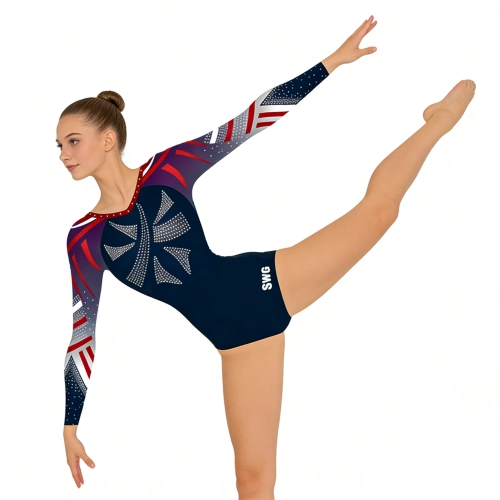
However, fabric names alone do not guarantee quality. Two fabrics with the same generic description can behave very differently depending on weight, stretch percentage, recovery, and finish. A manufacturer must understand how each fabric interacts with the body during movement. A fabric that feels soft in the hand may lack enough recovery to prevent sagging. A fabric that looks brilliant under stage lights may become transparent when stretched. A fabric that is comfortable in a sample may become hot during a full routine. These details matter. T&J Sportswear, a professional gymnastics apparel manufacturer with more than 10 years of experience, pays close attention to fabric selection because the company understands that performance begins before the first stitch.
Lycra and Spandex are essential for close-fitting gymnastics apparel. They allow the leotard to stretch with the body and return to its original shape. Good recovery is critical. Without it, the leotard may become loose after a few minutes of movement. It may sag at the seat, wrinkle at the waist, or gap at the neckline. Recovery also affects durability. A leotard that loses its elasticity quickly will not survive a full season of training and competition. When evaluating stretch fabrics, manufacturers consider elongation, modulus, and recovery. These technical details determine how the leotard feels and performs.
Polyester is often used for its strength, colorfastness, and resistance to stretching out. It can be blended with Spandex to create a fabric that holds its shape while still allowing movement. Polyester also accepts sublimation printing well, which makes it useful for custom team designs. Sublimation allows colors and patterns to become part of the fabric rather than sitting on top of it. This can reduce the risk of cracking or peeling. For clubs that need consistent team colors across many leotards, polyester blends can be an excellent choice.
Mystique fabric is known for its metallic, glossy appearance. It reflects light and creates a dramatic effect on stage. However, Mystique must be handled carefully. It can be less breathable than some other fabrics, and it may show creases or stress marks if the fit is incorrect. A skilled manufacturer uses Mystique strategically, often combining it with stretch mesh or other fabrics to maintain comfort. The goal is to use shine as an accent, not as a compromise.
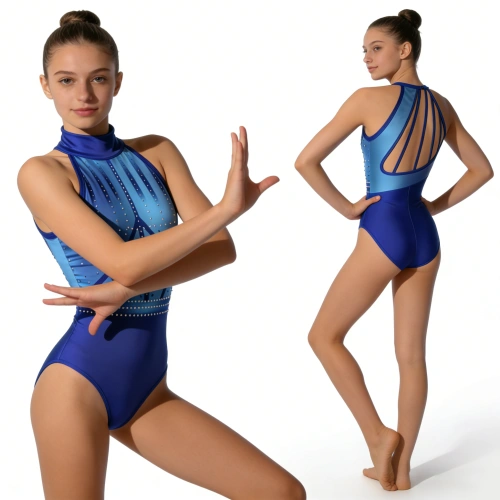
Mesh is frequently used in sleeves, side panels, back designs, and inserts. It adds breathability and reduces weight. It can also create a modern, airy look. However, mesh must be chosen with care. Some mesh fabrics are delicate and can tear if not reinforced. Others may not provide enough coverage. The placement of mesh is just as important as the mesh itself. A well-placed mesh panel can improve ventilation and add elegance. A poorly placed panel can create coverage problems or an awkward fit.
Pattern development is where art and engineering meet. A leotard pattern must translate a two-dimensional design into a three-dimensional garment that fits a moving body. This is not a simple task. Bodies are not flat. They curve, taper, and stretch. Rhythmic gymnasts often have specific physical characteristics, including long limbs, flexible shoulders, and strong cores. A pattern that works for one athlete may not work for another. Grading, which is the process of scaling a pattern across sizes, must preserve the intended fit and function. If grading is done poorly, a design that fits a sample size may become uncomfortable or unstable in other sizes.
Good pattern development considers armhole depth, shoulder slope, torso length, hip curve, leg opening angle, and neckline shape. It also considers how the fabric will behave when stretched. A pattern that looks correct on paper may pull in unexpected directions when sewn in a stretch fabric. For this reason, sampling and fitting are essential. Manufacturers who specialize in gymnastics apparel understand these nuances. They know that a leotard is not a scaled-down dress. It is a specialized garment with unique requirements.
Stitching is often invisible to the audience, but it is critical to performance. A rhythmic gymnastics leotard undergoes constant tension. Seams must stretch without breaking. They must lie flat against the skin without creating bulk or irritation. They must be strong enough to hold rhinestones, mesh, and other decorations. Different seams require different techniques. Flatlock stitching can provide stretch and comfort. Overlock stitching can secure edges. Reinforced stitching can add durability at stress points. The choice of stitch depends on the fabric, the design, and the intended use.
Construction also includes elastic application. Elastics at the leg openings, armholes, and neckline must be soft, durable, and correctly tensioned. If the elastic is too tight, it can dig into the skin. If it is too loose, the leotard may gap or shift. The elastic must be covered or finished in a way that feels comfortable against the body. This is especially important for athletes who wear the leotard for long training sessions or multiple competition routines. T&J Sportswear focuses on every stage of manufacturing, from cutting and sewing to decoration and inspection, because small construction details determine whether a leotard is merely attractive or truly performance-ready.
Coverage is a sensitive subject in gymnastics apparel. Athletes need to feel secure. Coaches need to know that the leotard will not shift inappropriately during movement. Parents need to trust that the garment is appropriate for young athletes. Judges and audiences should be able to focus on the performance, not on wardrobe adjustments. Good coverage is not about making a leotard conservative. It is about engineering the garment so that it stays in place. This requires careful pattern design, appropriate fabric selection, and secure finishing.
Key coverage areas include the neckline, armholes, back, and leg openings. A leotard may look fine when standing still, but when the athlete raises her arms, bends backward, or performs a split, the fabric may move. Mesh inserts can be beautiful, but they must be placed where they do not create transparency under stretch. Low backs can be elegant, but they must not compromise support. Leg openings must be cut at the correct angle to allow movement without cutting into the hip or exposing more than intended. These are technical decisions that require experience. A manufacturer who understands rhythmic gymnastics will know how to balance design ambition with practical security.
Rhinestones and crystals are signature elements of many rhythmic gymnastics leotards. They catch light, add dimension, and make the athlete stand out on stage. However, decoration must be treated as part of the garment, not as an afterthought. The weight, placement, and application method all matter. Heavy stones can distort the fabric. Poorly placed stones can restrict movement. Weak adhesive can cause stones to fall off during a routine. Sharp edges can scratch the skin. A beautiful crystal design that fails in competition is not a success.
Professional rhinestone application requires precision. The layout must be planned to complement the body lines and the design. The adhesive or setting method must be appropriate for the fabric. The stones must be secured so they can withstand movement, heat, and moisture. In some cases, stones are applied by hand. In other cases, they are applied using templates or machinery. The method depends on the design, quantity, and fabric. T&J Sportswear offers rhinestone gymnastics leotards and pays attention to decoration as part of its overall quality control. The company understands that sparkle should enhance performance, not interfere with it.
Stretch and support are often seen as opposites. Too much stretch can make a leotard feel loose. Too much support can make it feel restrictive. The ideal leotard finds a balance. It stretches where the body needs to move and supports where the body needs stability. This balance is achieved through fabric choice, pattern design, and construction. For example, a leotard may use a firmer fabric in the bodice for support and a softer mesh in the sleeves for flexibility. It may use a higher Spandex content in areas that need recovery and a more stable knit in areas that need structure.
Athletes have different preferences. Some prefer a tighter, more compressive fit. Others prefer a softer, lighter feel. Some need extra torso length. Others need a shorter torso or a different shoulder shape. Custom team leotards can address these differences by offering size options and fit adjustments. However, even within standard sizing, a well-designed leotard can accommodate a range of body types. The key is to avoid extremes. A leotard should not feel like a second skin that restricts breathing, nor should it feel like a loose garment that requires constant adjustment.
Rhythmic gymnastics routines are intense. Athletes may perform multiple routines in a single competition. Training sessions can last for hours. The body produces heat and sweat. If the leotard does not breathe, the athlete may feel overheated, uncomfortable, and distracted. Moisture management is therefore an important performance feature. Some fabrics wick moisture away from the skin. Mesh panels can increase airflow. Lightweight construction can reduce heat buildup. However, breathability must be balanced with coverage and durability. A highly breathable fabric may be too sheer or too delicate for certain areas. A manufacturer must choose the right fabric for the right part of the garment.
In training leotards, breathability and comfort are often prioritized. Athletes wear these garments repeatedly, so they need to be durable and easy to care for. In competition leotards, appearance and precision fit may take priority, but breathability still matters. A competition leotard that feels hot or itchy can affect concentration. The best competition designs use breathable panels, lightweight fabrics, and strategic construction to keep the athlete comfortable under pressure.
A rhythmic gymnastics leotard is an investment. Clubs may order dozens of leotards for a team. Parents may purchase a competition leotard that needs to last through a season. Brands may develop a collection that must meet customer expectations. Durability is therefore a major consideration. Durability includes fabric strength, color retention, elastic recovery, seam integrity, and decoration security. A leotard that fades, stretches out, or loses stones after a few wears will disappoint customers and damage trust.
Durability begins with material selection. High-quality stretch fabrics resist pilling and loss of recovery. Colorfast dyes resist fading from sweat and washing. Reinforced seams withstand repeated stress. Secure rhinestone application prevents loss. Proper finishing, such as clean edges and secure hems, prevents unraveling. Quality control during production helps catch defects before shipment. T&J Sportswear works to maintain stable workmanship and inspects finished products before shipment, because durability is not only a product feature but also a reflection of the manufacturer's reliability.
Rhythmic gymnasts come in many shapes and sizes. Junior athletes, senior athletes, and masters athletes all have different needs. A leotard that fits one body type perfectly may not fit another. This is why sizing and grading are so important. A good size range should offer consistent fit across sizes, not just scaled-up versions of a single pattern. The armhole, torso, hip, and leg opening must be adjusted proportionally. The stretch fabric can accommodate some variation, but it cannot solve fundamental pattern problems.
Custom team leotards can be produced in a range of sizes, and some manufacturers offer made-to-measure options. Made-to-measure can be valuable for athletes with unusual proportions or specific fit preferences. However, even standard sizing can be improved through thoughtful pattern development. A manufacturer with experience in gymnastics apparel knows where fit issues commonly occur and how to address them. This knowledge reduces the need for returns, exchanges, and alterations. It also helps athletes feel confident and comfortable.
Training leotards and competition leotards serve different purposes. Training leotards are worn frequently. They must be comfortable, durable, breathable, and easy to care for. They may use simpler designs and fewer decorations. They still need to fit well and allow full movement, but they do not need the same level of visual drama as competition leotards. Practice leotards from T&J Sportswear focus on comfort, stretch, breathability, and durability for everyday training, with a wide range of colors, patterns, and styles available for customization.
Competition leotards are designed for performance under lights. They often feature more elaborate designs, sublimation printing, mesh panels, rhinestones, and crystals. They must balance visual impact with fit, coverage, and comfort. Competition leotards may be worn only a few times, but they still need to be well-made. A competition leotard that fails during a routine can be devastating for the athlete. Therefore, competition leotards often receive more detailed quality control. T&J Sportswear competition leotards combine performance fabrics with creative designs, sublimation printing, rhinestones, and other decorative techniques, with attention to fabric selection, cutting, stitching, embellishment, and finishing.
For gymnastics clubs and teams, leotards are part of their visual identity. Team colors, logos, patterns, and design elements help create a unified look. Custom team leotards can strengthen team spirit and make competitions more memorable. They also help clubs present a professional image to parents, sponsors, and the wider gymnastics community. However, custom team leotards require coordination. The design must be consistent across sizes. The colors must match. The logos must be placed correctly. The production timeline must be reliable. The manufacturer must be able to handle the order quantity and deliver on time.
T&J Sportswear provides custom team leotards and matching team apparel, including gymnastics warm-up wear. Team colors, logos, patterns, labels, packaging, and other details can be customized. This allows clubs to build a complete collection that reflects their identity. For brands, custom leotards can be developed as part of a new collection. For distributors, custom production can meet the needs of different clubs and retailers. The ability to customize details from artwork to packaging makes the manufacturing process more flexible and efficient.
A good leotard begins with a good design process. The design may start as a sketch, a reference image, a color palette, or a written idea. The manufacturer translates that idea into a technical design, selecting fabrics, trims, and construction methods. A sample is then produced for review. The sample stage is critical. It allows the customer to see the design in physical form, check the fit, evaluate the fabric, and assess the decoration. If changes are needed, they can be made before bulk production. This reduces the risk of costly mistakes.
T&J Sportswear supports OEM and ODM services. The company can develop products based on customer designs, sketches, reference images, color requirements, or original ideas. Its professional design team can assist with artwork development and product optimization, helping customers turn concepts into finished gymnastics apparel. This design support is valuable for new brands that may not have in-house technical designers, as well as for clubs that want to create a unique team look. The process is collaborative and focused on practical results.
Sampling is not just a formality. It is the moment when design meets reality. A sample reveals how the fabric drapes, how the colors look, how the rhinestones catch the light, and how the garment fits. It also reveals potential problems. The neckline may be too high or too low. The sleeves may be too tight or too loose. The torso may be too short or too long. The leg opening may cut or gap. The rhinestone layout may be too heavy or too sparse. These issues are easier to fix at the sample stage than after bulk production.
Fitting should be tested on an athlete when possible, or at least on a fitting form that matches the intended body type. Movement testing is also important. The athlete should raise her arms, bend, twist, and leap in the sample. This reveals whether the leotard stays in place and whether it restricts movement. If the sample passes these tests, it can move to bulk production with greater confidence. T&J Sportswear pays attention to sample development because it helps ensure that the final product meets expectations.
Quality control is a continuous process, not a final step. It begins with fabric inspection. It continues through cutting, sewing, printing, rhinestone application, and finishing. Each stage has its own potential defects. Fabric may have flaws. Cutting may be inaccurate. Sewing may have skipped stitches. Printing may be misaligned. Rhinestones may be missing or loose. Measurements may be off. Finishing may be incomplete. A good quality control system catches these issues before they become customer complaints.
T&J Sportswear works to maintain stable workmanship and carefully inspects finished products before shipment. Key inspection points can include fabric condition, printing quality, stitching, measurements, rhinestone placement, coverage, and overall appearance. The production process is designed to reduce common problems such as inconsistent sizing, printing defects, loose decoration, or uneven finishing. The company also lists certifications such as ISO9001, SGS, and CE for applicable products. Specific certification and testing documentation can be provided according to the product and customer requirements. This commitment to quality helps build long-term partnerships.
One challenge in custom gymnastics apparel is order quantity. Many factories require large minimum order quantities, which can be difficult for small clubs, new brands, or boutique retailers. A gymnastics club may need only a few dozen leotards. A new brand may want to test a design before committing to a large production run. A small distributor may want to offer custom leotards without holding excessive inventory. Low MOQ policies make custom apparel more accessible.
T&J Sportswear offers low MOQ starting from 10 sets for selected products. This gives gymnastics clubs, new brands, boutique retailers, and smaller distributors greater flexibility when testing new designs or launching new collections. Instead of requiring customers to commit to large quantities before they know how a design will perform in their market, the company can support smaller initial orders and help customers gradually develop their collections. This flexibility is a significant advantage in a market where trends change and customer preferences vary.
Customization is at the center of modern gymnastics apparel manufacturing. OEM, or original equipment manufacturing, allows a customer to provide a design and have it produced. ODM, or original design manufacturing, allows the manufacturer to develop a design based on the customer's requirements or ideas. Both models have advantages. OEM gives the customer more control over the design. ODM gives the customer access to the manufacturer's design expertise and can speed up development.
T&J Sportswear supports both OEM and ODM. Customization can cover artwork, colors, sublimation printing, logos, rhinestone layouts, fabric combinations, sizes, labels, packaging, and other details. The production process covers design development, fabric selection, digital artwork, printing, cutting, sewing, decoration, inspection, packaging, and delivery. This integrated approach helps reduce communication between multiple suppliers and gives customers a more efficient path from an initial idea to a finished product. For clubs and brands, this means less time managing vendors and more time focusing on their athletes and customers.
Production capacity is often measured in quantity, but consistency is just as important. A factory may be able to produce a large number of leotards, but if the sizing varies, the stitching quality changes, or the decoration placement differs from piece to piece, the final order will be disappointing. Consistency requires skilled workers, clear processes, and reliable quality control. It also requires experience with the specific demands of gymnastics apparel.
T&J Sportswear has a factory team that includes more than 30 skilled workers, with reported production capacity of more than 300 leotards per day. This provides a balance between flexible customization and the ability to support larger wholesale and team orders. For customers, the real value is the ability to maintain consistent workmanship when moving from samples to bulk production. The company pays attention to fabric, printing, stitching, sizing, rhinestone placement, and overall finishing throughout production. This focus on consistency helps ensure that every leotard in an order meets the same standard.
There are several common mistakes that clubs, coaches, and brands make when purchasing rhythmic gymnastics leotards. One mistake is prioritizing appearance over fit. A beautiful design is worthless if the athlete cannot move comfortably. Another mistake is choosing fabric based on look alone. A shiny fabric may be attractive, but if it does not breathe or recover, it will not perform well. A third mistake is ignoring the sample stage. Approving a design without testing a physical sample can lead to costly problems in bulk production. A fourth mistake is underestimating the importance of sizing and grading. A design that fits one athlete may not fit the rest of the team. A fifth mistake is choosing a manufacturer based only on price. Low prices may come with lower quality, inconsistent sizing, or poor communication.
Another common mistake is treating decoration as an afterthought. Rhinestones and crystals should be planned as part of the design, not added randomly. Their weight, placement, and application method affect the garment's performance. A sixth mistake is ignoring the needs of training leotards. Clubs often focus on competition leotards and forget that athletes spend far more time in practice wear. Training leotards should be comfortable, durable, and affordable. A seventh mistake is failing to plan production timelines. Custom leotards take time to design, sample, produce, and ship. Last-minute orders can lead to rushed production and compromised quality. Avoiding these mistakes requires education, planning, and a reliable manufacturing partner.
When evaluating a rhythmic gymnastics leotard, appearance is only the beginning. The first step is to check the fabric. Does it feel soft and stretchy? Does it recover when stretched? Is it opaque where needed? Does it feel breathable? The second step is to check the fit. Does the leotard stay in place when the arms are raised? Does it pull at the shoulders or hips? Does it gap at the neckline or armholes? Does it cut into the legs? The third step is to check the construction. Are the seams flat and secure? Is the elastic comfortable? Are the edges clean? The fourth step is to check the decoration. Are the rhinestones securely attached? Are they placed symmetrically? Do they add weight or cause irritation? The fifth step is to check the overall finish. Does the leotard look professional? Does it match the approved sample? These checks help buyers make informed decisions.
It is also useful to test the leotard in motion. A garment that feels comfortable while standing may behave differently during a leap or turn. Athletes should be involved in the evaluation process whenever possible. Their feedback is invaluable. They can identify small discomforts that may become major distractions during competition. Coaches can also provide insight into coverage, durability, and practicality. A leotard that passes both visual and movement tests is more likely to succeed.
For clubs and brands, investing in better leotards is not just about athlete comfort. It is also a business decision. A club that provides well-fitting, durable leotards enhances its professional image. Parents are more likely to be satisfied with their purchase. Athletes are more likely to feel confident. A brand that offers high-quality leotards builds customer loyalty. A distributor that supplies reliable products reduces returns and complaints. A manufacturer that produces consistent quality attracts long-term partners. In a competitive market, quality is a differentiator.
Better leotards may cost more upfront, but they can reduce long-term costs. A leotard that lasts longer does not need to be replaced as often. A leotard that fits correctly does not require alterations. A leotard that performs well does not need to be remade. A manufacturer that communicates clearly reduces delays and errors. These factors add up. The total cost of ownership is often lower when quality is prioritized. This is why experienced buyers look beyond the initial price and consider the full value of a manufacturing partnership.
T&J Sportswear is a professional gymnastics apparel manufacturer specializing in custom gymnastics leotards and teamwear for clubs, teams, brands, wholesalers, and distributors worldwide. With more than 10 years of manufacturing experience, the company provides reliable quality, flexible customization, and professional service for customers in the US, Europe, and other international markets. Its main products include competition gymnastics leotards, practice gymnastics leotards, custom team leotards, rhinestone gymnastics leotards, and gymnastics warm-up wear. From everyday training to competition performances, its products are designed to provide a comfortable fit, excellent flexibility, and a professional appearance.
The company understands that gymnastics apparel needs to combine comfort, flexibility, durability, fit, and visual appeal. Its production team pays attention to every stage of manufacturing, from fabric selection and pattern development to cutting, sewing, printing, rhinestone application, quality inspection, and final packaging. This helps provide products that are suitable for both demanding training sessions and high-level competitions. The company works with gymnastics clubs, teams, brands, wholesalers, distributors, and other sportswear businesses, with a strong focus on customers in the US, Europe, and other international markets.
Customization is one of T&J Sportswear's key strengths. The company offers OEM and ODM services and can develop products based on customer designs, sketches, reference images, color requirements, or original ideas. Its professional design team can assist with artwork development and product optimization, helping customers turn concepts into finished gymnastics apparel. Whether a customer is a growing gymnastics club looking for customized team uniforms, a new brand developing its first collection, or an established distributor requiring regular production, the company provides flexible solutions with low MOQ, competitive pricing, professional communication, and one-to-one service.
Quality and consistency are important throughout T&J Sportswear's production process. The company works to maintain stable workmanship and carefully inspects finished products before shipment. Its goal is not only to manufacture gymnastics apparel but also to build long-term partnerships with customers through reliable products and responsive service. With experienced production capabilities, professional design support, flexible customization, and a customer-focused approach, T&J Sportswear is committed to being a dependable gymnastics apparel manufacturing partner for customers around the world. The company has served customers in more than 36 countries and continues to focus on the specific requirements of gymnastics apparel, including stretch, fit, comfort, coverage, durability, decoration, and freedom of movement.
A rhythmic gymnastics leotard is more than a pretty garment. It is a performance tool. It must stretch, recover, breathe, cover, support, and endure. It must fit the athlete's body and move with her through every leap, turn, and bend. It must hold its decoration securely and look beautiful under the lights. Sparkle is the finish, but performance is the foundation. Without the right fabric, pattern, construction, and quality control, sparkle cannot save the leotard. With the right foundation, sparkle becomes the final layer that makes the performance unforgettable.
For clubs, coaches, brands, and distributors, the lesson is clear. When choosing a rhythmic gymnastics leotard, look beyond the first photograph. Ask about fabric, fit, construction, decoration, sizing, and quality control. Work with a manufacturer who understands the sport and can provide consistent, flexible, and reliable production. Whether the need is a small custom team order or a large wholesale project, the right partner can make the process smoother and the final product better. T&J Sportswear is committed to making custom gymnastics apparel more efficient, flexible, and reliable. From the first idea to the final leotard, the company focuses on the details that help athletes perform with confidence. Because in rhythmic gymnastics, sparkle may catch the eye, but performance wins the routine.
A rhythmic gymnastics leotard needs more than sparkle because the sport demands extreme movement, fit, coverage, and durability. A beautiful design cannot compensate for poor fabric, weak stitching, or unstable pattern development. Athletes need garments that stretch and recover, breathe, stay in place, and feel comfortable through long training sessions and high-pressure competitions. Key considerations include fabric selection, pattern grading, seam construction, elastic tension, rhinestone application, and quality control. Training leotards prioritize comfort and durability, while competition leotards balance visual impact with precision fit and secure coverage. Custom team leotards also require consistency across sizes, colors, logos, and decoration. Manufacturers such as T&J Sportswear bring more than 10 years of experience, in-house design support, OEM and ODM services, low MOQ from 10 sets, skilled production capacity of more than 300 leotards per day, and a focus on quality inspection. The company serves customers in more than 36 countries, including the US and Europe, and works with clubs, teams, brands, wholesalers, and distributors. The best leotards are built from the inside out. Sparkle is the finish, but performance is the foundation. By evaluating fabric, fit, construction, and decoration together, clubs and brands can choose leotards that help athletes feel confident and perform at their best.
