Fitting competition leotards for growing athletes is a complex task that requires attention to measurements, fabric, construction, and changing body proportions. Unlike adult athletes, young gymnasts may experience growth spurts that alter torso length, hip circumference, and shoulder width within a single season. A leotard that fits well at the start of the season may become uncomfortable or restrictive later. This article explains why fit matters more than a simple size label and how training fit differs from competition fit. It outlines key measurements such as chest, waist, hips, and torso length, and it emphasizes the importance of updated measurements and fit testing.
The article also examines fabric and construction choices. Materials such as Lycra, Spandex, Polyester, Mystique, and Mesh offer different levels of stretch, recovery, durability, and appearance. For growing athletes, fabric recovery is especially important because a leotard must maintain its shape after repeated movement and washing. Construction details such as seam placement, gusset design, strap width, and leg opening finish affect comfort and coverage. Custom sizing, adjustable features, and stretch panels can help accommodate growth without compromising the secure fit needed for competition.
T&J Sportswear is presented as a specialized manufacturing partner for clubs, teams, brands, wholesalers, and distributors. With more than 10 years of experience, customers in more than 36 countries, more than 30 skilled workers, and daily capacity of more than 300 leotards, the company offers competition leotards, practice leotards, custom team leotards, rhinestone leotards, and warm-up wear. Its services include OEM and ODM customization, low MOQ starting from 10 sets, professional design support, sampling, quality control, and one-to-one service. These capabilities help customers address the fit needs of growing athletes more effectively.
Ultimately, the article concludes that a well-fitted competition leotard supports performance, confidence, and team identity. Coaches, parents, and clubs should work together to collect accurate measurements, test samples, and choose a manufacturer that understands gymnastics apparel. By combining thoughtful fitting practices with a reliable production partner such as T&J Sportswear, growing athletes can receive leotards that move with them rather than hold them back.
Growing athletes present one of the most complex fitting challenges in gymnastics apparel. A competition leotard must support powerful movement, maintain secure coverage, and look polished under bright arena lights, yet the athlete wearing it may change size within a single season. Coaches, parents, and club directors often find themselves asking the same question: how can a competition leotard fit well today without becoming uncomfortable or restrictive in three months? The answer lies in understanding how young gymnasts grow, how leotards are constructed, and how a specialized manufacturer can support flexible sizing, custom design, and consistent production. T&J Sportswear, a professional gymnastics apparel manufacturer with more than 10 years of experience, works with clubs, teams, brands, wholesalers, and distributors around the world, and its production approach offers useful lessons for anyone fitting competition leotards to growing athletes.
Fitting a growing gymnast is not simply about choosing a smaller or larger size. It is about balancing stretch, torso length, hip coverage, leg opening comfort, shoulder movement, and fabric recovery. A leotard that fits perfectly on a static body can still fail during a tumbling pass, a leap, or a dismount. For growing athletes, the fitting process must consider both current measurements and expected changes. This article explores the key principles of fitting competition leotards for growing athletes, from measurement and fabric selection to custom team orders, sampling, and quality control. It also examines how an experienced manufacturer such as T&J Sportswear supports clubs and brands with flexible customization, low minimum order quantities, professional design assistance, and one-to-one service.
In gymnastics, fit affects performance, comfort, and confidence. A competition leotard that is too tight can restrict breathing, pull at the shoulders, or create pressure points during skills that require extreme flexibility. A leotard that is too loose can shift, ride up, or expose areas that should remain securely covered. For growing athletes, the margin between too tight and too loose is often narrow because their bodies are changing rapidly. A gymnast may gain height in the torso, add muscle in the shoulders, or change hip circumference within a few months. These changes can alter how a leotard sits on the body even if the athlete has not changed weight significantly.
Competition leotards are typically designed with more compressive fabrics and more structured decoration than practice leotards. Rhinestones, sublimation printing, mesh panels, and color blocking can affect how the garment stretches. A seam that sits comfortably in a training leotard may feel different when combined with a heavier competition fabric or a decorative overlay. Growing athletes need a fit that accommodates movement without relying on excessive stretch. If the leotard depends entirely on fabric elasticity to fit, it may become uncomfortable or lose shape over time.
undefined

T&J Sportswear understands that gymnastics apparel must combine comfort, flexibility, durability, fit, and visual appeal. The company pays attention to every stage of manufacturing, from fabric selection and pattern development to cutting, sewing, printing, rhinestone application, quality inspection, and final packaging. This comprehensive approach helps create competition leotards that are suitable for demanding routines while still supporting the changing needs of growing athletes.
Growth spurts are unpredictable. Some gymnasts grow steadily throughout the year, while others experience sudden changes in height and limb length. The torso may lengthen before the legs, or the shoulders may broaden before the hips. These changes affect how a leotard fits at the neckline, under the arms, through the waist, and around the leg openings. A competition leotard that fit well at the beginning of the season may feel short in the torso by the end of it. This is especially common among athletes between the ages of eight and fourteen, when growth rates can vary significantly from one gymnast to another.
Coaches often notice that a growing athlete begins tugging at the leotard during practice or competition. The athlete may adjust the leg openings, pull at the shoulders, or complain about pressure on the shoulders or hips. These signals should not be ignored. They indicate that the leotard is no longer matching the athlete's body. In some cases, the solution is a different size. In other cases, the solution is a different pattern, a different fabric, or a custom-fit garment. For teams, the challenge is even greater because multiple athletes may be at different stages of growth at the same time.
T&J Sportswear has more than 10 years of experience in gymnastics apparel manufacturing, with a strong focus on competition and training leotards. Unlike general sportswear suppliers, the company understands the specific requirements of gymnastics apparel, including stretch, fit, comfort, coverage, durability, decoration, and freedom of movement. This specialized experience is valuable when fitting growing athletes because it allows for more informed decisions about patterns, fabrics, and sizing systems.
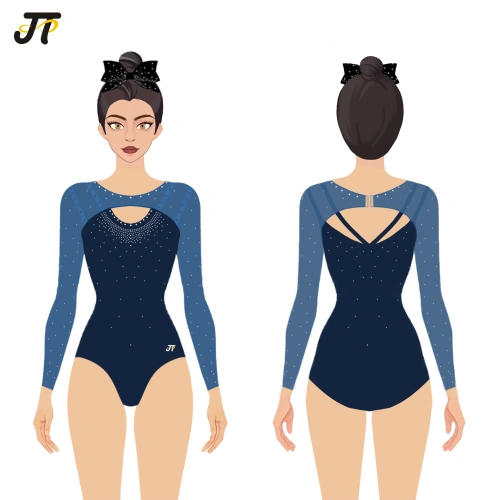
Training leotards and competition leotards serve different purposes, and their fit requirements can differ. Training leotards prioritize comfort, breathability, durability, and everyday wear. They may be washed more frequently, worn for longer hours, and subjected to repeated stretching and movement. Competition leotards prioritize precision fit, secure coverage, decorative details, and professional finishing. They are often worn for shorter periods but must perform flawlessly under pressure.
For growing athletes, training leotards can be slightly more relaxed in the torso or leg openings because the focus is on daily practice. Competition leotards, however, usually need a closer fit to prevent shifting during routines. The fabric may have more compression, and the design may include rhinestones or mesh that should not pull or gap. A gymnast who wears a comfortable training leotard in one size may need a different size or a custom fit for competition. Parents and coaches should not assume that the same size will work across all garment types.
T&J Sportswear produces both practice gymnastics leotards and competition gymnastics leotards, which allows the company to advise customers on the differences between training and competition fit. Practice leotards focus on comfortable stretch, durability, moisture management, and everyday wear. Competition leotards place greater emphasis on precision fit, secure coverage, decorative details, and professional finishing. This distinction helps clubs and brands choose the right product for the right purpose.
Accurate measurements are the foundation of a good fit. For growing athletes, several measurements are especially important. These include chest circumference, waist circumference, hip circumference, torso length from shoulder to crotch, and inseam or leg opening preference. Height and weight can provide additional context, but they should not replace direct measurements. A gymnast who is tall for their age may need a longer torso, while a gymnast with broader shoulders may need a different strap placement or neckline design.

When measuring a growing athlete, it is helpful to measure over lightweight clothing or a well-fitting training leotard. The tape should be snug but not tight. The athlete should stand naturally, without sucking in the stomach or lifting the shoulders. For torso length, the tape should run from the shoulder, over the fullest part of the chest, down through the crotch, and back up to the starting point. This measurement is critical because torso length often changes during growth spurts. If the torso length is too short, the leotard will pull at the shoulders and may cause discomfort. If it is too long, the leotard may sag or bunch at the waist.
Leg opening fit is another important consideration. Some gymnasts prefer a higher cut, while others prefer more coverage. Growing athletes may become more self-conscious about coverage as their bodies change. A competition leotard should allow full range of motion in the hips and legs without cutting or riding up. The leg opening should sit comfortably against the body without excessive pressure. If the athlete needs to adjust the leg openings frequently, the fit may need to be revised.
Measuring at home can be effective if the process is consistent. Parents should use a flexible measuring tape and take each measurement two or three times to check for accuracy. It is best to measure in the morning or early afternoon, as body measurements can change slightly throughout the day. The athlete should wear a well-fitting training leotard or lightweight clothing. Shoes and bulky garments should be removed. If possible, another adult should help with the torso measurement to ensure the tape is not twisted.
It is also useful to record the date of each measurement. Because growing athletes change quickly, a measurement taken six months ago may no longer be reliable. Clubs that order custom team leotards often ask families to submit updated measurements before each order. This practice reduces the risk of ordering leotards that are already too small by the time they arrive. For individual athletes, keeping a simple measurement log can help parents anticipate when a new size or custom fit may be needed.
T&J Sportswear supports custom team leotards and can develop products based on customer designs, sketches, reference images, color requirements, or original ideas. When customers provide accurate measurements and clear fit preferences, the company's design team can assist with artwork development and product optimization, helping turn concepts into finished gymnastics apparel that meets the needs of growing athletes.
Custom sizing is often the best solution for growing athletes who fall between standard sizes or who have specific fit challenges. A gymnast with a long torso and narrow hips may struggle to find a standard leotard that fits both areas well. A gymnast with broader shoulders may need a different strap design or neckline. Custom sizing allows the pattern to be adjusted to the athlete's proportions rather than forcing the athlete to adapt to a standard size chart.
Custom sizing is also valuable for teams. When a club orders competition leotards for a group of athletes, the range of body types can be wide. Some athletes may need a longer torso, while others may need a larger hip measurement. Ordering custom team leotards with individual measurements can improve fit across the roster. It also creates a more professional appearance because each athlete can move confidently without constantly adjusting their garment.
T&J Sportswear offers OEM and ODM services and can develop products based on customers' designs, sketches, reference images, color requirements, or original ideas. The company's professional design team can assist with artwork development and product optimization. For growing athletes, this means a club or brand can request specific pattern adjustments, size variations, and fit features that support changing bodies.
Fabric choice has a major impact on how a competition leotard fits a growing athlete. The ideal fabric should stretch in multiple directions, recover its shape, and feel comfortable against the skin. It should also be durable enough to withstand repeated wear and washing. Common materials in gymnastics apparel include Lycra, Spandex, Polyester, Mystique, and Mesh. Each material offers different benefits. Lycra and Spandex provide excellent stretch and recovery. Polyester adds durability and color retention. Mystique offers a shiny, performance-oriented look. Mesh adds breathability and visual texture.
For growing athletes, fabric recovery is especially important. If a fabric stretches but does not return to its original shape, the leotard may become loose over time. This can lead to shifting, riding up, or reduced coverage. A high-quality competition leotard should maintain its shape after repeated movements and washes. The fabric should also be tested for comfort during skills that require extreme flexibility, such as splits, backbends, and leaps. If the fabric feels restrictive or causes pressure points, the athlete may not be able to perform at their best.
T&J Sportswear pays close attention to fabric selection and garment construction. The company can use materials including Lycra, Spandex, Polyester, Mystique, and Mesh, depending on the design and application. Different products can be developed for different priorities, such as stretch, lightweight construction, breathability, quick drying, comfort, durability, and visual appearance. For training leotards, the focus is on comfortable stretch, durability, moisture management, and everyday wear. For competition leotards, the focus is on precision fit, secure coverage, decorative details, and professional finishing.
Construction details can make a significant difference in how a competition leotard fits a growing athlete. Seam placement, gusset design, strap width, neckline shape, and leg opening finish all affect comfort and coverage. A well-constructed leotard distributes tension evenly across the body rather than concentrating it in one area. For example, a narrow strap may dig into the shoulder during a long routine, while a wider strap may provide more support. A gusset that is too short may cause discomfort, while a gusset that is too long may create excess fabric.
Seams should be flat or covered to prevent chafing. This is especially important for growing athletes who may be sensitive to pressure points. The stitching should be strong enough to withstand stretching without breaking or popping. Rhinestones and other decorations should be applied securely so they do not fall off or scratch the skin. Mesh panels should be placed where they add breathability and style without compromising coverage. Every detail should be considered in relation to the athlete's movement and comfort.
T&J Sportswear's production team pays attention to every stage of manufacturing, from fabric selection and pattern development to cutting, sewing, printing, rhinestone application, quality inspection, and final packaging. This helps provide products that are suitable for both demanding training sessions and high-level competitions. For growing athletes, this attention to detail can mean the difference between a leotard that is merely wearable and one that truly supports performance.
Coverage is a sensitive topic for many growing athletes. As bodies change, gymnasts may become more aware of how a leotard fits around the chest, hips, and leg openings. A competition leotard should provide secure coverage without feeling restrictive. If an athlete feels exposed or uncomfortable, they may hesitate during skills or spend time adjusting their garment. This can affect performance and confidence. Coaches and parents should take these concerns seriously and work with the athlete to find a fit that feels secure and appropriate.
Comfort is closely linked to confidence. A gymnast who is not thinking about their leotard can focus on their routine. A gymnast who is constantly tugging at a strap or adjusting a leg opening cannot give full attention to their performance. For growing athletes, comfort may require a different cut, a different fabric, or a custom size. It may also require a conversation about preferences. Some athletes prefer a higher neckline, while others prefer a lower one. Some prefer wider straps, while others prefer a different back design. These preferences should be considered during the fitting process.
T&J Sportswear understands that gymnastics apparel needs to combine comfort, flexibility, durability, fit, and visual appeal. The company works with gymnastics clubs, teams, brands, wholesalers, distributors, and other sportswear businesses, with a strong focus on customers in the US, Europe, and other international markets. This international experience helps the company understand different sizing systems, cultural preferences, and fit expectations.
Some competition leotards can include growth-friendly features that extend their usable life. Adjustable straps, stretch panels, and carefully placed seams can accommodate small changes in body size. However, adjustability should not compromise the clean lines and secure fit required for competition. Any adjustable feature should be discreet, secure, and tested during movement. For example, an adjustable strap should not loosen during a routine or create bulk under the arms.
Stretch panels can be added in areas that experience the most change, such as the sides of the torso or the back. These panels can provide extra give without altering the overall design. However, they must be made from compatible fabrics that match the color and stretch of the main garment. If the stretch panel has different recovery properties, it may create an uneven fit. The design team should consider how each panel interacts with the rest of the leotard.
T&J Sportswear's in-house professional design team specializes in gymnastics apparel. The company does more than simply manufacture designs supplied by customers; it can also help develop new concepts based on sketches, reference images, color combinations, team identities, or brand requirements. For competition leotards, the team can combine sublimation graphics, color blocking, mesh, rhinestones, crystal decoration, and different fabric effects to create distinctive visual designs. Customers can also customize colors, logos, patterns, labels, and other branding elements.
Team uniforms add another layer of complexity. A gymnastics club may have athletes of different ages, body types, and growth stages. The goal is to create a cohesive look while ensuring each athlete has a comfortable, secure fit. Standard sizing can work for some athletes, but others may need custom adjustments. If the team orders only standard sizes, some athletes may end up with leotards that are too tight or too loose. This can affect both performance and team appearance.
One solution is to order custom team leotards with a size range that includes multiple torso lengths and hip measurements. Another solution is to use a base design with adjustable features or stretch panels. The best approach depends on the team's needs, budget, and timeline. Clubs should discuss their roster with their manufacturer early in the process so that sizing options can be planned effectively. It is also helpful to collect measurements well before the order deadline.
T&J Sportswear provides custom team leotards and matching team apparel. Team colors, logos, patterns, labels, packaging, and other details can be customized according to requirements. The company also offers custom gymnastics warm-ups and matching team apparel for customers looking to build a complete team collection. This integrated approach helps clubs create a professional look while addressing the fit needs of growing athletes.
Coaches and parents play an important role in the fitting process. Coaches see the athlete during practice and competition, so they can notice signs of poor fit, such as constant adjusting, restricted movement, or visible discomfort. Parents often handle measurements, orders, and communication with the manufacturer. When coaches and parents work together, they can identify fit issues early and take action before they affect performance.
Coaches can also provide feedback on how a leotard performs during specific skills. For example, a coach may notice that a leotard pulls at the shoulders during backbends or rides up during tumbling. This feedback can be shared with the manufacturer or designer to improve future orders. Parents can record these observations and include them in communication with the supplier. Over time, this feedback helps create better-fitting garments for the whole team.
T&J Sportswear emphasizes one-to-one professional service. From initial inquiry and design development to sampling, production, inspection, and shipment, the company provides professional support throughout the process. Customers can communicate their requirements directly and receive assistance with product development, customization, production details, and logistics. This direct communication is valuable when fitting growing athletes because it allows for specific questions and adjustments.
Sampling is a critical step in fitting competition leotards for growing athletes. Before bulk production, a sample leotard can be produced and tested by the athlete or team. The sample allows the athlete to move, stretch, and perform skills in the garment. It also allows coaches and parents to check coverage, comfort, and appearance. If the sample does not fit correctly, adjustments can be made before the full order is produced.
Fit testing should include a range of movements that represent the athlete's actual routine. This may include jumps, leaps, turns, splits, and tumbling. The athlete should also test the leotard during a full routine to see how it behaves when they are breathing heavily and moving quickly. Any discomfort, shifting, or restriction should be noted. The sample can then be adjusted in terms of size, pattern, fabric, or construction.
T&J Sportswear supports OEM and ODM services, from design development and sample making to bulk production. The company's professional design team can help transform ideas, sketches, or reference images into finished gymnastics apparel. With low MOQ, flexible customization, competitive pricing, and one-to-one service, the company makes it easier for new brands, gymnastics clubs, and established distributors to develop their own collections and test fit solutions before committing to large orders.
Choosing the right manufacturer is essential when fitting competition leotards for growing athletes. A specialized gymnastics apparel manufacturer understands the unique demands of the sport. T&J Sportswear is a professional gymnastics apparel manufacturer specializing in the development and production of high-quality gymnastics leotards and teamwear. With more than 10 years of experience in the sportswear industry, the company has built strong expertise in product development, custom design, manufacturing, and international business.
The company's main products include competition gymnastics leotards, practice gymnastics leotards, custom team leotards, rhinestone gymnastics leotards, and gymnastics warm-up wear. It works with gymnastics clubs, teams, brands, wholesalers, distributors, and other sportswear businesses, with a strong focus on customers in the US, Europe, and other international markets. This range of experience allows T&J Sportswear to support different types of customers, from small clubs ordering custom team uniforms to established distributors requiring regular production.
T&J Sportswear's products and services have reached customers in more than 36 countries. This international experience provides practical knowledge of different markets, customer requirements, sizing systems, and product preferences. Main markets include North America and Europe, where customers place strong emphasis on product quality, customization, consistency, and reliable communication. For growing athletes, this means access to a manufacturer that understands the importance of fit across different body types and sizes.
One major advantage for small and growing customers is a low minimum order quantity starting from 10 sets for selected products. This gives gymnastics clubs, new brands, boutique retailers, and smaller distributors greater flexibility when testing new designs or launching new collections. Instead of requiring customers to commit to large quantities before they know how a design will perform in their market, the manufacturer can support smaller initial orders and help customers gradually develop their collections.
For clubs with growing athletes, low MOQ can be especially useful. A club may want to test a new competition leotard design with a small group before ordering for the entire team. Or a club may need to order a few custom sizes for athletes who do not fit standard sizing. Low MOQ makes these smaller orders more feasible. It also allows clubs to update their uniform more frequently as athletes grow and team needs change.
T&J Sportswear understands that different customers have different order requirements. Whether a customer is a growing gymnastics club looking for customized team uniforms, a new brand developing its first collection, or an established distributor requiring regular production, the company provides flexible solutions with low MOQ, competitive pricing, professional communication, and one-to-one service.
Customization is at the center of T&J Sportswear's manufacturing service. The company supports both OEM and ODM, allowing customers to choose between producing their own designs and developing new products together with the company's team. Customization can cover artwork, colors, sublimation printing, logos, rhinestone layouts, fabric combinations, sizes, labels, packaging, and other details. The production process covers design development, fabric selection, digital artwork, printing, cutting, sewing, decoration, inspection, packaging, and delivery.
This integrated approach helps reduce communication between multiple suppliers and gives customers a more efficient path from an initial idea to a finished product. For growing athletes, customization can include specific pattern adjustments, size variations, and fit features. A club can request a longer torso for athletes who are growing quickly or a different leg opening for athletes who prefer more coverage. A brand can develop a size range that accommodates different body types. These options help create competition leotards that fit better and perform more reliably.
T&J Sportswear's professional design team can assist with artwork development and product optimization, helping customers turn concepts into finished gymnastics apparel. The company can develop products based on customers' designs, sketches, reference images, color requirements, or original ideas. This collaborative process is valuable when fitting growing athletes because it allows for ongoing adjustments as needs change.
The factory team at T&J Sportswear includes more than 30 skilled workers, with reported production capacity of more than 300 leotards per day. This provides a balance between flexible customization and the ability to support larger wholesale and team orders. For customers, production capacity is not simply about quantity. The real value is the ability to maintain consistent workmanship when moving from samples to bulk production. The company pays attention to fabric, printing, stitching, sizing, rhinestone placement, and overall finishing throughout production.
Consistent workmanship is especially important for team uniforms. If one leotard fits differently from another, the team may look uneven, and athletes may experience different levels of comfort. By maintaining consistent patterns, cutting, and sewing, the manufacturer can reduce variation between garments. This is crucial when fitting growing athletes because even small differences in sizing can affect comfort and performance. A well-managed production process helps ensure that each athlete receives a leotard that matches the intended fit.
T&J Sportswear works to maintain stable workmanship and carefully inspect finished products before shipment. The goal is not only to manufacture gymnastics apparel, but also to build long-term partnerships with customers through reliable products and responsive service. This commitment supports clubs and brands that need dependable competition leotards for growing athletes.
Quality control starts before bulk production. During sample development, customers can review the design, fabric, fit, decoration, and finishing before confirming mass production. This stage is critical for growing athletes because it allows the athlete to test the leotard and provide feedback. If adjustments are needed, they can be made before the full order is produced. This reduces the risk of ordering multiple leotards that do not fit correctly.
For finished garments, key inspection points can include fabric condition, printing quality, stitching, measurements, rhinestone placement, coverage, and overall appearance. The production process is designed to reduce common problems such as inconsistent sizing, printing defects, loose decoration, or uneven finishing. T&J Sportswear's product information also lists certifications such as ISO9001, SGS, and CE for applicable products. Specific certification and testing documentation can be provided according to the product and customer requirements.
Quality control is not only about avoiding defects. It is also about ensuring that the leotard performs as expected. A competition leotard must withstand stretching, movement, and repeated wear. It must maintain its shape and appearance. For growing athletes, quality control helps ensure that the leotard remains comfortable and secure even as the athlete's body changes. This reliability is essential for competition confidence.
Clear communication and responsive service are equally important, especially for customized gymnastics apparel. T&J Sportswear believes that manufacturing quality is only one part of a successful supplier relationship. From initial inquiry and design development to sampling, production, inspection, and shipment, the company's team provides professional support throughout the process. Customers can communicate their requirements directly and receive assistance with product development, customization, production details, and logistics.
For clubs fitting growing athletes, one-to-one service means they can ask specific questions about sizing, fabrics, and fit. They can share feedback from athletes and coaches. They can request samples or adjustments. This direct communication helps reduce misunderstandings and ensures that the final product meets the team's needs. It also makes the ordering process more efficient, which is important when competition deadlines are approaching.
T&J Sportswear's customer-focused approach is designed to be a dependable gymnastics apparel manufacturing partner for customers around the world. Whether a customer needs a small customized team order or a large wholesale production project, the company is committed to delivering quality gymnastics apparel with consistent workmanship and dependable service.
There are several common fitting mistakes that can affect growing athletes. One mistake is choosing a size based only on age or height. Body proportions vary widely, so age and height are not reliable indicators of fit. Another mistake is ignoring torso length. A leotard that fits well in the chest and hips may still be too short in the torso, causing shoulder pressure and discomfort. A third mistake is assuming that the athlete will grow into a larger size. A leotard that is too large can shift during routines and may not provide secure coverage.
Another common mistake is overlooking fabric recovery. A leotard made from low-quality fabric may stretch out quickly and lose its shape. This can be especially problematic for growing athletes who need reliable stretch and support. A fourth mistake is ordering team uniforms without collecting updated measurements. Because athletes grow quickly, measurements from a previous season may no longer be accurate. A fifth mistake is failing to test a sample before bulk production. Sampling allows fit issues to be identified and corrected early.
T&J Sportswear's experience with competition and training leotards helps customers avoid these mistakes. The company understands the specific requirements of gymnastics apparel, including stretch, fit, comfort, coverage, durability, decoration, and freedom of movement. This expertise supports better fitting decisions for growing athletes.
On competition day, a final fit check can help prevent problems. The athlete should put on the leotard and perform a few movements, such as arm circles, jumps, and a split. The leotard should stay in place without riding up or shifting. The straps should not dig into the shoulders or slip. The leg openings should not cut or gap. The athlete should feel comfortable and confident. If any issue is noticed, it should be addressed before the competition begins.
It is also helpful to check the leotard under competition lighting. Rhinestones and other decorations should be secure and not reflect in a distracting way. The color and design should look clean and professional. The athlete should be able to move freely without adjusting the garment. A competition leotard that fits well allows the athlete to focus on their routine rather than their clothing.
T&J Sportswear's competition leotards combine performance fabrics with creative designs, sublimation printing, rhinestones, and other decorative techniques. The company pays close attention to fabric selection, cutting, stitching, embellishment, and finishing to create eye-catching leotards that allow athletes to move confidently during competition. This attention to detail supports a successful competition day fit.
Proper care can extend the life of a competition leotard and help it maintain its fit. Leotards should be washed according to the manufacturer's instructions, usually in cold water and without harsh detergents. They should be air-dried rather than placed in a dryer, as heat can damage stretch fabrics and rhinestones. Turning the leotard inside out before washing can help protect decorative elements. Avoiding fabric softeners can also help preserve the fabric's stretch and recovery.
Growing athletes may wear their leotards frequently, so proper care is important. If a leotard is washed incorrectly, it may lose its shape, fade, or develop loose rhinestones. This can affect both appearance and fit. Parents and athletes should establish a care routine that includes gentle washing, proper drying, and careful storage. Leotards should not be left in a gym bag for long periods, as moisture and friction can damage the fabric and decorations.
T&J Sportswear's production process includes quality inspection and final packaging, which helps ensure that products arrive in good condition. The company's focus on quality and consistency supports long-term use when athletes follow proper care instructions.
Fitting growing athletes can be expensive because they may need new leotards more frequently than adult athletes. Clubs and parents can manage costs by planning ahead. One strategy is to choose a design that can accommodate small growth changes, such as a style with stretch panels or adjustable features. Another strategy is to order training leotards in a slightly more relaxed fit while keeping competition leotards closer to the body. This approach allows training garments to last longer while ensuring competition fit remains secure.
Clubs can also budget for team uniforms by ordering in phases. They may order competition leotards for the current season and plan to update sizes for athletes who are growing quickly. Low MOQ options can help clubs order smaller quantities as needed. Working with a manufacturer that offers flexible customization and competitive pricing can make the process more manageable.
T&J Sportswear provides flexible solutions with low MOQ, competitive pricing, professional communication, and one-to-one service. Whether a customer is a growing gymnastics club looking for customized team uniforms, a new brand developing its first collection, or an established distributor requiring regular production, the company aims to provide reliable products and responsive service.
T&J Sportswear's goal is to build long-term partnerships rather than simply complete individual orders. Whether a customer is a gymnastics club developing team uniforms, a new brand launching a collection, a distributor expanding a product range, or an established buyer looking for a reliable manufacturing partner, the company provides flexible solutions based on requirements. With more than 10 years of industry experience, customers in more than 36 countries, more than 30 skilled workers, daily leotard capacity of more than 300 units, low MOQ, professional design support, OEM and ODM customization, and one-to-one service, the company combines manufacturing capability with the flexibility required by today's international gymnastics apparel market.
For growing athletes, this partnership approach is valuable because needs change over time. A club may need different sizes each season. A brand may need to adjust its size range based on customer feedback. A distributor may need consistent quality across repeat orders. A manufacturer that understands these dynamics can provide better support. T&J Sportswear's experience with competition gymnastics leotards, practice gymnastics leotards, custom team leotards, rhinestone gymnastics leotards, and gymnastics warm-up wear allows it to serve a wide range of customers.
From the first idea to the final leotard, T&J Sportswear is committed to making custom gymnastics apparel more efficient, flexible, and reliable. This commitment supports clubs, teams, brands, and distributors as they fit competition leotards for growing athletes.
Fitting competition leotards for growing athletes requires patience, accurate measurements, thoughtful design, and a reliable manufacturing partner. Athletes change quickly, and their leotards must keep up. A good fit supports performance, comfort, coverage, and confidence. It allows gymnasts to focus on their skills rather than their clothing. Coaches and parents can help by observing fit during practice, collecting updated measurements, and communicating with their supplier. Clubs and brands can benefit from custom sizing, flexible ordering, and quality control.
T&J Sportswear's experience as a professional gymnastics apparel manufacturer makes it a valuable partner for customers who need competition leotards, practice leotards, custom team leotards, rhinestone leotards, and warm-up wear. With more than 10 years of manufacturing experience, a professional design team, OEM and ODM services, low MOQ, skilled production, and a customer-focused approach, the company supports customers in the US, Europe, and other international markets. For growing athletes, the right leotard is not just a uniform. It is a tool for performance, a source of confidence, and a reflection of the team's identity. Fitting that leotard well is a process worth investing in.
