Fabric is the foundation of every gymnastic practice leotard, and choosing it well determines comfort, performance, durability, and cost per wear. This article examined the fabric characteristics that matter most in training apparel, including four-way stretch, elastic recovery, breathability, moisture management, opacity, abrasion resistance, colorfastness, printability, and seam integrity. It reviewed the main fabric families used in gymnastics practice wear, covering nylon and spandex blends, polyester and spandex blends, Supplex nylon, Mystique, mesh and power mesh, cotton blends, and tricot, with a comparison table outlining how each behaves in stretch, breathability, durability, hand feel, and typical use. The article explained why recovery matters more than raw stretch, how fabric weight measured in grams per square meter affects comfort and coverage, and why opacity testing at full extension is essential before bulk production. It also addressed decoration compatibility, noting that sublimation printing performs best on polyester-rich fabrics while rhinestone adhesion depends on fabric stability and placement. A practical evaluation checklist was provided to help buyers compare samples systematically, along with common purchasing mistakes such as choosing on appearance alone, assuming all blends are equal, and ignoring seam construction or care requirements. Finally, the article outlined how T&J Sportswear approaches fabric selection, drawing on more than ten years of gymnastics apparel manufacturing experience, in-house design support, performance-oriented material choices, low MOQ flexibility from ten sets, OEM and ODM customization, a skilled workforce of over thirty people, daily capacity exceeding three hundred leotards, structured quality control from sample to bulk production, and one-to-one service for clubs, teams, brands, wholesalers, and distributors in more than 36 countries.
Ask any gymnast what matters most in practice wear and the answers will usually cluster around the same themes: it has to stay put, it has to move, and it has to survive the season. Fabric sits at the center of all three. A beautiful practice leotard made from the wrong textile will ride up during a back handspring, lose its shape after twenty washes, or turn transparent under gym lighting. A plain-looking one made from the right textile can become the garment an athlete reaches for four days a week without thinking. For coaches, club directors, brand owners, and distributors, understanding gymnastic practice wear fabrics is therefore not a design detail. It is a purchasing decision that determines comfort, performance, return rates, and reputation.
This guide examines the fabric characteristics that matter most in training leotards, how different fiber families behave, what to test before committing to a bulk order, and how an experienced manufacturing partner such as T&J Sportswear approaches material selection for clubs, teams, brands, wholesalers, and distributors across the United States, Europe, and other international markets.
Competition leotards are worn a handful of times per season. Practice leotards are worn constantly. A competitive gymnast training four to six days a week may put a single training leotard through dozens of wear cycles in a matter of months, each cycle involving stretching, sweating, washing, and drying. That level of repetition exposes every weakness in a textile: poor elastic recovery, weak colorfastness, thin coverage, abrasive seams, and pilling surfaces all become visible quickly.
Fabric also dictates how the garment feels against the skin, how it handles moisture, how it photographs, and how long it retains its shape. Pattern making, stitching, and decoration all matter, but they operate within the limits of the material chosen. A manufacturer can only optimize so much around a fabric that stretches unevenly or fades after ten washes.
undefined
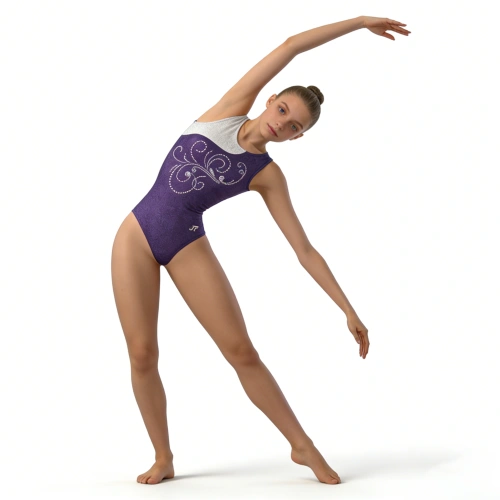
For buyers, this means fabric specification should be the first conversation, not the last. Before artwork, before rhinestone layouts, before color matching, the question of what the garment is made from determines whether the finished product will satisfy the athlete wearing it and the club or brand paying for it.
Gymnastics is not a single movement repeated in a single plane. It combines extreme ranges of motion across the hips, shoulders, and spine with landings, rotations, and sustained tension through the core. Practice wear must accommodate all of it simultaneously.
No single fabric excels at all seven. The goal is a considered balance that matches the intended use, the training environment, and the budget of the buyer.
Most training leotards on the market are built from a small number of fiber families, often blended together. Understanding each one makes it far easier to evaluate a supplier proposal or a sample garment.
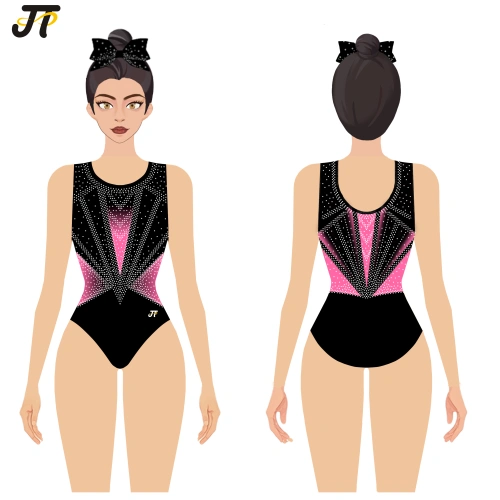
Lycra is a brand name for elastane, the fiber that gives fabric its stretch. Spandex is the generic term. In practice wear, elastane is rarely used alone; it is blended with nylon or polyester at rates typically between 15 and 30 percent, with the remainder providing structure and durability.
Nylon and spandex blends are the classic choice for gymnastics because they deliver a soft hand feel, excellent four-way stretch, and strong recovery. They drape well, hold color richly, and feel smooth against the skin. Their main drawbacks are cost and a moderate sensitivity to chlorine and high heat, which can degrade the elastane over time.
Polyester and spandex blends are more economical, highly durable, and excellent at wicking moisture. They tend to feel slightly less soft than nylon blends and can hold onto odors more readily if not properly finished, but for high-volume training programs they offer a compelling balance of price and performance.
Polyester is the workhorse of activewear. It resists stretching out, holds sublimated prints extremely well, dries quickly, and stands up to repeated washing. In gymnastics practice wear, polyester is often used in performance-focused garments where moisture management and durability outweigh a luxurious hand feel.
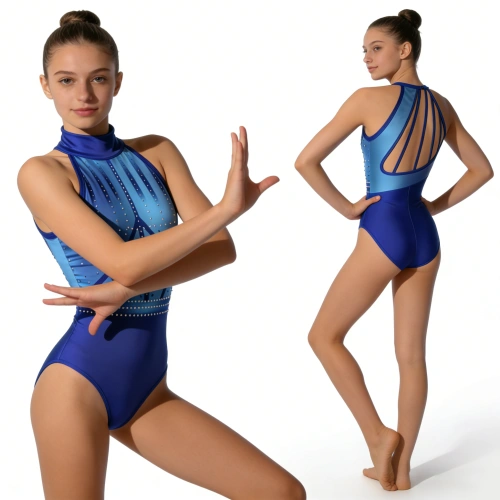
The quality of polyester varies enormously. Micro-denier and textured polyester yarns can feel surprisingly soft and provide better moisture movement than standard filament polyester. Buyers evaluating samples should compare not just the fiber name but the yarn construction and finish.
Nylon offers high strength, elasticity, and a smooth surface. Supplex is a specific type of textured nylon designed to feel like cotton while retaining the performance properties of synthetic fiber. It is soft, breathable, quick drying, and resistant to shrinking and wrinkling, which makes it attractive for training garments where comfort is the priority.
Nylon blends typically cost more than polyester, so they tend to appear in mid-range and premium practice leotards. For clubs that want a soft, matte finish rather than a shiny surface, nylon-based fabrics are often the better choice.
Mystique is a shiny, metallic-look fabric widely associated with competition leotards. It reflects light dramatically and photographs beautifully, which is why it remains popular for stage and floor appearances. Holographic and foil-laminated fabrics offer similar visual impact.
For everyday practice wear, these fabrics have limitations. The metallic finish can crack or dull with heavy use, they are generally less breathable than matte knits, and they may feel stiffer. Many manufacturers therefore use them as accent panels rather than as the primary body fabric of a training leotard.
Mesh is a lightweight, open-structured knit used for ventilation and visual contrast. It appears frequently in sleeves, back panels, and side inserts. Power mesh is a heavier, denser version with more compression and structure, often used for lining and support.
The critical question with mesh is transparency. Mesh panels must be positioned so that coverage requirements are met, and the mesh itself must be selected with an appropriate opacity for the garment design. Cheap, overly open mesh can create coverage problems that athletes notice immediately.
Cotton feels soft and breathable, but it absorbs moisture and holds it, which makes it a poor primary choice for intense training. A cotton-rich leotard can become heavy and clingy once a gymnast begins to sweat. Small percentages of cotton or cotton-like fibers can improve hand feel in low-intensity garments, but for serious training, synthetic performance fabrics are the standard.
Tricot and other warp-knit constructions provide stability with moderate stretch. They resist running and laddering, hold shape well, and are often used in linings or structured panels. They are less elastic than circular knits, so they tend to appear in supportive roles rather than as the main body fabric.
The table below summarizes how the most common options generally behave. Actual performance depends on the specific blend, weight, and finishing, but the relative tendencies are useful when comparing samples.
| Fabric Type | Stretch and Recovery | Breathability | Durability | Hand Feel | Typical Use |
|---|---|---|---|---|---|
| Nylon and Spandex | Excellent | Good | Very Good | Soft, smooth | Premium practice and competition leotards |
| Polyester and Spandex | Very Good | Very Good | Excellent | Firmer, drier | High-volume training wear |
| Supplex Nylon | Very Good | Very Good | Very Good | Cotton-like, matte | Comfort-focused practice wear |
| Mystique | Good | Moderate | Moderate | Slick, shiny | Accent panels, competition wear |
| Power Mesh | Good | Excellent | Good | Light, structured | Inserts, lining, ventilation |
| Cotton Blend | Moderate | Good when dry | Moderate | Very soft | Low-intensity or recreational wear |
| Tricot | Moderate | Moderate | Very Good | Firm, smooth | Linings and structured panels |
Reading a table is a starting point, not an answer. Two fabrics labeled nylon and spandex can differ significantly in weight, elastane percentage, and finish, producing very different garments. This is why sample evaluation and physical testing remain essential.
Stretch is easy to feel. Recovery is harder to judge and far more important over the life of a garment. A fabric that stretches beautifully but does not snap back will sag at the seat, bag at the knees, and lose its silhouette within a few weeks.
Two-way stretch fabrics extend in one direction, usually horizontally. Four-way stretch fabrics extend both horizontally and vertically. Gymnastics practice wear almost always benefits from four-way stretch because movement occurs in every direction: legs lift forward, sideways, and backward; shoulders rotate; the torso twists.
A four-way stretch knit allows the garment to follow the body without pulling at the shoulders or riding up. It also reduces stress on the seams, which extends the life of the garment.
Higher elastane content generally means more stretch and better recovery, but there are limits. Extremely high elastane percentages can make fabric feel rubbery and reduce breathability. Most quality practice wear fabrics sit in a range that balances elasticity with structure.
Recovery can be tested simply. Stretch a section of fabric by hand, hold it for ten seconds, release it, and observe how quickly it returns to its original dimensions. Then repeat the process twenty or thirty times in succession. A fabric with good recovery memory will still look and feel the same. One with poor memory will begin to show waves, distortion, or a permanently stretched area.
Breathability describes how easily air and vapor pass through a fabric. Moisture management describes how the fabric moves liquid sweat away from the skin. They are related but distinct, and both matter during training.
When a garment cannot move moisture, sweat saturates the fabric. The garment becomes heavier, clings to the body, and cools rapidly when the gymnast stops moving. In a cold gym, that can be genuinely uncomfortable. Saturated fabric also stretches differently, which affects fit and coverage.
Performance knits address this by using yarn structures and finishes that pull moisture to the surface where it can evaporate. The result is a garment that feels drier and stays lighter throughout a session.
Buyers without access to lab equipment can still gather useful information. Holding fabric up to a light source reveals how open the structure is. Breathing through a single layer of fabric gives a rough sense of air permeability. Placing a drop of water on the surface and watching how quickly it spreads and disappears indicates wicking behavior. None of these tests replace formal testing, but they can quickly separate promising samples from unsuitable ones.
Practice wear rarely fails dramatically. It degrades gradually, and the first signs usually appear in predictable places.
Pilling occurs when loose fibers work their way to the surface and form small balls. It is most common in lower-quality blends and on areas that rub against equipment or the body, such as the underarm, the seat, and the inner thigh. Snagging happens when a filament catches on a rough surface and pulls, creating a visible loop or run.
Fabrics with tightly spun, longer-staple fibers resist both problems better. Higher density knits also perform better than loose, open constructions. For clubs whose gymnasts train on older mats or wooden equipment, abrasion resistance should be a priority.
Color loss is one of the most common complaints about practice wear. Dyes can fade from repeated washing, from perspiration, and from exposure to chlorine if gymnasts train in or near a pool area. Sublimated prints, in which the color is integrated into the fabric rather than applied on top, generally hold up better than surface-printed or dyed alternatives.
Buyers should ask suppliers about colorfastness testing and about how the fabric behaves after repeated laundering. A simple wash test on a sample swatch, repeated several times and compared against an unwashed control, provides useful real-world evidence.
Even excellent fabric can fail if the construction is poor. Flatlock and coverstitch seams are standard in gymnastics apparel because they lie flat against the skin and stretch with the fabric. Standard overlock seams can create ridges that chafe and may pop under tension. Seam quality is often a clearer indicator of manufacturing discipline than fabric quality alone.
Coverage is non-negotiable in gymnastics practice wear. Athletes and parents notice immediately when a fabric turns sheer under stretch or in bright gym lighting, and the garment is effectively unusable regardless of how attractive it looks on a hanger.
Opacity depends on fabric weight, yarn density, color, and the amount of stretch applied. Light colors and thin fabrics are the highest risk. Two approaches reduce the problem: selecting a heavier or denser knit, or adding a lining in critical areas.
The best test is also the simplest. Stretch the sample fabric over a hand or a form and hold it up to a strong light. Then stretch it further and check again. Fabric that looks opaque at rest may become transparent at full extension, which is exactly the condition it will face during a leap or a split.
Fabric weight is usually expressed in grams per square meter, abbreviated as GSM. In gymnastics practice wear, common weights range from roughly 180 to 260 GSM, with lighter fabrics used for warm-weather training and heavier ones for structure and coverage.
A lighter fabric feels airy and cool but may lack opacity and shape retention. A heavier fabric feels substantial, holds structure, and covers reliably, but may feel warm. Many successful practice leotards use a mid-weight main fabric with lighter mesh inserts for ventilation, combining the strengths of both.
Comfort is not only about the fabric surface. It is also about how the garment is assembled. Soft, flat seams, well-placed elastic, and a properly constructed gusset all contribute to a leotard that can be worn for hours without irritation. Buyers should look closely at the crotch construction, the leg openings, and the shoulder area, since these are where complaints most often originate.
Many practice leotards now carry sublimated graphics, team logos, gradient patterns, or rhinestone accents. Not every fabric accepts every decoration well.
Sublimation works best on polyester because the process relies on the dye bonding with polyester fibers at high temperature. On nylon, cotton, or blends with high natural fiber content, sublimation produces weaker, less durable results. If a design depends on vivid, permanent, full-surface printing, polyester-rich fabric is usually the correct foundation.
Rhinestones require a stable surface that will not distort under heat and adhesive. Very stretchy or very lightweight fabrics can create adhesion problems, and stones may lift after repeated stretching. Placement also matters: stones positioned over high-stretch zones are more likely to detach than those on stable panels.
Manufacturers with dedicated decoration experience can advise on which fabrics and placements will hold up. T&J Sportswear, for example, handles rhinestone application as part of its in-house production process, which allows decoration choices to be evaluated alongside fabric selection rather than after the fact.
Price per garment is a misleading metric on its own. What matters is cost per wear. A practice leotard that survives two seasons costs far less over time than a cheaper one that loses shape in two months.
Fabric choice strongly influences longevity. Fabrics with high elastane recovery, tight knit structures, and good colorfastness last longer. So does proper care. Most gymnastics apparel should be washed in cold water, ideally in a mesh bag, and air dried rather than tumble dried. Heat is the primary enemy of elastane, and repeated high-temperature drying is one of the fastest ways to destroy stretch recovery.
Buyers who communicate care instructions clearly to end users often see measurable improvements in garment lifespan and customer satisfaction, which in turn reduces complaints and returns.
When comparing samples from different suppliers, a structured approach produces better decisions than subjective impressions. The following checklist covers the essentials.
Documenting the results of these checks creates a useful internal reference that makes future purchasing faster and more consistent.
T&J Sportswear is a professional gymnastics apparel manufacturer specializing in the development and production of high-quality gymnastics leotards and teamwear. With more than ten years of experience in the sportswear industry, the company has built expertise across product development, custom design, manufacturing, and international business. Its experience is reflected in how it handles the fabric decisions that sit at the foundation of every order.
General sportswear suppliers often treat gymnastics as one category among many. T&J Sportswear focuses specifically on competition leotards, practice leotards, custom team leotards, rhinestone leotards, and gymnastics warm-up wear. That specialization means the company understands the specific requirements of gymnastics apparel, including stretch, fit, comfort, coverage, durability, decoration, and freedom of movement.
Over the years, its products and services have reached customers in more than 36 countries, giving the team practical experience with different markets, sizing systems, customer requirements, and product preferences. Its main markets include North America and Europe, where buyers place strong emphasis on quality, customization, consistency, and reliable communication.
A beautiful leotard must also perform during movement. T&J Sportswear therefore pays close attention to fabric selection and garment construction. Its product range can use materials including Lycra, spandex, polyester, Mystique, and mesh, depending on the design and application. Different products are developed for different priorities such as stretch, lightweight construction, breathability, quick drying, comfort, durability, and visual appearance.
For training leotards, the emphasis falls on comfortable stretch, durability, moisture management, and everyday wear. For competition leotards, the focus shifts toward precision fit, secure coverage, decorative details, and professional finishing. This distinction matters because a fabric that performs well on stage is not always the fabric that performs best in a four-hour training session, and vice versa.
Fabric and design are connected. T&J Sportswear maintains an in-house design team specializing in gymnastics apparel, and the company does more than simply manufacture designs supplied by customers. It can help develop new concepts based on sketches, reference images, color combinations, team identities, or brand requirements.
For competition leotards, the team can combine sublimation graphics, color blocking, mesh, rhinestones, crystal decoration, and different fabric effects to create distinctive visual designs. Customers can also customize colors, logos, patterns, labels, and other branding elements. Because design and fabric selection happen together, the resulting products tend to be more coherent and more manufacturable.
Customization sits at the center of the company's manufacturing service. T&J Sportswear supports both OEM and ODM, allowing customers to choose between producing their own designs and developing new products together with the team. Customization can cover artwork, colors, sublimation printing, logos, rhinestone layouts, fabric combinations, sizes, labels, packaging, and other details.
The production process covers design development, fabric selection, digital artwork, printing, cutting, sewing, decoration, inspection, packaging, and delivery. This integrated approach reduces the need to coordinate multiple suppliers and gives customers a more efficient path from an initial idea to a finished product.
One significant advantage for smaller and growing customers is a low minimum order quantity starting from ten sets for selected products. This gives gymnastics clubs, new brands, boutique retailers, and smaller distributors greater flexibility when testing new designs or launching new collections.
Rather than requiring customers to commit to large volumes before knowing how a design will perform in their market, T&J Sportswear can support smaller initial orders and help customers gradually build out their collections. For a club ordering team uniforms for the first time, or a new brand testing its first fabric and fit combinations, this lowers the risk considerably.
The factory team includes more than thirty skilled workers, with reported production capacity of over three hundred leotards per day. This provides a balance between flexible customization and the ability to support larger wholesale and team orders.
For customers, production capacity is not simply about quantity. The real value lies in maintaining consistent workmanship when moving from samples to bulk production. T&J Sportswear pays attention to fabric, printing, stitching, sizing, rhinestone placement, and overall finishing throughout production, which helps ensure that the hundredth leotard matches the first.
Quality control begins before bulk production. During sample development, customers can review the design, fabric, fit, decoration, and finishing before confirming mass production. This stage is where fabric issues are most economically resolved, since changes made before cutting and sewing cost far less than changes made after.
For finished garments, key inspection points can include fabric condition, printing quality, stitching, measurements, rhinestone placement, coverage, and overall appearance. The production process is designed to reduce common problems such as inconsistent sizing, printing defects, loose decoration, or uneven finishing. Product information also lists certifications such as ISO9001, SGS, and CE for applicable products, and specific certification and testing documentation can be provided according to product and customer requirements.
Manufacturing quality is only one part of a successful supplier relationship. Clear communication and responsive service are equally important, especially for customized gymnastics apparel. From initial inquiry and design development through sampling, production, inspection, and shipment, the T&J Sportswear team provides professional support throughout the process. Customers can communicate requirements directly and receive assistance with product development, customization, production details, and logistics.
The company's stated goal is to build long-term partnerships rather than simply complete individual orders. Whether a customer is a gymnastics club developing team uniforms, a new brand launching a collection, a distributor expanding a product range, or an established buyer looking for a reliable manufacturing partner, T&J Sportswear aims to provide flexible solutions based on specific requirements.
With more than ten years of industry experience, customers in over 36 countries, more than thirty skilled workers, daily capacity of over three hundred leotards, low MOQ, professional design support, OEM and ODM customization, and one-to-one service, the company combines manufacturing capability with the flexibility that today's international gymnastics apparel market demands. From a first idea to the final leotard, the commitment is to make custom gymnastics apparel more efficient, flexible, and reliable.
Even experienced buyers sometimes fall into predictable traps. Recognizing them in advance saves time, money, and frustration.
A glossy fabric that looks striking in a photo may feel stiff, trap heat, or lose its finish quickly. Appearance should be evaluated alongside performance, not instead of it.
Many coverage problems are discovered only after delivery, when gymnasts begin wearing the garments. Testing opacity at full stretch before production eliminates most of these issues.
Two fabrics with identical fiber labels can differ dramatically in weight, density, finish, and recovery. Fiber content is a starting point, not a full specification.
Excellent fabric sewn with poor technique still produces a poor garment. Seam type, stitch density, and finishing quality deserve the same scrutiny as the textile itself.
If end users wash garments in hot water and tumble dry them, even premium fabric will degrade quickly. Clear care guidance protects the investment.
The cheapest option is rarely the most economical over a full season. Cost per wear is the more meaningful measure.
For most training environments, a four-way stretch knit combining nylon and spandex or polyester and spandex offers the best overall balance of stretch, recovery, durability, and comfort. The right choice depends on climate, training intensity, budget, and design requirements.
Most quality gymnastics fabrics use elastane in a range that provides strong stretch and recovery without becoming rubbery. Exact percentages vary by construction, and the practical test is how the fabric performs after repeated stretching.
Polyester tends to be more durable, more economical, and better for sublimation printing. Nylon tends to feel softer and offers a richer hand feel. Both work well when the blend and weight are appropriate.
Stretch the fabric over a form or hand and hold it against strong light, then stretch further and check again. Testing in every colorway matters, since light colors are more likely to appear sheer.
With quality fabric and proper care, a training leotard used several times a week should maintain its shape, color, and coverage for a full season or longer. Garments that fail within weeks usually indicate a fabric or construction issue.
Rhinestone adhesion depends on fabric stability and heat tolerance. Stones hold best on stable panels and can loosen on highly stretchable areas. Working with an experienced manufacturer helps ensure decoration choices suit the chosen fabric.
Yes. Lighter fabrics feel cooler but may lack opacity and structure, while heavier fabrics provide coverage and shape but can feel warmer. Many designs combine a mid-weight main fabric with lighter mesh inserts.
Choosing fabric for gymnastic practice wear is a balance of competing priorities. Stretch must be paired with recovery, breathability with durability, softness with opacity, and visual appeal with practical performance. No single textile delivers everything perfectly, which is why the most successful practice leotards are built from carefully selected materials matched to their intended use.
For clubs, teams, brands, wholesalers, and distributors, the process starts with clear specifications and thorough sample evaluation. Fiber content, weight, stretch direction, recovery, opacity, colorfastness, printability, and seam construction all deserve attention before a bulk order is placed. Getting these details right at the sample stage prevents expensive problems later.
Working with a manufacturer that specializes in gymnastics apparel makes the process considerably easier. T&J Sportswear brings more than a decade of focused experience, in-house design capability, performance-oriented material selection, low MOQ flexibility, OEM and ODM customization, skilled production capacity, and structured quality control to every project. With customers in more than 36 countries and a service model built around one-to-one communication, the company positions itself as a manufacturing partner rather than a simple supplier.
Fabric is where comfort begins, where durability is decided, and where the athlete's experience of a garment is ultimately determined. Buyers who invest attention in this single decision tend to see the results everywhere else: fewer complaints, longer garment life, better performance, and stronger relationships with the gymnasts who wear what they produce.
