Common fit problems in gymnastics leotards for girls often involve ride-up, strap discomfort, chest tightness, gapping, torso length, leg openings, sizing inconsistency, fabric stretch, seam irritation, sheerness, decoration stiffness, growth spurts, and team uniformity. These issues arise from the complex demands of gymnastics apparel. A leotard must stretch, recover, breathe, and stay in place through extreme movement. Standard sizes based only on height and weight may not match a gymnast's torso length, shoulder width, hip shape, or muscular development. Parents and coaches can reduce problems by measuring torso length and other key measurements, checking brand-specific size charts, choosing four-way stretch fabrics, testing leotards through squats, splits, straddles, and handstands, and looking for flat seams and tagless labels. Custom sizing and pattern adjustments can solve issues that standard sizes cannot. For teams, sample fittings and consistent fabric, pattern, and construction are essential. T&J Sportswear, a professional gymnastics apparel manufacturer with more than 10 years of experience, specializes in competition leotards, practice leotards, custom team leotards, rhinestone leotards, and warm-up wear. The company serves customers in 36+ countries and focuses on comfort, flexibility, durability, fit, and visual appeal. Its production process covers fabric selection, pattern development, cutting, sewing, printing, rhinestone application, quality inspection, and packaging. T&J Sportswear offers OEM and ODM services, low MOQ starting from 10 sets for selected products, professional design support, and one-to-one service. With 30+ skilled workers and reported capacity of 300+ leotards per day, the company balances customization with reliable bulk production. Quality control checks fabric, printing, stitching, measurements, rhinestone placement, coverage, and finishing to reduce inconsistent sizing and other common defects. By combining experienced manufacturing with flexible customization, T&J Sportswear helps clubs, teams, brands, wholesalers, and distributors create leotards that fit better, perform better, and look professional. The key takeaway is that fit is not a luxury; it is essential for comfort, confidence, and performance in gymnastics.
Gymnastics leotards are more than uniforms. They are performance equipment that must stretch, support, breathe, and stay in place through vault, bars, beam, and floor. When a leotard fits well, the gymnast can focus on technique and confidence. When it fits poorly, every turn, jump, and handstand can become a distraction. Parents, coaches, and gymnasts often encounter the same frustrating problems: straps that dig into the shoulders, fabric that rides up, leg openings that pinch, or a torso that feels either too short or too long. Solving these problems requires an understanding of body shape, fabric behavior, pattern design, and proper sizing. T&J Sportswear, a professional gymnastics apparel manufacturer with more than 10 years of experience, works with clubs, teams, brands, wholesalers, and distributors around the world. The company specializes in competition gymnastics leotards, practice gymnastics leotards, custom team leotards, rhinestone gymnastics leotards, and gymnastics warm-up wear. Its experience in product development, custom design, manufacturing, and international business provides useful insight into why fit problems happen and how they can be solved.
This blog examines common fit problems in leotards for gymnastics girls and offers practical solutions for parents, coaches, clubs, and apparel buyers. It also explains how a specialized manufacturer such as T&J Sportswear approaches fit, fabric, construction, customization, and quality control. The goal is simple: help gymnasts find leotards that feel comfortable, look professional, and support peak performance.
undefined
A gymnastics leotard is engineered for movement. Unlike a T-shirt or leggings, it must remain close to the body while allowing extreme ranges of motion. It must stretch in multiple directions, recover its shape, and provide secure coverage without slipping. A leotard also has fewer seams and fasteners, so the fit depends heavily on pattern design, fabric elasticity, and accurate sizing. A small error in torso length, strap placement, or leg opening can create a noticeable problem during training or competition.
Girls' gymnastics leotards must also accommodate different body types. Two gymnasts of the same age and height may have very different torso lengths, shoulder widths, hip shapes, and proportions. A size chart based only on height and weight may not be enough. This is why many fit problems are not caused by the gymnast choosing the wrong size alone. They are caused by a mismatch between the leotard's pattern and the athlete's individual shape.

T&J Sportswear notes that gymnastics apparel needs to combine comfort, flexibility, durability, fit, and visual appeal. The company pays attention to every stage of manufacturing, from fabric selection and pattern development to cutting, sewing, printing, rhinestone application, quality inspection, and final packaging. This attention to detail helps reduce common fit issues before a leotard reaches the gym.
One of the most common complaints among gymnastics girls is that the leotard rides up in the crotch or back. This problem is often called a wedgie or a ride-up. It can happen when the torso length is too short, when the leg openings are cut too high, or when the fabric does not have enough stretch and recovery. It can also happen when the leotard is too loose in the hip area, allowing the fabric to shift during movement.
The first step is to check torso length, not just height. A gymnast should measure from the shoulder, through the crotch, and back to the shoulder. If the leotard is too short in the torso, sizing up may help, but it can create looseness elsewhere. A better solution is a custom or semi-custom leotard with a longer torso. Choosing a leotard with a well-designed gusset and moderate leg cut can also reduce ride-up. Fabrics with strong stretch and recovery, such as quality Lycra or Spandex blends, help the leotard hold its shape. T&J Sportswear uses performance-oriented materials and construction to support stretch, comfort, and coverage, which can reduce the likelihood of riding up during practice or competition.
Shoulder straps are a major source of fit problems. Straps that dig into the shoulders can leave marks and cause pain during bars or handstands. Straps that slip off the shoulders can distract the gymnast and force her to adjust her leotard repeatedly. Straps that stretch out over time can make the leotard feel loose and unsupportive.
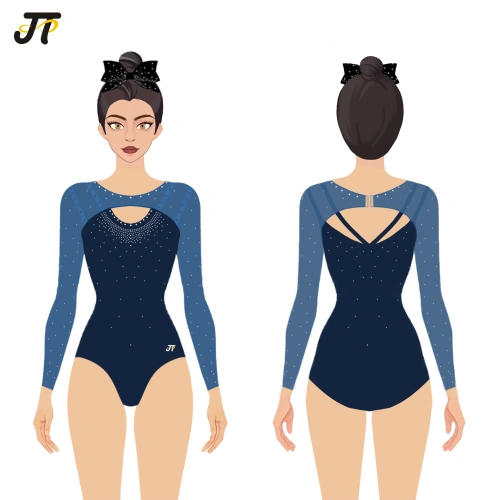
Adjustable straps are helpful for growing gymnasts, but they are not common in competition leotards. A better approach is to choose a strap style that matches the gymnast's shoulder shape. Wider straps can distribute pressure, while crossed or racerback styles can improve security for some body types. If a leotard is consistently uncomfortable in the straps, custom pattern adjustments may be needed. T&J Sportswear offers OEM and ODM services and can develop products based on designs, sketches, reference images, color requirements, or original ideas. This flexibility allows clubs and brands to adjust strap placement, width, and construction for better fit.
Some gymnasts feel that a leotard is too tight across the chest, shoulders, or underarms. This can restrict breathing and arm movement. It can also cause the fabric to pull, creating stress lines and an uncomfortable sensation during bars or vault.
Gymnasts should avoid choosing a leotard that feels restrictive, even if it looks flattering. The fabric should stretch comfortably with the body. Mesh panels and strategic color blocking can provide visual appeal without reducing stretch. A manufacturer with experience in gymnastics apparel can adjust the pattern to add room in the chest and shoulders while maintaining a secure fit. T&J Sportswear's product range can use materials including Lycra, Spandex, Polyester, Mystique, and Mesh, depending on the design and application. Different products can be developed for priorities such as stretch, lightweight construction, breathability, quick drying, comfort, durability, and visual appearance.
Gapping is the opposite of tightness. It occurs when the leotard does not sit flat against the body. Gaps at the back, armholes, or neckline can expose skin, feel insecure, and look unprofessional. They can also cause the leotard to shift during movement.

Gapping often requires a pattern change rather than a simple size change. If the leotard fits in the torso but gaps at the armhole, the armhole curve may need adjustment. If the neckline gaps, a different neckline style or a smaller size in that area may help. Custom team leotards can be developed with specific measurements and preferences. T&J Sportswear's professional design team can assist with artwork development and product optimization, helping customers turn concepts into finished gymnastics apparel. For teams, this means consistent fit across multiple gymnasts with different body shapes.
Torso length is one of the most important measurements in leotard fit. If the torso is too short, the leotard pulls down, rides up, and puts pressure on the shoulders. If the torso is too long, the leotard may bunch at the waist, sag in the crotch, or feel loose around the hips.
Gymnasts and parents should measure torso length before buying. If a standard leotard is close but not perfect, a custom option may be the best solution. Many gymnastics apparel manufacturers, including T&J Sportswear, can produce custom team leotards and practice leotards based on specific measurements. The company supports low MOQ starting from 10 sets for selected products, which gives gymnastics clubs, new brands, boutique retailers, and smaller distributors flexibility when testing new designs or launching new collections.
Leg openings can make or break comfort. If they are too tight, they can pinch, rub, or leave red marks. If they are too loose, they can gap and expose more than intended. The height of the leg cut also affects how the leotard fits around the hips and thighs.
Gymnasts should test leg openings by doing a squat, split, and straddle. The elastic should lie flat without digging. A moderate leg cut often provides better coverage and comfort than an extremely high cut. For teams, choosing a consistent leg cut and elastic specification helps ensure that all gymnasts feel comfortable. T&J Sportswear focuses on comfort, stretch, breathability, and durability for practice leotards, and on precision fit, secure coverage, decorative details, and professional finishing for competition leotards.
One of the most confusing issues for parents is that a gymnast may wear a child large in one brand and an adult small in another. Sizing labels are not universal. Different manufacturers use different patterns, fabric stretch, and target body types. This inconsistency leads to online returns, frustration, and leotards that do not fit properly.
The best solution is to rely on measurements rather than labels. Bust, waist, hip, torso, and height should all be considered. When ordering from a new brand, parents should check the specific size chart and return policy. For clubs and teams, working with a manufacturer that provides consistent sizing across repeat orders is essential. T&J Sportswear has more than 10 years of experience in gymnastics apparel manufacturing and serves customers in 36+ countries. This international experience helps the company understand different sizing systems and customer preferences.
Fabric choice affects fit as much as pattern design. A leotard made from high-quality stretch fabric can adapt to the body, recover after movement, and provide breathability. A low-quality fabric may sag, bag, or become uncomfortable after a few washes.
Gymnasts should look for leotards that feel soft, stretch in multiple directions, and return to their original shape. For training, breathability and moisture management are important. For competition, fit, coverage, and visual impact are priorities. T&J Sportswear selects fabrics based on the design and application. The company can use Lycra, Spandex, Polyester, Mystique, and Mesh to balance stretch, lightweight construction, breathability, quick drying, comfort, durability, and appearance.
Some gymnasts are sensitive to seams, tags, and rough edges. A seam that rubs in the wrong place can cause irritation during a long practice. A tag at the neck or side can feel scratchy. These issues are especially common in girls' gymnastics leotards because the garment is worn close to the skin.
Flatlock seams, tagless labels, and soft elastics can improve sensory comfort. If a leotard has a tag, it can often be cut carefully. If seams cause irritation, the fit may be too tight, or the construction may be poor. T&J Sportswear pays attention to cutting, sewing, printing, rhinestone application, quality inspection, and final packaging. Quality control can include checking stitching, measurements, and overall finishing to reduce problems such as loose decoration or uneven finishing.
Sheerness is a common concern, especially in lighter colors and during stretching movements. A leotard that looks opaque in a standing position may become sheer when the gymnast bends, squats, or stretches. This can make the gymnast feel uncomfortable and self-conscious.
Choosing a well-lined leotard or a darker color can help. For light colors, a manufacturer can add lining or select a denser fabric. Gymnasts should test the leotard in different positions before competition. T&J Sportswear's competition leotards combine performance fabrics with creative designs, sublimation printing, rhinestones, and other decorative techniques. The company pays close attention to fabric selection and finishing to create eye-catching leotards that allow athletes to move confidently.
Rhinestones and prints are popular in competition leotards, but they can affect fit if not applied correctly. Heavy rhinestone layouts can make the fabric stiff or cause it to pull. Poorly placed stones can scratch the skin or fall off during movement. Sublimation printing can also change the way the fabric stretches if the process is not controlled.
Decoration should enhance the leotard, not compromise comfort. Rhinestone layouts should be planned around stretch zones. Printing should be tested for stretch and recovery. T&J Sportswear can combine sublimation graphics, color blocking, mesh, rhinestones, crystal decoration, and different fabric effects to create distinctive visual designs. Customers can also customize colors, logos, patterns, labels, and other branding elements.
Children and young gymnasts grow quickly. A leotard that fits perfectly in September may feel tight by January. Growth spurts can change torso length, shoulder width, hip shape, and overall proportions. This makes fit a moving target for parents and coaches.
For growing gymnasts, adjustable or stretch-friendly styles can help. When ordering team leotards, coaches should allow some room for growth without compromising safety or coverage. Custom sizing can be a good option for athletes who are between sizes. T&J Sportswear supports OEM and ODM services and can develop products based on customer designs, sketches, reference images, color requirements, or original ideas. This flexibility helps clubs and brands address growth-related fit challenges.
Team leotards present a special challenge. A club may have gymnasts of different ages, heights, and body types. The team leotard must look uniform while fitting each gymnast comfortably. If the fit is inconsistent, the team may look uneven, and gymnasts may feel uncomfortable.
Clubs should work with a manufacturer that offers size sets, sample fittings, and custom sizing. Consistent fabric, pattern, and construction are essential. T&J Sportswear works with gymnastics clubs, teams, brands, wholesalers, distributors, and other sportswear businesses. The company offers custom team leotards, competition leotards, practice leotards, rhinestone leotards, and warm-up wear. Team colors, logos, patterns, labels, packaging, and other details can be customized according to requirements.
Parents, coaches, and gymnasts can use the following checklist to reduce fit problems before they happen.
T&J Sportswear is a professional gymnastics apparel manufacturer specializing in the development and production of high-quality gymnastics leotards and teamwear. With more than 10 years of experience in the sportswear industry, the company has built expertise in product development, custom design, manufacturing, and international business. Its main products include competition gymnastics leotards, practice gymnastics leotards, custom team leotards, rhinestone gymnastics leotards, and gymnastics warm-up wear.
The company understands that gymnastics apparel needs to combine comfort, flexibility, durability, fit, and visual appeal. Its production team pays attention to every stage of manufacturing, from fabric selection and pattern development to cutting, sewing, printing, rhinestone application, quality inspection, and final packaging. This helps provide products suitable for both demanding training sessions and high-level competitions.
Customization is one of T&J Sportswear's key strengths. The company offers OEM and ODM services and can develop products based on customer designs, sketches, reference images, color requirements, or original ideas. A professional design team can assist with artwork development and product optimization, helping customers turn concepts into finished gymnastics apparel.
T&J Sportswear also understands that different customers have different order requirements. Whether a growing gymnastics club needs customized team uniforms, a new brand is developing its first collection, or an established distributor requires regular production, the company provides flexible solutions with low MOQ, competitive pricing, professional communication, and one-to-one service.
Customization is not only about colors and logos. It is also a powerful fit solution. When standard sizes do not work, custom pattern adjustments can address torso length, shoulder width, hip shape, leg opening, and strap placement. T&J Sportswear supports low MOQ starting from 10 sets for selected products. This gives gymnastics clubs, new brands, boutique retailers, and smaller distributors greater flexibility when testing new designs or launching new collections.
Instead of requiring customers to commit to large quantities before they know how a design will perform in their market, the company can support smaller initial orders and help customers gradually develop their collections. Customization can cover artwork, colors, sublimation printing, logos, rhinestone layouts, fabric combinations, sizes, labels, packaging, and other details. The production process covers design development, fabric selection, digital artwork, printing, cutting, sewing, decoration, inspection, packaging, and delivery.
Quality control starts before bulk production. During sample development, customers can review the design, fabric, fit, decoration, and finishing before confirming mass production. For finished garments, key inspection points can include fabric condition, printing quality, stitching, measurements, rhinestone placement, coverage, and overall appearance. T&J Sportswear's production process is designed to reduce common problems such as inconsistent sizing, printing defects, loose decoration, or uneven finishing.
The company has a factory team that includes 30+ skilled workers, with reported production capacity of 300+ leotards per day. This provides a balance between flexible customization and the ability to support larger wholesale and team orders. For customers, production capacity is not simply about quantity. The real value is the ability to maintain consistent workmanship when moving from samples to bulk production. T&J Sportswear pays attention to fabric, printing, stitching, sizing, rhinestone placement, and overall finishing throughout production.
Product information also lists certifications such as ISO9001, SGS, and CE for applicable products. Specific certification and testing documentation can be provided according to the product and customer requirements.
When choosing a leotard, gymnasts and parents should prioritize comfort and movement. A leotard that looks beautiful but causes pain or distraction is not the right choice. The best leotard is one that fits securely, stretches with the body, provides appropriate coverage, and allows the gymnast to focus on training.
For practice, breathability, durability, and easy care are important. For competition, precision fit, secure coverage, and visual impact matter. T&J Sportswear's practice leotards focus on comfort, stretch, breathability, and durability for everyday training. The company offers a wide range of colors, patterns, and styles, with customized designs available for gymnastics clubs and teams. Its competition leotards combine performance fabrics with creative designs, sublimation printing, rhinestones, and other decorative techniques.
For customers looking to build a complete team collection, T&J Sportswear also provides custom gymnastics warm-ups and matching team apparel. Team colors, logos, patterns, labels, packaging, and other details can be customized according to requirements.
Common fit problems in leotards for gymnastics girls are frustrating, but they are not unavoidable. Most issues come from a mismatch between body proportions, pattern design, fabric behavior, and size selection. By measuring carefully, choosing quality fabrics, testing movement, and working with an experienced manufacturer, parents, coaches, and clubs can solve many fit problems before they affect training or competition.
T&J Sportswear is committed to being a dependable gymnastics apparel manufacturing partner for customers around the world. With more than 10 years of experience, 36+ countries served, 30+ skilled workers, 300+ daily leotard capacity, low MOQ, professional design support, OEM and ODM customization, and one-to-one service, the company combines manufacturing capability with the flexibility required by today's international gymnastics apparel market. From the first idea to the final leotard, T&J Sportswear works to make custom gymnastics apparel more efficient, flexible, and reliable.
For gymnasts, the right leotard should feel like a second skin. It should support movement, protect confidence, and allow the athlete to shine. When fit problems are solved, gymnastics becomes what it should be: a celebration of strength, skill, and grace.
