This blog article, written in third person, provides a comprehensive buying guide for gymnastics practice leotards aimed at parents and coaches. It begins by explaining why practice leotards deserve more attention than they typically receive, given their heavy use and their status as the largest cumulative apparel expense for most families and clubs. The article compares practice leotards with competition leotards using a detailed table, then outlines the seven criteria that genuinely matter: fit and coverage, fabric quality and stretch recovery, breathability, durability of stitching, shoulder freedom of movement, leg-line comfort, and price per wear. A fabric reference table covers Lycra, Spandex, Polyester, Mystique, and Mesh, explaining where each material is best applied. Sizing guidance emphasizes torso measurement over age or height, growth planning, and checking brand-specific size charts. Separate sections offer targeted advice for parents and for coaches, covering rotation strategy, care practices, design standardization, roster size planning, and supplier evaluation. The article then explores team orders and custom practice leotards, introducing T&J Sportswear as a specialized gymnastics apparel manufacturer with more than ten years of experience, customers in over thirty-six countries, an in-house design team, OEM and ODM services, low minimum order quantities from ten sets, a factory team of over thirty skilled workers, and production capacity exceeding three hundred leotards per day. Quality control from sample approval to final inspection, certifications such as ISO9001, SGS, and CE, and one-to-one professional service are also covered. Additional sections address care and maintenance, common buying mistakes, budget planning with a reference table, a final buying checklist, and a frequently asked questions section. The conclusion reinforces that consistent workmanship, flexible customization, and dependable service are the factors that determine long-term satisfaction for gymnasts, families, clubs, brands, and distributors.
Gymnastics Practice Leotards: Buying Tips for Parents and CoachesFor most young gymnasts, the practice leotard is the single most-used piece of equipment in the gym bag. A competitive athlete may train four, five, or even six days a week, which means the same style of garment is worn, washed, stretched, and worn again dozens of times each month. Unlike a competition leotard that might be worn a handful of times per season, practice wear has to survive the daily grind of conditioning, tumbling, bar work, and beam routines. That reality makes the purchase decision far more important than many families and coaches initially assume.
Parents who are new to the sport often discover that the leotard market is far more complicated than expected. There are dozens of brands, hundreds of prints, a wide range of price points, and a confusing vocabulary of fabric names. Coaches face a different version of the same problem: they must select team practice wear that fits a range of body types, holds up through an entire season, and represents the club well without straining the budget of every family on the roster.
This guide is written for both audiences. It explains what actually matters in a practice leotard, how to evaluate fabric and construction, how to size correctly, and how to think about value over the course of a training year. It also looks at the team-order side of the equation, including what clubs should expect when they work with a dedicated gymnastics apparel manufacturer such as T&J Sportswear, a specialist producer of competition leotards, practice leotards, custom team leotards, rhinestone leotards, and gymnastics warm-up wear.
A competition leotard is essentially a costume with a job: it has to look striking under arena lighting, photograph well, and stay in place for a two-minute routine. A practice leotard has a much harder job. It is worn during long conditioning blocks, repeated tumbling passes, endless bar rotations, and hours of stretching. It is laundered constantly, stretched in every direction, and subjected to chalk dust, sweat, and friction against mats, beams, and bars.
undefined
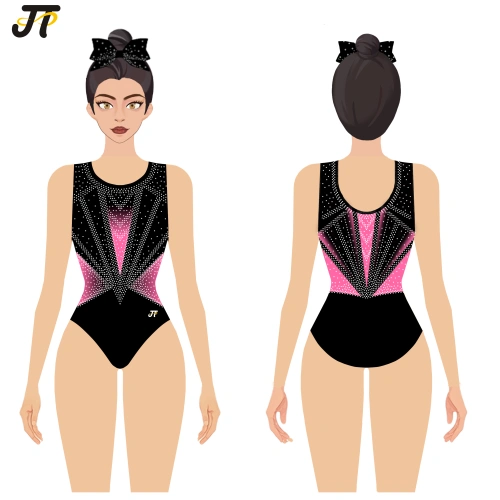
Because practice leotards are replaced more often and purchased in greater numbers, they also represent the largest cumulative apparel cost for most families and clubs over the course of a year. A single competition leotard may cost significantly more than a practice leotard, but a gymnast training five days a week may need several practice leotards in rotation. Over a season, the total spend on training wear frequently exceeds the total spend on competition wear.
The logical conclusion is that practice wear deserves the same careful evaluation as competition wear, even if the design priorities are different. Comfort, durability, fit consistency, and price per wear matter far more than rhinestones and dramatic visual effects. A well-chosen practice leotard is one that a gymnast forgets she is wearing, because nothing about it distracts from the work at hand.
Understanding the difference between the two categories helps buyers avoid paying for features that a training garment does not need, or, worse, choosing a training garment that lacks features it genuinely requires.
| Consideration | Practice Leotard | Competition Leotard |
|---|---|---|
| Primary purpose | Daily training comfort and durability | Performance presentation and visual impact |
| Typical fabric | Soft stretch Lycra or Spandex blends, sometimes with Mesh panels | Mystique, foil, mesh, and layered performance fabrics |
| Decoration | Minimal trim, sublimated prints, simple color blocking | Rhinestones, crystals, metallic appliqués, complex printing |
| Expected lifespan | One or more seasons of heavy rotation | One or more competitive seasons with lighter wear |
| Fit priority | Comfort, coverage, unrestricted movement | Precision fit, secure coverage, no shifting during skills |
| Number typically owned | Three to eight per gymnast | One or two per season |
| Washing frequency | Very high | Moderate |
The practical takeaway is straightforward. A practice leotard should be evaluated like a piece of athletic equipment, not like a costume. It should be judged on how it behaves in the tenth week of the season, not on how it looks in a product photograph.
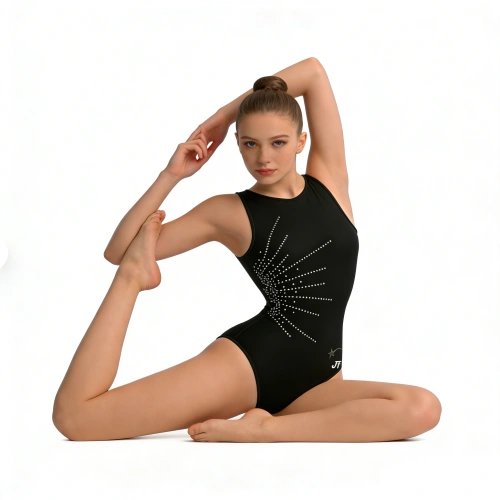
Experienced coaches, gymnasts, and apparel manufacturers generally agree on a short list of factors that separate a good training leotard from a disappointing one. Each of these factors can be assessed before purchase, provided the buyer knows what to look for.
Fit is the single most important variable, and it is also the one most often compromised. A practice leotard that rides up, cuts into the shoulders, or shifts during a back handspring will distract the gymnast on every pass. Coverage at the hip and seat should be generous enough that the garment stays in place through splits, leaps, and inverted skills. The torso length should be appropriate for the gymnast's proportions, because a torso that is too short for a long-waisted athlete will pull uncomfortably during stretching and bar work.
It is worth noting that fit is not the same as tightness. A leotard should feel secure but not restrictive. If the fabric is stretched to its maximum just to close the garment, the athlete has very little room left for movement.
The fabric determines how the leotard feels, how long it lasts, and how well it recovers its shape after repeated stretching. Cheap blends tend to lose elasticity, develop a shiny worn appearance, and sag at the seat and knees. Higher-quality stretch fabrics return to their original shape after washing, which keeps the fit consistent from the first wear to the fiftieth.

A gymnast training in a warm gym for three hours will sweat. A fabric that traps moisture will become heavy, clingy, and uncomfortable, and it may cause chafing during high-repetition work. Breathable, quick-drying fabrics keep the garment comfortable through the full session and dry quickly between practices, which matters when a leotard is washed in the evening and worn again the next morning.
Flatlock and coverstitch seams are common in quality gymnastics apparel because they lie flat against the skin and reduce bulk and irritation. Buyers should look for even stitching, no loose threads, and reinforced stress points around the leg openings and shoulder straps. Weak seams are the most common failure point in a training leotard, and they typically fail within the first two months of regular use.
Gymnastics places unusual demands on shoulder mobility. A leotard with a narrow back, a poorly placed strap, or a rigid binding across the shoulder can restrict the athlete's range of motion during giants, clear hips, and inbar skills. For this reason, many coaches prefer styles with a moderately open back and stretch-friendly straps rather than heavily structured designs.
The leg opening is a frequent source of complaint. High-cut legs can cause discomfort during splits and leaps, while very low-cut legs can feel restrictive. Many gymnasts prefer a moderate leg cut that stays in place without pressure. This is one area where personal preference plays a large role, and where buying a single test leotard before ordering several is a sensible strategy.
The true cost of a practice leotard is not its sticker price but its price divided by the number of times it is worn. A moderately priced leotard that survives a full season of five-day-a-week training is better value than a cheap leotard that fades, sags, and is replaced after two months. Parents and coaches who calculate price per wear rather than price per unit usually make better long-term decisions.
The fabric names used in product listings can be confusing. The table below summarizes the most common materials used in gymnastics leotards and what each one is best suited for.
| Fabric | Key Characteristics | Best Used For |
|---|---|---|
| Lycra | Excellent four-way stretch, soft hand feel, good recovery | Everyday practice leotards |
| Spandex | Very high elasticity, often blended with other fibers | Training and competition garments requiring maximum stretch |
| Polyester | Durable, colorfast, good for sublimation printing | Printed designs and team collections |
| Mystique | Smooth, slightly metallic sheen, medium stretch | Competition leotards and special-occasion designs |
| Mesh | Lightweight, breathable, often semi-sheer | Panels and inserts for ventilation and visual interest |
A capable manufacturer will combine these materials intelligently. A practice leotard might use a soft Lycra body with mesh panels for ventilation and a sublimated print for team identity. A competition leotard might use Mystique as the base, with mesh inserts and rhinestone decoration applied to specific areas of the design. The right combination depends entirely on the intended use.
Sizing errors are the most common and most avoidable source of dissatisfaction with leotard purchases. A garment that fits poorly will not be worn, no matter how attractive the design.
Leotard sizing is driven primarily by torso length, not by overall height or age. Torso measurement is taken from the shoulder, down through the crotch, and back up to the starting shoulder point. Two gymnasts of identical height can require different leotard sizes if their torso proportions differ. Parents who order by age alone are likely to be disappointed.
Children grow, and a leotard that fits perfectly in September may be uncomfortably short by March. Buying one size up can extend the useful life of a garment, but going too large introduces its own problems: excess fabric bunches, straps slip, and the gymnast feels unsupported. A reasonable compromise is to select a size that fits comfortably at the time of purchase with a modest amount of room, rather than a size that is loose at the outset.
Size charts are not standardized across manufacturers. A size 10 from one brand may correspond closely to a size 12 from another. Buyers should always consult the specific chart provided by the seller and, where possible, order a single sample before committing to multiple units.
Different styles fit differently even within the same size. Tank styles, halter styles, and styles with adjustable straps each interact with body shape in distinct ways. A gymnast who has found a style that works well for her body type may benefit from staying with that silhouette across multiple purchases.
Although function comes first in training wear, design is not irrelevant. Gymnasts spend a great deal of time in their practice leotards, and how they feel in the garment affects how they carry themselves in the gym. A design that a young athlete genuinely likes is a design she will wear willingly, which reduces friction in the daily routine.
Fortunately, function and style are not in conflict. Modern sublimation printing allows vibrant, complex, and fully customized patterns to be applied to performance fabrics without adding weight or stiffness. Colors can be matched to club identity, and logos, names, and numbering can be incorporated cleanly. For teams, this creates a coherent look across the entire roster while preserving the comfort that training requires.
Parents shopping for individual practice leotards generally do well to prioritize solid colors and simple prints for heavy rotation, saving more elaborate designs for occasional wear. Coaches ordering team practice wear usually benefit from a consistent design language that can be reproduced reliably across multiple production runs.
Parents are typically buying for one or two gymnasts, often on a budget, and often without deep knowledge of the apparel market. The following guidance reflects the practical experience of families who have been through several seasons of training wear.
One additional consideration is worth emphasizing: parents should involve the gymnast in the decision, within reasonable limits. A leotard that the athlete likes is more likely to be cared for and worn consistently.
Coaches and club administrators face a more complex set of requirements. They are ordering for a group, often with varying body types, varying budgets, and a need for a consistent visual identity across the team.
A team looks cohesive when the design language is consistent: the same silhouette, the same color placement, the same logo position, the same trim details. Standardizing only the color often produces a roster that looks mismatched because the styles vary. Working from a single design specification with a manufacturer solves this problem.
Collecting measurements early in the preseason allows the club to identify outliers and to order the correct distribution of sizes. It also reduces the risk of a late scramble when a new gymnast joins the team after the order has been placed.
Many successful programs use a simpler, lower-cost design for everyday practice and a more decorated design for competitions, exhibitions, and special events. This keeps the overall cost manageable for families while still giving the team a distinctive look at meets.
Practice leotards are only part of the picture. A coordinated team collection typically includes warm-up jackets, pants or leggings, and sometimes a matching training top. Ordering these items from the same manufacturer ensures that colors match precisely and that sizing is consistent across the range.
A sample leotard tells a coach what the product looks like. It does not reveal whether the manufacturer can reproduce that quality across two hundred units, three months later, in a different size range. Coaches should ask about production capacity, quality control procedures, and the process for handling discrepancies before placing a large order.
For clubs that want something more distinctive than off-the-shelf practice wear, custom team leotards offer a clear advantage. A custom program allows the club to specify colors, logos, patterns, silhouettes, and even label and packaging details, producing a collection that is genuinely its own.
The practical question is how to source custom leotards reliably. This is where working with a dedicated gymnastics apparel manufacturer becomes valuable. T&J Sportswear, for example, is a professional gymnastics apparel manufacturer specializing in the development and production of high-quality gymnastics leotards and teamwear. With more than ten years of experience in the sportswear industry, the company has built expertise in product development, custom design, manufacturing, and international business.
T&J Sportswear works with gymnastics clubs, teams, brands, wholesalers, distributors, and other sportswear businesses, with a strong focus on customers in the United States, Europe, and other international markets. Its product range includes competition gymnastics leotards, practice gymnastics leotards, custom team leotards, rhinestone gymnastics leotards, and gymnastics warm-up wear.
One of the practical barriers to custom team wear has traditionally been the minimum order quantity. Small clubs and new programs often cannot justify ordering hundreds of units before they know how a design will perform with their athletes.
T&J Sportswear addresses this with a low minimum order quantity starting from ten sets for selected products. This gives gymnastics clubs, new brands, boutique retailers, and smaller distributors greater flexibility when testing new designs or launching new collections. Rather than requiring customers to commit to large volumes before validating a design, the company supports smaller initial orders and helps customers develop their collections gradually.
Customization sits at the center of the manufacturing service. T&J Sportswear supports both OEM and ODM, allowing customers to choose between producing their own designs and developing new products together with the company's design team.
Customization can cover artwork, colors, sublimation printing, logos, rhinestone layouts, fabric combinations, sizes, labels, packaging, and other details. The production process spans design development, fabric selection, digital artwork, printing, cutting, sewing, decoration, inspection, packaging, and delivery. This integrated approach reduces the need to coordinate between multiple suppliers and gives customers a more efficient path from an initial idea to a finished product.
Design capability is a significant differentiator among manufacturers. T&J Sportswear maintains an in-house professional design team specializing in gymnastics apparel. The team does more than simply manufacture designs supplied by customers; it can also help develop new concepts based on sketches, reference images, color combinations, team identities, or brand requirements.
For competition leotards, the design team can combine sublimation graphics, color blocking, mesh, rhinestones, crystal decoration, and different fabric effects to create distinctive visual designs. Customers can also customize colors, logos, patterns, labels, and other branding elements. For practice leotards, the emphasis shifts toward comfortable stretch, durability, moisture management, and everyday wearability, with a wide range of colors, patterns, and styles available.
Not every club needs a custom manufacturing relationship, but for clubs, brands, and distributors placing recurring orders, the choice of partner has a direct effect on product quality, delivery reliability, and total cost.
Gymnastics apparel has specific requirements that differ from general sportswear. Stretch, fit, comfort, coverage, durability, decoration, and freedom of movement all have to be balanced in a single garment. A supplier that specializes in gymnastics understands these constraints and can advise on design decisions that a general apparel manufacturer might not anticipate.
T&J Sportswear, for instance, has more than ten years of experience focused specifically on competition and training leotards. Over the years, its products and services have reached customers in more than thirty-six countries, giving the company practical experience with different markets, customer requirements, sizing systems, and product preferences.
Production capacity is not simply about quantity. The real value lies in the ability to maintain consistent workmanship when moving from a sample to bulk production. A factory that produces one excellent sample but delivers inconsistent bulk units creates far more problems than one with slightly lower peak output but reliable quality.
T&J Sportswear's factory team includes more than thirty skilled workers, with a reported production capacity of over three hundred leotards per day. This provides a balance between flexible customization and the ability to support larger wholesale and team orders. Throughout production, the team pays attention to fabric, printing, stitching, sizing, rhinestone placement, and overall finishing.
Quality control should begin before bulk production. During sample development, customers can review the design, fabric, fit, decoration, and finishing before confirming mass production. This stage prevents costly errors later.
For finished garments, key inspection points typically include fabric condition, printing quality, stitching, measurements, rhinestone placement, coverage, and overall appearance. A well-designed production process reduces common problems such as inconsistent sizing, printing defects, loose decoration, or uneven finishing. T&J Sportswear also lists certifications such as ISO9001, SGS, and CE for applicable products, with specific certification and testing documentation available according to the product and customer requirements.
Manufacturing quality is only one part of a successful supplier relationship. Clear communication and responsive service are equally important, particularly for customized gymnastics apparel, where small details can significantly affect the final product.
From initial inquiry and design development to sampling, production, inspection, and shipment, a dedicated manufacturer provides support throughout the process. Customers can communicate their requirements directly and receive assistance with product development, customization, production details, and logistics. T&J Sportswear emphasizes one-to-one service and professional communication, which is especially valuable for first-time buyers developing their initial collection.
Even the highest-quality leotard will degrade prematurely if it is cared for incorrectly. The following practices significantly extend the useful life of training wear.
Coaches who manage team collections should also communicate care instructions to families. When an entire team follows consistent washing practices, the club's apparel investment lasts noticeably longer, and the team looks sharper at every practice.
Most dissatisfaction with practice leotards can be traced back to a small number of recurring errors.
The cheapest leotard available is rarely the least expensive in the long run. Garments that lose shape quickly must be replaced, and a gymnast who is uncomfortable in a leotard may avoid wearing it altogether.
Ordering by age, height, or dress size alone produces a high rate of fit problems. Torso length is the measurement that matters most.
A design that looks striking in a photograph may have a restrictive shoulder construction or a leg line that causes discomfort during skills. Function should be evaluated first, with style layered on top.
Placing a large order without first approving a sample is a significant risk. Sample approval protects both the club and the manufacturer.
Practice leotards are often worn with warm-ups before and after training. Coordinating the two from the same supplier ensures color and sizing consistency.
Young gymnasts grow quickly. Clubs and parents who plan sizes with growth in mind avoid mid-season replacement orders.
Budgeting for gymnastics apparel is easier when the full picture is considered rather than individual purchases in isolation.
| Category | Typical Quantity | Notes for Planning |
|---|---|---|
| Practice leotards | 3 to 8 per gymnast | The largest cumulative apparel cost; prioritize durability and fit |
| Competition leotard | 1 to 2 per season | Higher unit cost, lighter wear; often a club-managed purchase |
| Warm-up jacket and pants | 1 set per gymnast | Used across multiple seasons; coordinate with team colors |
| Grips, tape, and accessories | Consumable | Recurring cost, separate from apparel |
| Gym bag and small accessories | 1 per gymnast | Occasional replacement |
Clubs that order team apparel directly from a manufacturer often reduce per-unit costs while improving consistency. Low minimum order quantities make this approach accessible even to smaller programs, and flexible customization allows a club to build a collection over several seasons rather than committing to everything at once.
The following checklist condenses the guidance above into a practical set of questions that parents and coaches can apply to any leotard purchase.
Most gymnasts training three to five days per week benefit from at least three leotards in rotation, with four to six being comfortable. Rotation allows garments to be washed and dried properly between sessions, which preserves elasticity and color.
Often, yes, but not automatically. Price should be evaluated against fit, fabric quality, stitching, and expected lifespan. A moderately priced leotard that survives a full season offers better value than a cheap one that must be replaced every two months.
They can be, particularly at lower levels or in-house events, but most competitions have presentation expectations that favor a dedicated competition leotard with more elaborate decoration and a more precise fit.
Soft Lycra and Spandex blends with good stretch recovery are the most common choice, often combined with mesh panels for ventilation. Polyester is frequently used when sublimated printing is required.
Clubs generally begin by defining colors, logos, and design direction, then request a sample for approval. Once the sample is confirmed, bulk production follows. Working with a manufacturer that offers design support and low minimum order quantities simplifies this process considerably.
Specialization in gymnastics apparel, demonstrated production capacity, a structured quality control process, design support, flexible customization options, and responsive communication are the core criteria. Experience serving international markets is an additional advantage.
Practice leotards are the workhorses of a gymnast's wardrobe. They are worn more often, washed more frequently, and stretched more aggressively than any other garment in the gym bag. Choosing them well requires attention to fit, fabric, construction, and durability, along with a realistic understanding of how the garment will be used over a full training season.
For parents, the priorities are straightforward: measure the torso, prioritize comfort and coverage, build a small rotation, and care for the garments properly. For coaches, the priorities extend to team consistency, size planning, sample approval, and selecting a supplier capable of reproducing quality across bulk production.
For clubs, brands, and distributors seeking custom practice leotards, custom team leotards, or a complete coordinated collection, working with a specialized gymnastics apparel manufacturer offers clear advantages. T&J Sportswear combines more than ten years of industry experience, customers in over thirty-six countries, an in-house design team, OEM and ODM customization, low minimum order quantities, a factory team of more than thirty skilled workers, and a production capacity of over three hundred leotards per day. Its goal is not only to manufacture gymnastics apparel but also to build long-term partnerships through reliable products and responsive service.
From a first idea to a finished leotard, the right manufacturing partner makes custom gymnastics apparel more efficient, flexible, and reliable. Whether the requirement is a small customized team order or a large wholesale production project, the combination of consistent workmanship and dependable service is what ultimately determines whether a gymnast, a family, or a club is satisfied with the result.
