Competition gymnastics leotards are far more technically demanding than they appear, and this article examines how high standards are built into every stage of production inside a specialist manufacturing facility. It follows the process from design development through fabric selection, pattern making, cutting, sewing, sublimation printing, rhinestone application, quality inspection, and packaging, explaining why each stage matters to the performance and appearance of the finished garment. The article highlights how a focused gymnastics apparel manufacturer such as T&J Sportswear combines more than ten years of specialised experience, an in-house design team, and a skilled production workforce of over thirty people with a reported capacity of more than three hundred leotards per day. It also explores the commercial side of manufacturing, including low minimum order quantities starting from ten sets for selected products, OEM and ODM customisation, one-to-one customer service, and the ability to serve gymnastics clubs, teams, brands, wholesalers, and distributors across more than thirty-six countries, with a strong focus on the United States and Europe. Throughout, the article emphasises that comfort, flexibility, durability, fit, and visual appeal must be balanced simultaneously, and that quality is not a final checkpoint but a continuous discipline. From fabric selection and pattern development to cutting, sewing, printing, rhinestone application, inspection, and final packaging, every stage contributes to a product suited to both demanding training sessions and high-level competition. The result is a manufacturing approach built not merely around producing gymnastics apparel, but around building long-term partnerships through reliable products, consistent workmanship, and responsive service.
Inside a Competition Gymnastics Leotard Factory With High StandardsA competition gymnastics leotard looks, at first glance, like a simple garment. It is small, lightweight, and often appears almost weightless on the shoulders of the athlete wearing it. Yet anyone who has spent time on the production floor of a serious gymnastics apparel factory knows that this impression is deeply misleading. A competition leotard is one of the most technically demanding pieces of sportswear that can be manufactured. It must stretch in four directions without losing its shape, hold colour and crystal decoration through repeated wear, sit perfectly against the body during a full-twisting double back, and still look elegant enough to be judged by a panel sitting thirty metres away. Every one of those requirements is decided long before the athlete steps onto the floor. It is decided in the factory.
This article takes a close look inside one such factory: the production facility behind T&J Sportswear, a professional gymnastics apparel manufacturer that has spent more than a decade building its reputation on competition leotards, practice leotards, custom team leotards, rhinestone leotards, and gymnastics warm-up wear. The company, often shortened to T&J, works with gymnastics clubs, teams, brands, wholesalers, and distributors, with a particular focus on customers in the United States, Europe, and other international markets. What follows is an examination of how high standards are actually built into a leotard, step by step, from the first sketch to the final sealed bag.
General sportswear manufacturers frequently assume that a leotard is simply a swimsuit with a different cut. The assumption rarely survives contact with a real gymnastics programme. A swimsuit is designed primarily for water resistance and short-term fit. A competition leotard is designed for an entirely different set of pressures. It must allow a full range of overhead movement, hold the body securely during inversions, resist the abrasive friction of a beam or a bar, and remain visually intact after months of training and repeated competition use.
There are specific technical requirements that a specialist manufacturer understands almost instinctively. Stretch is the first. A leotard must move with the athlete rather than against her. If the fabric recovery is weak, the garment will sag at the hip or ride up at the leg within minutes of warm-up. If the fabric is too stiff, the athlete will feel restricted during back extension elements. The balance between stretch and recovery is a matter of both material choice and construction.
undefined
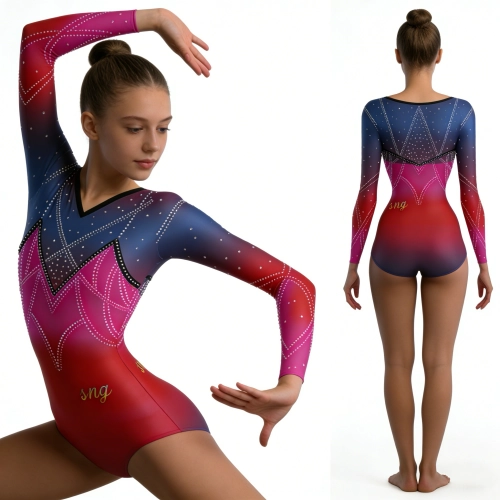
Fit is the second requirement, and it is the most visible. A competition leotard that gaps at the chest, twists at the shoulder, or cuts uncomfortably at the leg opening will distract the athlete and, in some cases, affect her performance. Coverage matters here as well. A garment that shifts during a leap or a turn can create a risk of an unwanted wardrobe issue at exactly the wrong moment. High-standard factories therefore treat fit not as a matter of appearance, but as a matter of athletic security.
Durability and decoration come next. Competition leotards often carry sublimated graphics, colour blocking, mesh panels, and hundreds or even thousands of rhinestones. Each of those elements introduces a new failure point. Print that cracks, mesh that tears, or a crystal that falls off on the competition floor is not a cosmetic problem. It is a manufacturing problem, and it is one that a serious factory must design out of the process long before the first order ships.
One of the defining characteristics of T&J Sportswear is its narrow specialisation. The company has accumulated more than ten years of experience specifically in gymnastics apparel manufacturing, with a strong focus on competition and training leotards. That focus shapes everything from the machinery on the floor to the vocabulary used in internal quality meetings.
Specialisation matters more than it might appear. A general sportswear supplier may produce excellent leggings, running tops, and team jerseys, but gymnastics apparel demands a specific understanding of stretch, fit, comfort, coverage, durability, decoration, and freedom of movement. These are not interchangeable priorities. They interact with one another, and they often conflict. Increasing decoration can reduce stretch. Increasing compression can reduce comfort. A specialist manufacturer knows where the balance point lies for each product category.
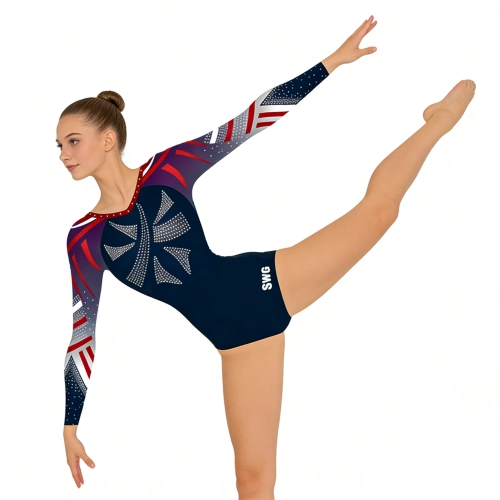
Over the years, the company has served customers in more than thirty-six countries. That reach has given the production and design teams practical experience with a wide range of markets, sizing systems, customer requirements, and product preferences. Sizing expectations differ meaningfully between regions, and so do preferences regarding cut, coverage, colour intensity, and the density of decoration. A leotard designed for one market may need adjustment before it performs well in another.
The main markets remain North America and Europe, where customers tend to place strong emphasis on product quality, customisation, consistency, and reliable communication. Those four priorities map directly onto the way the factory is organised. Quality is protected by inspection systems. Customisation is protected by an in-house design team. Consistency is protected by controlled production processes. Communication is protected by a one-to-one service model in which each customer deals with a specific point of contact rather than a rotating queue.
Before a single metre of fabric is cut, a competition leotard exists only as an idea. Inside the factory, the design studio is where that idea acquires structure. Design is one of the company's key strengths, and the in-house team is made up of designers who specialise in gymnastics apparel rather than general fashion or general activewear.
This distinction is important because the studio does far more than manufacture designs supplied by customers. Customers arrive with very different starting points. Some bring a complete technical drawing. Some bring a rough sketch on paper. Some bring a reference image from a previous season. Some bring nothing more than a colour combination and a team identity. Some bring a vague ambition to look sharper than their rivals at the next regional championship. The design team is equipped to work from any of these starting points.
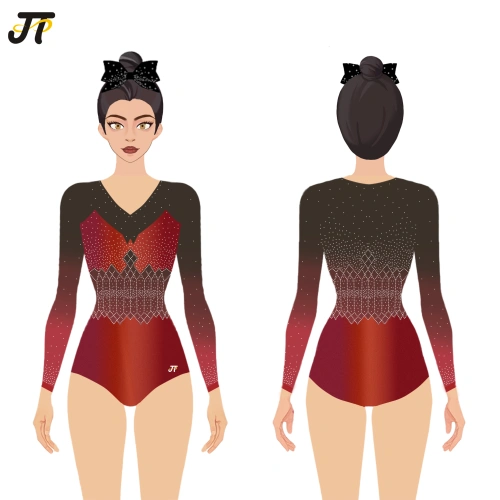
For competition leotards, the studio combines a range of techniques to build distinctive visual designs. Sublimation graphics allow complex, multi-colour artwork to be integrated into the fabric itself. Colour blocking creates strong geometric lines that flatter the body and emphasise movement. Mesh inserts introduce contrast and ventilation. Rhinestones and crystal decoration add depth and light. Different fabric effects, including metallic and gloss finishes, change the way a garment reads under arena lighting.
Customers can also customise colours, logos, patterns, labels, and other branding elements. This is where the studio shifts from being a purely creative function to being a commercial one. A gymnastics club wants its identity to be recognisable from the stands. A brand wants its logo to sit correctly on the chest without distorting the artwork. A distributor wants a collection that looks coherent across multiple styles. The design team works within those constraints rather than treating them as obstacles.
A well-run design stage also protects the customer commercially. Artwork that looks beautiful on a screen can behave unpredictably when it is transferred onto a stretch fabric. Lines that appear straight in a flat drawing may curve when the garment is worn on a moving body. Colours that sit comfortably side by side in a digital file may clash once they are printed on a matte surface. Experienced designers anticipate these effects and adjust the artwork before sampling begins, which saves both time and money.
No amount of skilled sewing can rescue a poorly chosen fabric. Fabric selection is therefore treated as a technical decision rather than a purely aesthetic one. The factory works with a range of materials, each of which brings different properties to a finished leotard.
| Fabric | Primary Characteristics | Typical Application |
|---|---|---|
| Lycra | High stretch and recovery, smooth hand feel | Competition and practice leotards |
| Spandex | Excellent elasticity, shape retention | Fitted competition styles |
| Polyester | Durability, colour retention, sublimation friendly | Printed competition leotards |
| Mystique | Metallic sheen, high visual impact | Accent panels and competition detailing |
| Mesh | Lightweight, breathable, semi-sheer | Contrast inserts and ventilation zones |
Different products are developed for different priorities. Some designs are built around maximum stretch and lightweight construction. Others prioritise breathability, quick drying, comfort, durability, or visual appearance. The factory does not treat these as competing marketing claims. They are engineering targets, and the fabric choice is the first decision that either supports or undermines them.
For practice leotards, the emphasis falls on comfortable stretch, durability, moisture management, and everyday wear. Training garments are subjected to a punishing routine. They are worn four or five days a week, washed constantly, stretched repeatedly, and pulled on and off in changing rooms. A practice leotard that looks excellent on the first day but loses its shape after three washes has failed its primary purpose.
For competition leotards, the emphasis shifts. Precision fit becomes more important. Secure coverage becomes more important. Decorative details must be applied with greater care because they will be seen from a distance and photographed repeatedly. Professional finishing becomes visible in a way that it rarely is in a training garment. The same factory therefore operates with two distinct quality philosophies, applied to two different product families.
Fabric selection is also a matter of consistency. A fabric that performs well in a sample may behave differently in bulk if the supplier changes. The production team therefore pays attention not only to the initial choice of material, but to the repeatability of that choice across orders and seasons. For clubs ordering team uniforms year after year, consistency of colour and hand feel is often more valuable than novelty.
Once the design and fabric are agreed, the pattern development stage begins. This is the least visible part of leotard manufacturing and, arguably, the most important. A pattern determines how a flat piece of stretch fabric will wrap around a three-dimensional moving body. Small errors at this stage are magnified dramatically when the garment is worn.
Pattern development for gymnastics apparel is complicated by the nature of the sport. A leotard must accommodate a body in motion, not a body standing still. Shoulders rotate through a full circle. The spine extends and flexes. Hips open and close. Legs split. A pattern that fits perfectly in a static fitting can fail completely during a back handspring. Experienced pattern makers therefore work with movement in mind from the beginning.
Grading is the second half of the equation. A single pattern must be scaled across a full size range without losing its proportions. In gymnastics, the size range is unusually wide. A junior athlete and a senior athlete may wear garments built from the same base design, but the fit priorities differ considerably. Coverage requirements, torso length, and leg opening height all change with age and level.
This is where working with an experienced manufacturer becomes valuable for clubs and brands. A supplier that produces only a handful of leotards a year may never encounter the full range of fit problems that a specialist factory resolves as a matter of routine. Over ten years of production, the pattern library becomes a genuine asset, and it is one that customers benefit from directly.
Cutting is the stage at which an idea becomes a physical object. It is also the stage at which errors become expensive. Once fabric has been cut, it cannot easily be recovered. The cutting team therefore works carefully, matching panels to the pattern, checking the direction of stretch, and ensuring that printed or sublimated artwork aligns correctly across seams.
Alignment is a particular challenge for competition leotards. When a graphic runs across the chest, over the shoulder, and down the back, the panels must match precisely when they are sewn together. A slight misalignment that would be invisible on a plain garment becomes glaringly obvious on a printed one. The cutting and printing stages therefore have to be coordinated rather than treated as separate operations.
Fabric direction is equally important. Stretch fabrics have a grain, and a panel cut against the grain will behave differently from one cut with it. A leotard assembled from panels cut in inconsistent directions may twist when worn, even if every individual seam is perfectly executed. Careful cutting eliminates this problem before it reaches the sewing floor.
The sewing floor is where the factory's capability becomes tangible. The production team includes more than thirty skilled workers, with a reported production capacity of over three hundred leotards per day. That figure reflects a balance between flexible customisation and the ability to support larger wholesale and team orders.
For customers, production capacity is not simply a matter of quantity. The real value lies in the ability to maintain consistent workmanship when moving from samples to bulk production. A factory that produces twenty leotards a week can inspect every garment individually. A factory that produces three hundred a day must build consistency into its processes, because individual attention alone will not scale.
That consistency is achieved through standardised operations. Stitching specifications are defined and followed. Seam types are selected for the demands of the garment. Elastic applications are measured rather than estimated. Operators specialise in particular operations, which improves both speed and reliability over time.
Gymnastics leotards present specific sewing challenges. The fabrics are stretchy, which means the machine tension must be adjusted carefully to avoid wavy seams or puckering. The garments are small, which means the curves are tight and the tolerances are narrow. The leg openings and necklines must be finished cleanly because they are highly visible and because they come into direct contact with the skin.
Throughout production, the team pays attention to fabric, printing, stitching, sizing, rhinestone placement, and overall finishing. Those six categories form the backbone of the factory's internal quality language, and each one is checked at multiple points rather than once at the end. The result is a production line that is designed to catch problems early, when they are still cheap to fix.
Sublimation printing is one of the most important techniques in modern competition leotard manufacturing. Unlike surface printing, which sits on top of the fabric, sublimation uses heat and pressure to convert solid dye into gas, which then bonds with the fibres of the material. The result is a graphic that becomes part of the fabric itself.
This has practical consequences that matter to athletes. Sublimated graphics do not crack, peel, or feel stiff against the skin. They do not add weight. They do not restrict stretch in the way that a heavy transfer can. For competition leotards, where the design is often complex and multi-coloured, sublimation allows a level of visual detail that would be impossible with other techniques.
It also demands discipline. Colour accuracy must be managed carefully across panels, because the same colour can appear differently depending on the base fabric and the density of the print. Artwork must be prepared with an understanding of how it will distort when stretched over a moving body. Registration between panels must be precise, or the graphic will break awkwardly at the seams.
Because the printing stage sits between design and assembly, it acts as a bridge between the creative and production sides of the factory. When the two sides communicate well, the result is a leotard that looks exactly as the designer intended. When they do not, the result is a garment that looks almost right, which in a competitive setting is not good enough.
Rhinestone leotards are a category of their own, and they place particular demands on a factory. A competition leotard may carry hundreds or even thousands of individual stones, arranged in patterns that range from subtle scatter effects to dense, fully crystallised panels. Each stone represents a small opportunity for failure.
Placement is the first challenge. Stones must sit where the design intends them to sit, at the correct spacing, following the curves of the garment. Because leotards are small and highly curved, a layout that looks correct on a flat table may shift once the garment is worn. Skilled operators understand how the fabric will move and adjust accordingly.
Adhesion is the second challenge. Stones must remain attached through stretching, sweating, washing, and the general abrasion of training and competition. Loose decoration is one of the most common complaints in gymnastics apparel, and it is one that a high-standard factory works hard to eliminate through careful material selection and controlled application processes.
Balance is the third challenge. Decoration adds visual impact, but it also adds weight and reduces stretch if applied too heavily. The design team and the production team therefore work together to place decoration where it will be seen and appreciated, while keeping the garment comfortable and mobile. A leotard that sparkles brilliantly but restricts a leap has not achieved its purpose.
Quality control at a serious gymnastics apparel factory does not begin when the finished garments are stacked in the warehouse. It begins during sample development. At that stage, customers can review the design, fabric, fit, decoration, and finishing before confirming mass production. This early review is the single most effective quality tool available, because it allows problems to be corrected while changes are still inexpensive.
Once bulk production begins, inspection points are defined and followed systematically. For finished garments, the key inspection categories typically include the following.
The purpose of this system is to reduce common problems before they reach the customer. Inconsistent sizing, printing defects, loose decoration, and uneven finishing are the four most frequent complaints in the gymnastics apparel market, and each of them can be traced back to a specific stage in production. By controlling those stages, the factory controls the outcome.
| Stage | Primary Risk | Control Measure |
|---|---|---|
| Design | Artwork that does not translate to fabric | Technical review before sampling |
| Fabric | Inconsistent stretch or colour | Supplier consistency and incoming checks |
| Cutting | Misaligned panels and wrong grain | Pattern matching and direction control |
| Sewing | Wavy seams and size drift | Standardised operations and measurement checks |
| Decoration | Loose stones and cracked print | Controlled application and adhesion testing |
| Finishing | Uneven appearance | Final inspection before packing |
The company's product information also lists certifications such as ISO9001, SGS, and CE for applicable products. Specific certification and testing documentation can be provided according to the product and customer requirements. For buyers who need to satisfy their own compliance obligations, this documentation is often as important as the garment itself.
Packaging is the last stage of manufacturing and the first thing a customer sees. For gymnastics clubs and brands, packaging is part of the product experience. A team uniform that arrives neatly folded, correctly labelled, and properly protected reflects the professionalism of the club that ordered it.
Because customisation extends to labels and packaging, customers can align the final presentation with their own brand identity. Team colours, logos, patterns, labels, and packaging details can all be customised according to requirements. For a new brand launching its first collection, this level of control can make the difference between a product that looks amateur and one that looks established.
Inspection before shipment closes the loop. Finished products are reviewed carefully, and the goal is not only to manufacture gymnastics apparel but to build long-term partnerships through reliable products and responsive service. A shipment that arrives complete, correct, and on schedule is the foundation on which repeat business is built.
One of the most practical advantages for small and growing customers is the low minimum order quantity, which starts from ten sets for selected products. This gives gymnastics clubs, new brands, boutique retailers, and smaller distributors greater flexibility when testing new designs or launching new collections.
The logic behind low MOQ is commercial rather than charitable. Requiring customers to commit to large quantities before they know how a design will perform in their market creates unnecessary risk. A club may be unsure whether a particular colour will suit its athletes. A new brand may want to test three designs rather than commit to one. A distributor may want to evaluate quality before placing a seasonal order.
Supporting smaller initial orders allows customers to develop their collections gradually. A club can begin with a single team set, evaluate the fit and durability, and then expand. A brand can launch with a tight, well-executed capsule and grow from there. In both cases, the relationship develops over time rather than being forced into a single high-stakes transaction.
For established buyers, the same flexibility applies in a different way. Flexible order structures allow distributors to respond to demand rather than forecast it perfectly, which is a meaningful advantage in a market where trends move quickly and inventory is expensive to hold.
Customisation sits at the centre of the manufacturing service. The company supports both OEM and ODM, allowing customers to choose between producing their own designs and developing new products together with the in-house team. The distinction matters, because different customers arrive with different levels of readiness.
An OEM customer typically arrives with a developed design and wants it manufactured accurately and consistently. The priority is fidelity: the finished leotard should match the specification. An ODM customer typically arrives with a concept and wants help turning it into a manufacturable product. The priority is development: the finished leotard should match the intention, even if the details were not fully defined at the start.
Customisation can cover artwork, colours, sublimation printing, logos, rhinestone layouts, fabric combinations, sizes, labels, packaging, and other details. The production process spans design development, fabric selection, digital artwork, printing, cutting, sewing, decoration, inspection, packaging, and delivery. Because these stages sit under one roof, the customer is not required to coordinate between multiple suppliers.
That integrated approach reduces communication overhead and shortens the path from an initial idea to a finished product. It also reduces the risk of a design being misinterpreted at handover points, which is one of the most common causes of disappointment in custom apparel manufacturing.
Manufacturing quality is only one part of a successful supplier relationship. Clear communication and responsive service are equally important, particularly for customised gymnastics apparel, where small misunderstandings can produce large quantities of the wrong product.
From initial inquiry and design development to sampling, production, inspection, and shipment, the team provides professional support throughout the process. Customers can communicate their requirements directly and receive assistance with product development, customisation, production details, and logistics.
The one-to-one service model means that a customer works with a specific contact rather than a rotating queue of representatives. For a gymnastics club ordering team uniforms for a competition season, that continuity is valuable. The contact knows the history of the order, the approved artwork, the sizing list, and the delivery deadline. Nothing has to be re-explained.
Responsiveness also matters in a market with hard deadlines. Competition seasons do not move. A team uniform that arrives late is not a minor inconvenience; it is a problem that the club has to solve in front of its athletes and its parents. A supplier that understands this pressure behaves differently from one that treats every order as an abstract production slot.
The stated goal is to build long-term partnerships rather than simply complete individual orders. That distinction shapes how the factory approaches customers at different stages of development.
For a gymnastics club developing team uniforms, the factory provides design support, sizing guidance, and consistent production across repeat orders. For a new brand launching a collection, it provides development assistance, low MOQ flexibility, and help translating a visual concept into a manufacturable product. For a distributor expanding a product range, it provides reliable production, documentation, and consistent quality. For an established buyer looking for a dependable manufacturing partner, it provides capacity, process control, and responsive communication.
The overall proposition combines several elements: more than ten years of industry experience, customers served in over thirty-six countries, a team of more than thirty skilled workers, a daily leotard capacity of over three hundred units, low MOQ, professional design support, OEM and ODM customisation, and one-to-one service. Individually, each of these is a useful feature. Together, they represent manufacturing capability combined with the flexibility required by today's international gymnastics apparel market.
That combination is not easy to find. Large factories often lack the flexibility that small clubs and new brands need. Small workshops often lack the consistency that established buyers require. A manufacturer that can serve both ends of that spectrum has built something genuinely useful, and it has usually done so by protecting quality at every stage rather than by promising it at the end.
High standards are often described in marketing language, but on a factory floor they are visible in specific, unglamorous details. They are visible in a cutting table where the grain direction is checked before every lay. They are visible in a sewing line where the machine tension is adjusted for a stretch fabric rather than left at the default setting. They are visible in a decoration station where stones are counted rather than estimated. They are visible in an inspection area where garments are measured rather than eyeballed.
They are also visible in the way problems are handled. A factory with high standards treats a defect as information. If a batch of stones adheres poorly, the cause is investigated and the process is corrected. If a size drifts, the pattern or the sewing specification is adjusted. Over time, this creates an institutional memory that is difficult for a newer competitor to replicate.
For customers, the benefit is predictability. A gymnastics club ordering team leotards for a second season wants the same fit, the same colour, and the same quality as the first. A brand reordering a best-selling style wants the same result. Predictability is what turns a single successful order into a long-term supplier relationship.
Gymnastics apparel has to satisfy five requirements simultaneously: comfort, flexibility, durability, fit, and visual appeal. Any manufacturer can optimise one or two of these. Optimising all five at the same time is what separates a specialist from a general supplier.
Comfort is largely a function of fabric choice and construction. Soft, breathable materials with good recovery feel better against the skin and reduce distraction during training. Flexibility is a function of stretch and pattern design. A garment that moves with the athlete rather than against her supports performance rather than hindering it.
Durability is a function of material quality, stitch integrity, and decoration adhesion. It is the least visible of the five requirements at the moment of purchase and the most important after three months of use. Fit is a function of pattern development and grading, and it determines whether the garment looks professional on every athlete in a squad rather than on a single body type.
Visual appeal is the requirement that draws the most attention, and it is the one most often mistaken for the only one that matters. In reality, visual appeal is the visible surface of a much deeper structure. A leotard looks impressive because it fits, moves, holds its shape, and keeps its decoration. Appearance is the result, not the cause.
Gymnastics clubs and apparel brands choose specialist manufacturers for a mixture of practical and emotional reasons. Practically, a specialist understands the sport. It knows what a leotard must do during a bar routine. It knows how a junior size should differ from a senior size. It knows which decorations survive a season and which do not.
Emotionally, a specialist understands what the garment represents. A competition leotard is worn at moments that athletes remember for years. It appears in photographs that end up on walls, in albums, and on social media. It carries a club's identity and, in a small way, its pride. Manufacturers who understand this tend to approach their work with a level of care that is difficult to fake.
For brands, the calculation is more commercial. A brand entering the gymnastics market needs a manufacturing partner that can deliver consistent quality, flexible quantities, and reliable communication. It needs a partner that can handle the technical complexity of stretch fabrics, sublimation, and rhinestone application without requiring the brand to become a manufacturing expert itself.
The full journey of a competition leotard is longer than most people imagine. It begins with an idea, often expressed in a sketch, a colour reference, or a conversation. It moves through design development, artwork preparation, fabric selection, pattern making, sampling, and customer approval.
It then enters production: printing, cutting, sewing, decoration, and assembly. It passes through inspection, where measurements, stitching, printing, and decoration are verified. It is finished, labelled, packed, and shipped. Weeks or months later, it appears on the competition floor, where it either performs as intended or does not.
Every stage in that chain offers an opportunity to get something wrong. High standards are simply the systematic refusal to accept those opportunities. They are built into the process, reinforced by inspection, and maintained through experience. That is what a factory with high standards actually means, and it is what customers ultimately pay for when they choose a specialist manufacturer.
Inside a competition gymnastics leotard factory with high standards, quality is not a final checkpoint. It is a continuous discipline that begins with design and ends with delivery. From fabric selection and pattern development to cutting, sewing, printing, rhinestone application, quality inspection, and final packaging, every stage contributes to a product that must perform under demanding conditions and look exceptional while doing so.
T&J Sportswear approaches gymnastics apparel manufacturing with that discipline in mind. With more than ten years of experience, an in-house design team, low MOQ flexibility, OEM and ODM customisation, a skilled workforce of over thirty people, and a reported capacity of more than three hundred leotards per day, the company combines manufacturing capability with the responsiveness that clubs, brands, wholesalers, and distributors need.
From the first idea to the final leotard, the commitment is to make custom gymnastics apparel more efficient, flexible, and reliable. For athletes, that commitment is invisible. For the clubs, teams, and brands that place the orders, it is the difference between a supplier and a partner.
